|
November 2013 - new websites on the genealogy and history of the noble
Konstantynowicz family in Russia 1772 - 1918, Poland 1918 - 1939 and next at a Polish territory
1939 - 2012. |
Armand, Paszkowski, Demonets, Konstantinovich and Duflon
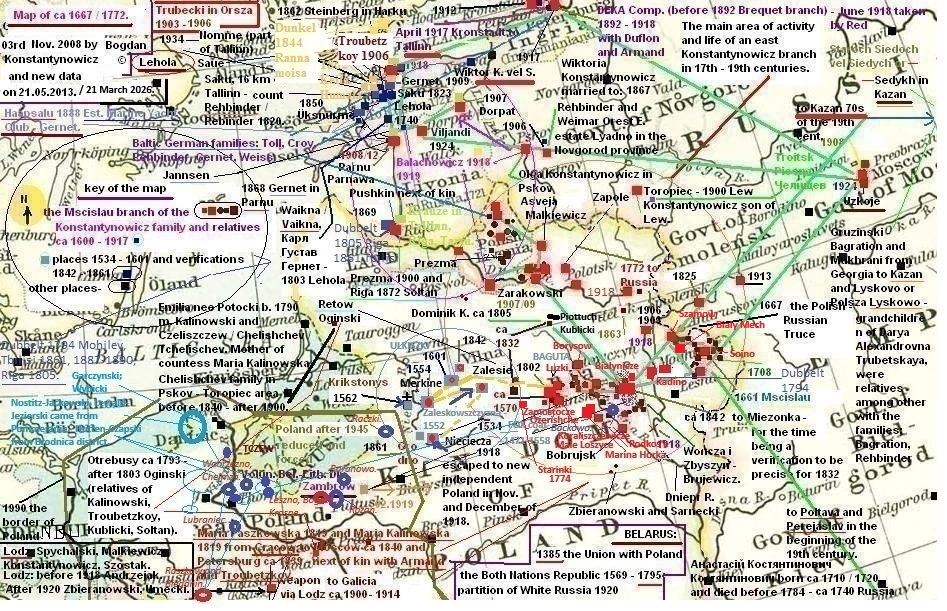
Orlov Denisov, Radzivill, Pociej, Trubetskoy, Bagrationi, Siedych, Wittgenstein, Armand, Paszkowski, Demonets, Konstantinovich and Duflon families in Russia, Estonia, Latvia and Belarus.
© author Bogdan Konstantynowicz
© author Bogdan Konstantynowicz
Sowiecka agresja na Polske 17 wrzesnia 1939 roku - © author Bogdan Konstantynowicz
Literacki komentarz o historii i nie tylko...
© Walki z sowietami po 23 wrzesnia
1939
Pictures Exhibition of Andrzej Konstantynowicz in 2011 - part six
Pictures Exhibition of Andrzej Konstantynowicz in 2011 - part five
Pictures Exhibition of Andrzej Konstantynowicz in 2011 - part four
Pictures Exhibition of Andrzej Konstantynowicz in 2011 - part three
Pictures Exhibition of Andrzej Konstantynowicz in 2011 - part two
Pictures Exhibition of 'konstantynowicz.info' 2010
The Polish well-off proprietors in the second half of 19th cent.:
the
Wankowiczs 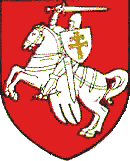 in Zazierzce, Kaluzyca, Smilowicze and
Horodyszcze
in Zazierzce, Kaluzyca, Smilowicze and
Horodyszcze
The famous persons in the Ihumen district:
Wankowicz Jan - entomologist
The Polish archives in the Ihumen district in the 19th cent.:
Moniuszko and Wankowicz in Smilowicze and Szypiany
the Wankowicz family in Horodyszcze and Zasierz (Zazierzce ?)
The Wankowicz family from the Berazino parish
Gaspar Wankowicz the Minsk territorial judge (in the Orsa area, too; with Fox arms which head was to the left of shield)
Mateusz Wankowicz in 1550 - the Minsk territorial judge
Hrehory Wankowicz of 1640
Piotr and his brother Stefan of 1643; a sons of named Piotr: Jan, Wladyslaw, Teodor and Stanislaw of 1671
named Wladyslaw Wankowicz of 1680, died 1695
Antoni Wankowicz in the Minsk province of 1697, in Vicebsk A.D. 1709
Mateusz Wankowicz in the Minsk province of 1765, he was the Minsk territorial judge 1764 - 1775
priest Wankowicz in 1798, a parson in Minsk
Melchior Wankowicz from Kaluzyca, was born c. 1775 in the Minsk province; in the Ihumen region in 1793
his sons:
Stefan (his son Teodor Bej, the January Insurrection 1863 - 1864; 1864 - 1905 emigre),
other Stefan was commandant of the police in Dokszyce and in the Barysau region after liberation in 1812
(a certain Joachim Wankowicz was commissioner of independent authorities in Smaljavicy of the Barysau district in 1812; Antoni Wankowicz, Michal duke Puzyna, Ignacy Moniuszko, Jan Chodzko and Xawery Lipski signed Act of Temporary Administration of the Minsk Province on 19 July 1812 under general Oppeln Bronikowski; a certain Stanislaw Wankowicz in the Zadziewo estate in 1840 - he was insurgent in 1831; Wladyslaw Wankowicz - emigration to< USA and settled in Washington)
Otton,
Walenty painter,
Zygmunt from Slepianka (his son Piotr from Slepianka was the activist of independence),
Karol who was born c. 1800, died 1854 in Kaluzyca; his peers - Hipolit Wankowicz in Olginiany of 1856 and Konstanty Wankowicz who was cancelled off office in 1866
the sons of Karol above named:
Stanislav from Rudakovo, naval engineer,
Bohdan, Joachim, Florjan and
Melchior (was born 1843 in Kaluzyca, died in March of 1892, the January Insurrection 1863, 1863 - 1873 at Siberia, the Minsk Agricultural Society after)
his peer - Adam Wankowicz from the Minsk government was displaced to the Kazan government; authorized of their arms in the Minsk government in 1876 (they come from Kazimierz through Jerzy, Michal, Jozef, Dominik, Jozef 2nd to Kazimierz and Dominik 2nd in the Minsk government);
children of this Melchior Wankowicz:
Czeslav (1882 - 1912)
Renata
Witold "Tolo" Wankowicz born 1877 Kaluzyca, 1917 commissioner in Berazino, 1917 - 1918 the chief of the Union of Weapon (= Union of Arms), the commander of the Polish Military Organisation in the Berazino region till 1920, afterwards in Poznan area (his son Jur)
Melchior writer was the last son of Melchior senior: was born January of 1892, died 1975, member of the Polish Military Organisation. His two daughters:
Krystyna died 1944 in Warsaw
Marta call TILI married to Erdman, Switzerland before 1939, emigrant after 1945. Her two daughters:
Anna Krystyna Erdman born 1946 and
Eva Erdman - Lazarewicz born in New Jersey, married to Tadeusz Walendowski from USA; them son:
David
Walendowski who
worked in a Dutch bank in
Warsaw.
Melchior Wankowicz b. ca 1760-1815
(his brothers:
Wincenty ca 1760 - died 1814, m. in 1804 to Kajetana Gąsowska b. ca 1790;
and
Teodor born ca 1760, married Izabela Gąsowska),
m. in 1800 to Scholastyka Gorecki; with sons:
Walenty 1800-1842 m. in 1827 to Aniela Rostocka;
Stanisława b. ca 1803, m. Wincenty Hornowski;
Karol 1805-1854, m. Rozalia Wańkowicz born ca 1807-1891 with
son
Melchior 1842-1892 m. in 1876 to Maria Szwoynicki ca 1855-1895,
and grandson
Melchior 1891-1974 m. in 1916 to Zofia Małagowska 1891-1969.
Above Melchior ca 1760-1815,
Wincenty,
Teodor and
Stanisław b. ca 1760 were sons of
Aleksander and unknown Hrehorowicz.
Above Aleksander had brothers:
Wladyslaw;
Piotr;
Marcin
(b. ca 1730 with sons:
Teodor b. ca 1760;
Jozef b. ca 1760;
Ignacy with sons:
Hipolit b. 1809 and
Wladyslaw 1810-1848;
next sons of MARCIN:
Jakub b. ca 1760 and
Joachim m. Malgorzata JESMAN with
Jozef b. 1819 m. Wanda Swida with son
Florian b. 1851);
Mateusz m. in 1750 to Katarzyna Janiszewski
(with sons
Kasper + Eleonora Makowiecka and
Józef + Marianna b. ca 1775);
and SEBASTIAN b. ca 1740
(with son Szczepan ca 1775 + Barbara Koziełł-Poklewski
and grandson Aleksander b. 1828 + Konstancja Estko;
and great-grandson Aleksander b. 1854 + Stanisława Aleksandrowicz;
and his children:
Aleksander b. 1881;
Wanda 1882-1938 + 1st in 1900 to Rutkowski, 2nd in 1912 to Aleksander Ponomarew
1875-1965;
and Zygmunt born 1884).
Above Aleksander born 1854 had sibilings:
Ludwik b. ca 1858;
Stefan 1859-1923 + Helena Boguszewski 1868-1928, and
Konstanty b. 1860.
Above Stefan had children:
Maria b. 1890 + Jankowski b. ca 1880;
Maurycy 1893-1918;
Zofia 1894-1981 m. in ca 1925 to Tadeusz Römer 1894-1978;
Jadwiga 1900-1938 m. ca 1922 to Jan Rostworowski 1897-1975.
Above Mateusz Wankowicz (Mateusz m. in 1750 to Katarzyna Janiszewski)
was son of Jan WANKOWICZ and Katarzyna Brzuchowski;
Jan was son of Stanislaw b. ca 1652 + Joanna Korsak.
Tadeusz Oginski owner of Luczaj, let this estate to Tadeusz Wankowicz and Anna Wankowicz nee Swietorzecka;
Andrzej and Franciszek Ksawery Oginscy, sold Luczaj to the Wankowiczs.
Tadeusz Wankowicz junior was owner of Łuczaj in 1786, son of Tadeusz Wańkowicz senior
b. ca 1675
(grandson of Jan Wankowicz b. ca 1646 and Zofia Chrapowicki;
Jan had brothers:
Wladyslaw b. ca 1648 and
Teodor b. ca 1650; and
Stanislaw b. ca 1652 +
Joanna KORSAK)
and
Helena Wołodkowicz born ca 1685;
Tadeusz Wankowicz junior m. in 1755 to
Anna Świętorzecka ca 1735-1812, daughter of Antoni Świętorzecki
(Tadeusz Wankowicz junior had sibilings:
Antoni Wańkowicz b. ca 1710;
Eleonora Wańkowicz b. ca 1715;
Scholastyka Wańkowicz born
ca 1720;
Franciszka Wańkowicz b. ca 1725;
half brother was Adam Wańkowicz
son of Teresa Filipowicz and Tadeusz senior);
son of Tadeusz junior was
Antoni ca 1758-1812 m. Anna Sołtan ca 1785-1812.
Daughters of above Antoni:
Klementyna b. ca 1804, m. in 1820 to Edward Mostowski 1790-1855;
Waleria b. 1805, m. in 1821 to Konstanty Tyzenhauz 1785-1853;
and Wanda 1808-1842, m. in 1825 to Benedykt Emanuel Tyszkiewicz 1801-1866.
See
more at http://genealogia.plewako.pl.
Пётр / Piotr Wankowicz, officer in Minsk, Belarus, owner of Wolma and
Skarabagatawa farm in the Minsk county in 1654, died before 1670,
married to Ганна Дунін-Глушынская / Anna / Hanna Dunin-Gluszynska of Wolkowysk;
his son was Stanislaw Wankowicz b. ca 1652.
Above Stanislaw Wankowicz / Станіслаў, of Smolany north-west of Orsha,
bought from Tomasz Cedrowski and Katarzyna nee Drucka-Lubecka,
Siemionkowicze / Сяменькавічы and Slobodka / Slobudka in the Minsk county in
1672, landowner of Domaszewicze / Damashevichi / Дамашы / Дамашэвічы
in the Minsk county in 1682, 1st married to Krystyna Cedrowska / Цадроўская,
2nd to Hanna Korsak / Anna / Ганна Корсак of Polock.
Son of Stanislaw Wankowicz was Jan Antoni Wankowicz; see below.
All sons of above Stanislaw:
Kazimierz Wankowicz / Казімір;
Andrzej Wankowicz killed in 1700 near Olkienniki;
Tomasz / Тамаш, officer in Minsk in 1704, exiled in 1706, died before
1746, married Teofila Korsak;
Jan Antoni Wankowicz / Ян-Антоні, officer in Minsk - 06.10.1744,
owner of Zabaszewicze / Забашавічы in the Minsk county in 1753, d. before 1766,
married Katarzyna Brzuchowski / Bruchanska / Brzuchanska / Кацярына Бруханская;
Emercjanna / Emerencjana, m. Michal Rowinski of the Dobrzyn county.
Above Jan Antoni Wankowicz
(Melchior ca 1760-1815, Wincenty, Teodor and Stanisław b. ca 1760 were sons of
Aleksander and unknown Hrehorowicz - see below;
Jan Antoni Wankowicz had sons:
Aleksander + lady Hrehorowicz;
and
Mateusz m. in 1750 to Katarzyna Janiszewski
with sons:
Kasper + Eleonora MAKOWIECKA, and
Jozef + Marianna b. ca 1775);
Jan Antoni Wankowicz had also son Piotr Wankowicz.
Mateusz Wankowicz (Mateusz m. in 1750 to Katarzyna Janiszewski)
was son of Jan WANKOWICZ that is Jan Antoni Wankowicz and Katarzyna Brzuchowski;
Jan was son of Stanislaw b. ca 1652 + Joanna Korsak
[Stanislaw Wankowicz / Станіслаў, of Smolany north-west of Orsha,
bought from Tomasz Cedrowski and Katarzyna nee Drucka-Lubecka,
Siemionkowicze / Сяменькавічы and Slobodka / Slobudka in the Minsk county in
1672, landowner of Domaszewicze / Damashevichi / Дамашы / Дамашэвічы
in the Minsk county in 1682, 1st married to Krystyna Cedrowska / Цадроўская,
2nd to Hanna Korsak / Anna / Ганна Корсак of Polock].
Above named
Piotr was judge in Minsk, and married to Urszula Illicz / Ілліч.
They had sons:
Michal Wankowicz;
Jan Wankowicz m. Anna Szablowska / Ганна Шаблоўская;
and last son Wincenty Wankowicz.
Above Michal / Міхал, officer in Orsha, 1st m. Teofila Mikusz with
two sons, 2nd Elzbieta Dzierzynska with 2 sons.
Sons of above Teofila Mikusz Wankowicz:
Damazy Wankowicz died 30.11.1797 in Rakow, lieutenant, m.
Kazimiera Zaroska;
Adam Wankowicz officer under command of Count Eugeniusz Wurttemberg in 1833
(Duke Eugen of Württemberg / Eugen Carl Paul Ludwig von Württemberg, b. 1788, d. 1857,
a General of Infantry in the Imperial Russian Army during the Napoleonic Wars,
his younger brother was the explorer Duke Paul Wilhelm of Württemberg. His aunt was Empress Maria Feodorovna
the consort of Paul I of Russia. 1776 moved to Petersburg to General Ehrenfried von Diebitsch und Narten,
father of Iwan Dybicz).
Sons of Elzbieta Dzierzynska Wankowicz:
Antoni Franciszek Piotr Wankowicz, died in June 1820, buried in Smolany church;
Eustachy Wincenty Wankowicz d. April 1827, buried in Smolany church.
Смаляны / Смоляны / Smolany - north-west of Orsza / Orsha, ca 25 / 28 km.
A branch from Samuel Sołtan b. 1654, killed in 1709, m. 1st to Wisiunianka / Wisimianka, and
2nd to Helena Ewa von Manteuffel 1-v. Jan von Berk;
his son:
Stanisław Pereświt Sołtan 1698 - 1758, owned
Andrepna and Zielonpole close to Rezekne / Rzeczyce, and Lideksna with Sprykutow close to Ludsen / Lucyn,
m. 1st to Eleonora Hilzen, daughter of
Jerzy Konstanty Hilzen, and Anna Regina Schimmelpfennig von der Oye;
m. 2nd time in Dyrwiany to Helena Römer / Romer b. ca 1730 - she was 2-v. Jan Wayssenhof;
children of Stanislaw Soltan:
1. Augusta Sołtan, b. ca 1750 m. Eliasz Piottuch-Kublicki;
2.
Stanisław Sołtan b. 27.8.1756 - died in 1836 in Mitawa, General, secret acted in 1793, then in 1812, member of Parliament of 1782, 1788,
m. Franciszka Teofila Radziwiłł d. 1802, daughter of Stanisław RADZIWILL
and Karolina Pociej, owned Zdzięcioł;
m. 2nd in 1820 to Konstancja Toplicka-Tupalska 1-v Kasper Korsak, daughter of Antoni and Róża Górska.
Children of above Stanislaw Soltan:
1. Karolina Sołtan, b. ca 1780 / 1790 married after 1800 to Józef Piottuch-Kublicki;
2. Anna Sołtan, b. ca 1780 / 1785 / 1788 / 1790 + Antoni Wańkowicz ca 1758 / 1760 or in 1780
- 1812 son of Tadeusz Wankowicz junior
[Tadeusz-Casimir Tadeushevich Vankovich / Tadeusz Kazimierz Wankowicz son of Tadeusz Wankowicz
owner of SWOLNA in 1725]
who m. in 1755 to Anna Świętorzecka ca 1735-1812, daughter of Antoni Świętorzecki;
with children:
Waleria Wańkowicz, m. Konstanty Tyzenhauz,
Wanda Wańkowicz, + Benedykt Tyszkiewicz-Łohojski,
Klementyna Wańkowicz, + Mostowski.
Antoni Wankowicz / Anton Vankovich married Catholic noblewoman Anna Stanislavovna Soltan, who belonged to a
wealthy and influential in those days family, was in close relationship with the magnate clans;
her mother was Franciszka Teofila Radziwill / Francisco Theophile Stanislavovna Radziwill,
daughter of Stanislaw Radziwill (1722-1787) and Karolina Pociej / Carolina (1732-1776);
her father Stanislav Stanislavovich Soltan Pereswiat (1756-1836), who was court Marshal of the Grand Duchy of
Lithuania (1791-1792 ), and in 1812 he led the Commission to the Provisional Government.
3.
Helena Sołtan b. 1790 m. to Franciszek Soltan b. 1780, member of the Order of Malta;
4.
Adam Leon Ludwik Sołtan, b. 2.7.1792 in Warsaw, freemason, m. Idalia Pociej 1790 - 1839;
5.
Stanislaw Soltan, 1822 - died 1897 in Anninsk, from Brzostowica Murowana in the Hrodna goverment, with wifes:
Maria Dunin-Jundzill b. 1827 and
Albertyna Dunin-Jundzill, b. 1837.
Children of Stanislaw Soltan b. 1822:
1. Bogdan Wiktor Soltan 1861 - 1912 married to Maria Franciszka Soltan b. 1863,
with daughter
- Maria Emilia Soltan b. 1889 Aninsk and died 1963, m. Zdzisław Henryk Grocholski -
her daughter
Maria Grocholska b. 1911 Pietniczany and died in 1940 Otrebusy;
2.
Emilia Soltan Korsak, b. 1847 d. 1908,
3. Stanislaw Soltan, 1848 - 1850,
4. Helena Soltan 1849 - 1852,
5.
Adam Soltan 1851 - 1902 Brzostownica Murowana,
6.
Wiktor Władyslaw Rudolf Pereswit-Soltan, born in 1853 - d. 1905 Warsaw, owner of Kraszuty.
Wiktor Dunin-Jundziłł / Jundzill Dunin had three daughters (see above and below):
1. Albertyna Sołtan nee Dunin-Jundziłł, 1836 - 1863;
2. Maria Sołtan nee Dunin-Jundziłł, 1827 - 1858;
3. Helena Chodźko nee Dunin-Jundziłł, 1822 - 1886 in Paris.
Alexandre Chodzko / Aleksander Borejko Chodźko / Александр Ходзько / Аляксандар Ходзька, born 1804 in Krzywicze / Krivitchi, the Vilna Governorate, Russian Empire (now Kryvitchi, Minsk Region); died 1891 in Noisy-le-Sec; an Orientalist, Polish writer and poet, was Russian consul in Persia. Son of the writer January Chodzko; from 1841 to 1842, he stayed in Greece, in Italy and the United Kingdom.
In 1847 he married in Lausanne to
Helena Dunin-Jundzill (1822 - 1886), daughter of Earl Wiktor / Victor Jundzill Dunin,
General who emigrated from Poland;
she was the granddaughter of Mikołaj Michał Cichocki
(godchild of Marshal Joseph Poniatowski),
son of Stanislas Poniatowski King of Poland,
and Marianna Iwanska (Magdalena Agnieszka Lubomirska ?).
Stanislaw Soltan, 1822 - died 1897 in Anninsk, from Brzostowica Murowana in the Hrodna goverment,
married named above:
Maria Dunin-Jundzill b. 1827 and
Albertyna Dunin-Jundzill, b. 1837.
Parents of Józef Kazimierz Broel-Plater / PLATER 1796-1852:
August Jacek Hieronim Broel-Plater / August Hiacynt 1745-1803 and Anna Beydo-Rzewuska 1761-1800.
Józef Krzysztof Donat Broel Plater b. 1796 in Krasław, died 1852 in Wilno, m.
Antonina Pereświt-Soltan (1800-1871) or
she married to
Józef Kazimierz Broel-Plater who was sentenced to settlement in Smolensk, where he lived with his family to
1846.
In Smolensk he has established a contact with Jozef Ignacy Kraszewski. After 1846 he returned to Kombula, in 1847 was elected assessor of the Criminal Chamber of the Novgorod province.
Writer under nick-name Joseph Płaskoziemski in 1846, gave his own theory of light, heat and electricity, but not supported by experiences in the mid-nineteenth century.
He was also the author of the short history and geography of Livonia; died in 1852 in Vilnius, was buried in Krasław.
He was married from 1819 to Antonina Pereświt-Soltan (1800-1871) and had 14 children.
Antonina Pereświt-Soltan (1800-1871) was daughter of Benedykt Soltan b. ca 1770
and Jozefa Benislawska
(Jozefa had also son Władysław Józef Sołtan 1795 - 1843 +
Walentyna Piottuch-Kublicka b. ca 1800 with daughter
Oktawia Sołtan 1830 - 1871 +
Władysław Hieronim Samuel Sołtan 1824-1900);
Antonina was granddaughter of Piotr Sołtan + Przyborowska + Kopeć + Szostakowska;
the great-granddaughter of Jan who was son of Samuel Soltan;
Samuel was son of Jan Sołtan
+ Aleksandra Boreysza.
dr Maciej Urbanowski o F. Czarnyszewiczu i jego "Nadberezyncach"
© May 11th, 2011 - All rights reserved. No part of this work covered by copyright hereon may be translated or / and reproduced in any form or by any means - graphic, electronic, or mechanical - including photocopying, recording, dowwnloading, uploading, taping, or storage in an information retrieval system, without the prior written permission of the copyright owner - Bogdan Konstantynowicz.
In search of genealogy. It is of greatest importance to me.
I am looking for all information about my grandfather Marian or Jerzy Konstantynowicz and about his family from the parish of Berazino (Berezina, Berezino or Berezyna). He belonged to one of the old noble families from the farthest eastern reaches of the Grand Duchy of Lithuania. Those lands were also the first to be taken by tsarist Russia as the result of the partitions of Poland.
Those near and dear (families at the beginning of the 20th cent.) in the Berazino parish (Mother of God of Mercy catholic church), Riga, the Dryssa ujezd and elsewhere:
|
1. |
Malkiewicz |
Old Svolna, Miezonka and the Jauji farm (i.e. Jowce or Javci in LATVIA; 49 km north - east of Vilani in the Ludsen = Ludza district formerly) www.surnameweb.org/registry/m/a/l/malkiewicz.shtml |
|
2. |
Nieciejewski |
in farms Hrynica / Griniza and Usochy in the Ihumen district, and also village Luszewska Slobodka in the Rahacou district (345 ha., here a family of Gorski lived, too) since 1881; the Russian and Soviet general, count Bronislaw Nieciejewski who was born c. 1870 in the Berazino parish came from Hrynica, and his daughter worked as translator and interpreter as early as November 1917 (after completion of the University of Paris) at the first Council of People's Commissars under direction of Wladymir (Vladimir) Boncz Brujewicz who was the chief of the Lenin's office 1917 - 1918; either Nieciejovski or Niecijevskij, Nicijewski and Nieciovski, too |
|
3. |
Uminski |
or Uminskas with Cholewa arms in the Vilna and Vicebsk provinces (Manulki farm A.D. 1672), Bruslevo (or Bryjelov, Brialewo in the Berezina parish) and Smolarnia - Florian Czarnyszewicz has written the book "Nadberezyncy" about this village; Smolarnia was situated next to Krasny Brzeg in the Babrujsk district, property of the Korzeniewski family and also of Wincenty Stanislaw Koziell Poklewski - he was born 1853 and died 1929, son of Alfons Koziell Poklewski 1810 - 1890, member of the State Administration of Trade 1907 - 1912 according to Tatiana Pietrovna Mosunov and he was related to Hotowski i.e. Gatovskij, Slotwinski from Ravanicy and Malkiewicz, too; Uminski family was related to Sarnecki (or Sarneckis from Skierniow estate in the Trakai district) family with Slepowron arms |
|
4. |
counties Zarako Zarakowski |
i.e. the Zarokovskij family e.g. during war 1878 - 1879; properties: Holubovo palace, Kniazievo village and the great Svolna / Swolna estate - the chief military state prosecutor of communistic Poland (after - see http://konstantynowicz.info/September_1939 - 1939 P. O. W. in Russia and next Military Attorney in Warsaw / Attorney General) and Soviet general, count Stanislaw Zarako Zarakowski was born here in 1909 or November 1907; neighbourhood of them: Lipski Jan who was the noble marshal of the Vicebsk government, Alina Rykow, Maryia Zabiella, famous Czerski by 1835, Szczyt since 1725, Rudomin, Korsak, Dluzniewski; Jan Zaraka(o) - Zarakowski b. 21.02.1857, Russian general, stayed in Vicebsk in June 1918, next Polish division general 1923, d. in Warsaw before 1934 according to T. Kryska-Karski; Soviet and Polish general Boleslaw Zarako - Zarakowski was chief of the main staff of the Polish People Army in 1944, b. in Polack 1894 |
|
5. |
Zbieranowski |
Igumen, Berazino (Michal born Berezino in 1882 son of Jozef Zbieranowski and his wife Zofia nee Witkowski, after Bobrujsk, Sluck and Riga / Ryga 1899 - 1904), Riga and Miezonka; they were relations of Sarnecki (or Sarneckis) family with Slepowron arms |
|
6. |
Szostak |
Miezonka and (acquaintances of Raczkiewicz) Babrujsk = Bobruisk or Bobruysk www.surnameweb.org/registry/s/z/o/szostak.shtml |
|
7. |
Konstantynowicz |
Miezonka, Petersburg, Svolna = Svol'na or Swolna, Krycau, Daugavpils, Kovalki, Riga, Omsk, Borovina |
|
8. |
Pilecki |
Pileckis with Leliwa arms in the Vilna region in 1632 and the Trakai district in 1648, Navahrudak in 1674; first information of 1484 and 1511; they verified the Swan coat of arms in Vilnius and Kaunas in 1807, and also the family possessed a farmland near by Lida and close to an estate of Marshal Edward Rydz Smigly west of Lida in the thirties of the 20th cent. |
|
9. |
Stankiewicz |
The
Stankiewicz ancestry
with the Wadwicz coat of arms lived in the
Minsk and
Mscislau provinces,
according to
Kasper Niesiecki,
vol. 8 (among others 1648
and 1661) as
early as the 17th century; the Mazyr district, the province of Polack
A.D. 1674. They were related to
Kotowski and
Oginski families.
According to
Jan Ciechanowicz,
vol. 5, p. 134 - 135: Stankiewicz or Stankevicius of the Mogila,
Boncza and Wadwicz coats of arms; they were near related to
Bilewicz (or
Billewicz)
family from Samaites at the turn of the 16th century. There are
information about Jan Stankiewicz in
Samaites and
Vilna A.D. 1635 and about Michal and Adam Mikolaj here in 1648; Jan
Mikolaj from
Raseiniai region
in 1646, and also Kazimierz in 1658; about Stefan from the Minsk
province in 1697 and Adam Stankiewicz in Samaites 1788. They verified
the Mogila coat
of arms on March
16th, 1835 and derived from Samaites territory in
Lithuania. Here they owned Raseiniai in 1535 and next moved to
Vilkmerge district (Kirbutiszki
and Krekszle farms).
The noble Stankiewicz family with the Wadwicz coat of arms came of the
Orsa district,
and next in the
Asmjany one,
also the Minsk province
and the Mscislau one. They verified the Wadwicz coat of arms in
Minsk on
February 25th, 1828; besides they lived in the
Braslau region.
You can to see interesting website on the Stankiewicz family, http://republika.pl/aord/stankiewicz.htm among other things about: 1. Wladyslaw, Adam and Witold Stankiewicz from Vilna; 2. Antoni from the Minsk government (b. circa 1870, the member of the Civil Guard in Minsk in 1918); 3. Feliks b. 1927 in Babrujsk;
4. The Stankiewicz family from Przydrusk village near by Daugavpils was related to
colonel Jan Stankiewicz. Przydrusk = Przydrujsk or Piedruja in the former Grand duchy of Lithuania, and
Latvia now, 44 km West of Malkiewicz's Old Svolna = Stara Swolna;
Jan Stankiewicz born 04.04.1862 in Vilna / Wilno as son of Franciszek
Stankiewicz with the Mogila coat of arms and Pelagia nee Sienkiewicz, got married
to Maria Odrowaz
in 1886 and next as colonel served and lived in
Riga / Ryga 1887
- 1909 / 1910 and
possesed the Awocin
property
in Latvia to c. 1910; the friend
of the minister Jozef Beck
parents from Riga and
acquaintance of
Jozef Pilsudski in August 1919 in
Wilno; the relation of Butrym family. Colonel
Jan Stankiewicz was Polish educational activist and freedom fighter
within the Pilsudski undercover movement before 1910 in Riga. Colonel Jan Stankiewicz
had withdrawn from the Russian Army on 01.01.1918, and the Bolsheviks assented to this
discharge on 28.02.1918; reunion with family
in Smolensk
after
January 1918; and next after settled himself
in Vilna
/ Wilno /
Vilnius
in 1918 or maybe after spring 1919. But
he served for the Polish Army just since April 1919 and
as
brigade-general in October 1923; died in Milanowek near
to Warsaw in December 1945.
5. Bronislaw from Riga (b. 1913,
his grandfather Nikodem was policeman in Riga). He was mistaken for colonel Gustaw Stankiewicz son of Marian from the Siedlce government b. 1860 - 1918 who was maybe commandant of the 2nd Polish Corps in Ukraine in accordance with Nicman of 1995 and with a Moscow Archive of 2000, and Gustaw died in 1918 over a fight against "reds" somewhere in Ukraine; also he was mistaken with Sylwester Stankiewicz, according to Vronskya J. of 1992.. Sylwester Stankiewicz born 1866 and died in Taganrog close to Rostov-na-Don in March 1919; maybe since 10th January 1918 to 28th March 1918 as the commandant of the 2nd Polish Corps in Moldova and Ukraine; General-Lieutenant Sylwester Stankiewicz after served for general Anton Denikin in the Voluntary Army with 3000 Russian soldiers; maybe since January 1919 under command of general Piotr Vrangel. It's not plain statement seeing as turned up just now and come in from East surely. Entries in Wikipedia of September 2008 on Gustaw and Sylwester (!) have got only currently edited references and there are mistakes in details. Main former historians: Baginski H., Dowbor - Musnicki J., Holowko T. of 1931 and Michaelis E. of 1929 point out Russian General-Lieutenant Jan Stankiewicz as the commandant of the 2nd Polish Corps in Moldova and Ukraine during December 1917 - March 1918. Who was a Commander of the 2nd Polish Corps in Soroka (Soroca by Dnister in present north Moldova id est Soroki) and Iasi (east Romania now) in the end of January 1918 till March 08th, 1918? Colonel Jan Stankiewicz from Riga? General Jan Stankiewicz? Old Gustaw Stankiewicz or an unknown Stankiewicz? Sylwester Stankiewicz? Commander of the 2nd Polish Corps retreated front of Germans (a withdrawal of military forces after acceptance the Ukraine as ind. state by Germany on 09 February 1918 and 03 Mar. 1918) and after stayed in Iasi on March 02nd, 1918 and came into contact with Haller in Jaruga on March 05th, 1918; when Romania on the same day March 05th, 1918 concluded an alliance with Germany - Haller and Jan Stankiewicz with the 2nd Corps on 08th March 1918 launched a march east and crossed Dnister river going into Ukraine evading a disarmament in the then Romania. On the other hand General - Lieutenant Jan Stankiewicz went out from Czeczelnik to Kiev on March 25th, 1918, to Gen. Michaelis, and next he joined the White Russian Gen. Aleksiejew / Alekseev by the Kuban river in April 1918. He fought north of Stavropol in September - October 1918, e.g. battle near by Ternovka on October 14th, 1918 with White Russians against "reds". Jan Stankiewicz took the offensive against Stalin's troops for Astrakhan in middle of November 1918, and after a retreat of the Voluntary Army, fought at Stavropol "White" Territory in December 1918 and at the beginning of 1919. General Jan Stankiewicz evacuated himself from Novorossijsk and probably arrived close by Odessa in March 1919 or Taganrog close to Rostov-na-Don in March 1919. He served for general Anton Denikin in the Voluntary Army with 3000 Russian soldiers, March and April 1919. Note: the retreat of 3500 soldiers of the Voluntary Army from under Odessa commenced at the beginning of April 1919 towards Bessarabia - it was a province of the then Romania between 1918 and 1940/44 - where the Romanians had disarmed "white" Russians, and a part of this "Army" joined in General Zeligowski 4th Division transcending Dniestr / Dnister river on 10th April 1919; made Tschernowzy (= Chernovits, Černivci) and Stanislavov in Poland in June 1919. See Berezyna |
|
10. |
Spychalski |
The Spychalski family from Lodz, worked in a garage of Andrzejak at the beginning of the 20th century and they were acquainted with Pilsudski. |
my grandfather was a regular; at first he learnt in the secondary school in Mahileu by the river Dnjapro, next a real school in PÄRNU / Pernau / Parnawa (the Livland government, and Estonia present) and the Naval Corps (or at the Petrograd Naval College = the Naval War College; Course of Navigation Officers 1912 - December 1916) in St Petersburg and he first served in the Kronstadt Stronghold (the Bureau of Navy Transport - in a navigation ensign capacity, i.e. concretly "pra'porchik", this is a temporary rank, about equivalent to Sub-Lieut., R.N.R. in British Navy, one 1/2-inch gold stripe without curl - Dec. 1916 / March 1917); during the First World War he escaped on powerboat from the Kronstadt Stronghold to Tallinn (Reval = Revel, the capital of autonomous Estonia = Estland since March 1917) with Estonian engineer Jansen and stayed here since April by June of 1917; next in Petrograd by November 1917;
Genealogy of the Constantinovich family 1534 - ca 1945 in Belarus, Poland, Estonia, Latvia, Ukraine, Russia, Lithuania. 
during the fighting between the "whites" and "reds" after the Bolshevik Revolution towards the end of 1917 (Minsk - here in December 1917 - and at a later date Bychau = Bychow) by summer 1918 my grandfather Marian or Jerzy Konstantynowicz served for
secret service of anti-revolutionary White Corps
under general Dowbor Musnicki (a troop under command of engineer Wroblewski - who later worked in an armoury in Pionki in the thirties of the 20th century keeping in touch with the Wankowicz family still - recognized Mahileu and Babrujsk) and fought (Orsa = Orscha, Rahacou - 4th infantry regiment, the 1st Division of Polish Rifles, Hradzianka / Grodsjanka - North of Ossipowitschi Mahilyow google satellite maps) against the Bolsheviks for freedom of this country; he carried out duties of courier (Minsk, Babrujsk, Barysau) for the Polish Women Rings; next in the
Civil Guard of the Minsk Government and the Government of Mahileu
- then met the family of Wankowicz (quod vide Appendix D about this family) in Old Kaluzyca = Kaluzyn because Mr. Witold "Tolo" Wankowicz was chief of the Union of Weapon in the Ihumen district -
autonomous section of the Polish Military Organization
- and my grandfather was courier between
the
Luboszany (=
Libuschany) estate and
Kaluzyca in fall 1918; see:
Berezyna
;
here you can to acquaint with information about former Ihumen
district and with data on the Polish in the parish of Berezino; it's a
large part devoted to Polish senior officers in Tsarist Army and which
next served for the 1st Polish Corps in Belarus in 1917 - 1918; 
my grandfather was near to general Wejtko (ensign of orderly in Minsk and Vilna 1918) in the
Self-defence of Lithuania and Belarus
- after the collapse of tsarist Russia, Poland regained its independence after 123 years of foreign rule and he was professional officer in the
intelligence service of Polish Army
(namely IInd Bureau of the General Staff - determination according to "The Secret Story of SOE (...)" by W. J. M. Mackenzie, U.K. 2000, p. 312; 04 December 1918 he owned document in Marian Konstantynowicz name but he wasn't this person surely over military service in voluntary Lithuanian - Byelorussian Division) 1918 - 1947; military oath in Vilna on December 29th, 1918 during defense of the town against Soviet troops; the 77th Kovno Regiment next; he served when Poland was fighting with the Bolsheviks in defense of its independence (1919 - 1920).
The LIDA garrison (the barracks had name of Marshal Edward Rydz Smigly; the 77th Infantry Regiment handed over an estate to the Marshal west of Lida near by a farmland of famous Pilecki family; a pilot and the pioneer of Polish air force Witold Worbek Lettaw from Lithuania (the Lettowt family was verified in the Kaunas government in 1844 - 1847 and in Vilna on 03.05.1827 as Letowt; also as Letovt Vorbek or von Lettow Vorbeck, v. Lettow-Vorbeck, Lettow von Vorbek) acted in this garrison) by morning 18 - 09 - 1939; my grandfather at the night 17 / 18 September 1939 co-organized burning of the LIDA garrison's documentation and next was in Landwarow (= Lentvaris) on September 19th, 1939, ZAWIASY, probably arrived at the Rudziszki (= Rudiskes) station and to Grodno 20th September 1939. He gone on Lithuania on September 21st (= Litauen; was interned and after registered at the Vievis station 21st September 1939; see more information about Polish September 1939: http://konstantynowicz.info) 1939; he was in camps for prisoners of war in: Palanga, relocated to Vilkaviskis, Ponoj (= Ponoi in USSR Karta), Archangel / Archangelsk and Viazniki / at the Wjasniki station (here in August 1941; that is the Jusha camp = Jusk);
Walki z sowietami po 23 wrzesnia 1939New website! © author Bogdan Konstantynowicz
September 1941 - May 1947 Army of general Anders. 1947 -- 1948 émigré from Italy to ARGENTINA. I think he lived after in New Mexico, too. I am unclear about where he died; he used pseudonym Stankiewicz as though a second surname.
His particular personal signs (photo of 1934):
- his blood - group: A
- a scar under right knee
- he was 160 cm tall.
Encyklopedia internetowa Polski Niepodleglej. Czesc 1. 1768-1990. Encyklopedia internetowa Polski Niepodleglej. Czesc 2. 1772-1989. Encyklopedia internetowa Polski Niepodleglej. Czesc 3. 1795-1988. Encyklopedia internetowa Polski Niepodleglej. Czesc 4. 1815-1987.
| |||||
