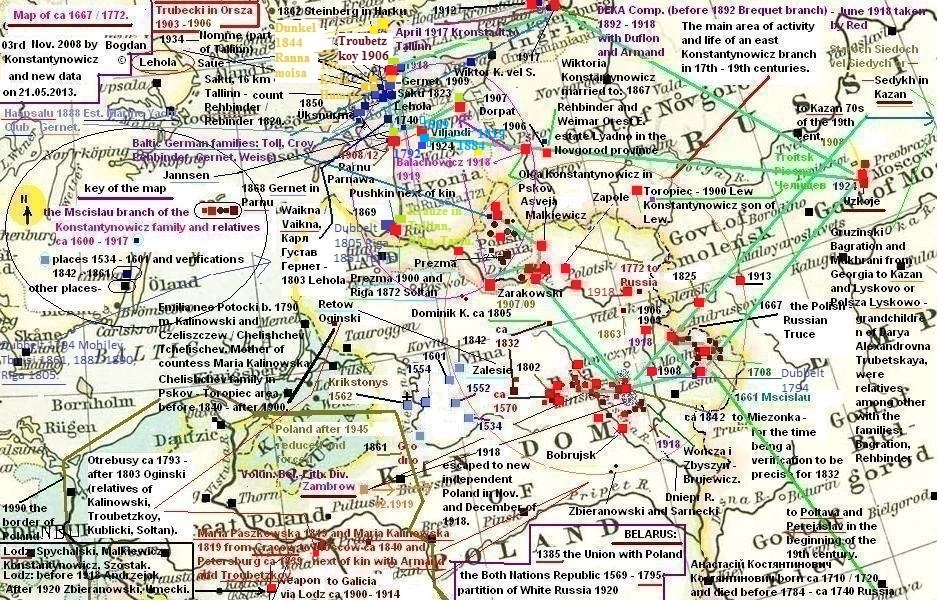
History and genealogy of the noble  families:
Konstantynowicz / Kanstantinovich / Constantinowitz / Konstantinovich
(Belarus, Estonia, Latvia, Russia, Poland,
Georgia / Sakartvelo),
Armand, Troubetskoy, Sedykh / Siedoch / Siedych, Kalinowski, Oginski,  Radziwill, Demontet or Demonets, Paszkowski, counties Orlov Denisov and dukes  Gruzinsky-Bagrationi.
The Duflon / Dyuflon / Dufflon and Konstantynowicz Company 1892 - 1918 in Moscow, St.  Petersburg / Piotrogrod and Zaporozh'e / Zaporozhye / Zaporizhzhya.

Genealogy of the Constantinovich family 1534 - ca 1945 in Belarus, Poland, Estonia, Latvia, Ukraine, Russia, Lithuania. Константинович - биография. History and genealogy of the Constantinovich family with relatives: Troubetzkoy, Radziwill, Piottuch-Kublicki, Sedykh from Kazan, Soltan, Oginski, Paszkowski and Kalinowski from Cracow, Zbieranowski, Zarako-Zarakowski, Malkiewicz, Armand in Moscow and Petersburg, Gernet from Estonia, Bakst, Demonet or De Monet, Dizeren, Azbelev, Holynski of 18th cent., Bagration-Gruzinski and Mukhrani from Sakartvelo-Georgia.  The Baltic German families in Estonia: von Gernet, Rehbinder, Toll, Croy, Weiss.

Von Gernet (Gern), Croy (Krey), Weiss, Toll, Rehbinder / Rebinder, Steinberg - the Baltic German nobility from Estland / Estonia, Livland / Latvia and St Petersburg in Russia of the 19th century. Tallinn/ Reval, Nomme, Harku, Saku, Üksnurme, Lehhola / Lehola, Vaikna, Parnu / Parnawa, Dorpat / Tartu and Viljandi / Fellin in Estonia.


© author Bogdan Konstantynowicz / Константинович

References:  see: Fox coat of arms  

1939 Warszawa

Zbrojna agresja Zwiazku Sowieckiego na Polske we wrzesniu 1939 roku a stan wojny z Sowietami po 1939.

Duflon

Zamach stanu generala Wladyslawa Sikorskiego we wrzesniu 1939 roku

Berezyna

Bartosz Paprocki of 1578 and 1584 

Kojalowicz of 1648  

"The Armorial of many houses in (...) the Grand duchy of Lithuania" by S. J. Dunczewski, edited in 1757 

Pogon Pahonia"The Armorial of the Orsa area" of 1775 

"The Inventory of nobility in the Vilkmerge district" of 1795 

"The Inventory of nobility of the Dzisna district" 1796 

an armorial by Jan Dworzecki - Bohdanowicz   and   "The List of nobility of the Vilna district (...)" 1809  

"The Record of rental (...) nobility from the Barysau district" of 1812 

"The Inventory of nobility in the Lida district" of 1855 

Stanislaw count Mieroszowski  (Stanislaw count Grocyn pseudonym, 1827 - 1900 or Jan Stanislaw Mieroszowski),  "(...) about Polish heraldry",  Cracow 1887 

N. Szaposznikow, "Heraldica"   and  "The List of landowners of the Minsk government" 1899 

a manuscript of armorial by Boleslaw Starzynski  and an armorial by Leszczyc of 1908 / 13  

Jerzy count Dunin - Borkowski of 1909 

Uruski of 1910 

Andrzej Zajaczkowski, "Polish nobility", edit. by "Semper" 1993 

Jan Ciechanowicz, "Knightly ancestries (...)", vol. 1 - 5, edit. Rzeszow 2001

Smolensk 10 kwietnia 2010 katastrofa samolotu

Bogdan Konstantynowicz / Константинович, History of the lineage from Lithuania as compiled by Bogdan Konstantynowicz. Includes the surnames Malkiewicz, Zbieranowski, Szostak, Brzezinski and Zarakowski. 2003 / 2010


Ancestors of ours 

- Piotr Konstantynowicz who was born c. 1610 in the Minsk province; he lived in the Mscislau  province A.D. 1669 

- Augustin / Augustyn Rokoz Konstantynowicz (Augustyn was a clerk of the Lithuanian military  confederation since 1661 by 1667 and after a special envoy of Michal Pac to Moscow to ask tsar Aleksei / Aleksey to put up his son Feodor /  Fiodor III as a candidate to Polish election; the municipal and territorial writer in the Mscislau province, born c. 1635, had died 1713 or before  1713

- Adam  Konstantynowicz of 1697 

- Krzysztof  Konstantynowicz in 1697 

- Copyright by Bogdan Konstantynowicz / Константинович, Map of the north east Poland 18 cent.; The Konstantinovich ancestry in Russia, Estonia, Latvia, Lithuania and Belarus in 16th cent. to the beginning of the 20th centuryAdam Franciszek Konstantynowicz A.D. 1707  

- Franciszek Rohoza Konstantynowicz near of kin with Holynski family from Soino (either Big  Soino or Voronove Slobody near by a  farm of Mielkovka = Mietkowka), and his siblings and Hurko family also (from  Krotowsza otherwise called Krynki  or  Krotovshe that belonged to Romejko - Hurko family in the Orsa district)  were in trouble  for this reason with Holynski  (Kazimierz  son of Stefan Kazimierz Holynski from Chlyszczewo i.e. Chwostowo close by  border between Belarus and  Russia, from  Soino and Uszpol) family after 1714.  
   The above
 Soino is situated 18 km east away from Mscislau, at territory of Russia now i.e. 7 km from present border; it was the Grand duchy of Lithuania 1359 - 1772 and next in Russia: the Mstislavl district, Soino region = "volost" that is similar to county, in a parish of Mscislau (archbishopric of Mahileu, in the Mscislau - Klimavicy catholic area were three parishes: Lozovica, Mscislau and Smolensk in the 19th cent.); one our leg lived in the territory of  present Belarus, but the second one stood  at the present land of Russia in borders after 1992. A fortunes of Poles in this remote easterly territories of the former Both Nations Republic turned out differently than by Vistula, because not a few Poles had got to choose military service in the Russian Army since the end of the 18th cent. or they worked as engineers in different corners of former Russia since second half of the 19th century.

Acc. to 'Secret Memoirs of the Court of Petersburg...' Zachary Konstantynowicz / Constantinowitz in 1796 was a valet (servant) of Yekaterina Alexeevna or Catherine II the Great, Empress of Russia.

Stephen (Stefan) Golynsky (Stefan Kazimierz Holynski) was the third son of Davyd / Dawid, owned the estate Soin (Soino, Soino Wielkie, Woronowe Slobody). In 1663 Golynsky / Holynski mentioned, Mayor Zhmudsky, served in the regiment of Ilya Surin (mother of Stepan Holynski was kind of Surin ancestry). January 31, 1664 a priest of  the  Mstislavl Church, Herman Konstantynowicz filed a complaint against Paul Moskevich and Stephen Golynsky / Stefan Holynski for armed mob to his house, for loot his grain bread and torturing her daughters (a data extracted from the Vitebsk and Mogilev documentary province books, stored in a central repository in Vitebsk, and published under the editorship of  M. Verevkin, T. 24, Vitebsk 1893, p. 455-457). Christina Golynskaya (Krystyna Holynska) was the third daughter of Stephen Holynski. She gave her estate in  will to her brother Kazimierz and to her sister Frantiska. In 1718, she sold the Chodun estate in the hands of the Order of  Jesuits. Frantisek Rogosa / Franciszek Rohoza Konstantynowicz with the Fox coat of arms - but not the Srzhenyava (Szreniawa) arms - was her first husband; the second husband: Jan Gurko (Jan Hurko) was the Vitebsk province clerk and was mentioned in 1714 (I think that the above error about the Rohoza nickname arose from confusion between this nickname and surname Rahoza; for example Michał Rahoza with the Szreniawa coat of arms from Kiev in 1579). 

- Antoni Konstantynowicz signed the Second Manifesto of Lithuanian Nobility in 1763 

The third partition of Poland - all Belarus to Russia in 1795.

- Dominik Konstantynowicz / Константинович was born in the Mahileu (either Mogiliow or Mogiljow by Dnepr, Mogilev =  Mahilyow by Dnieper, Moghilev) Government in Russia near by Krycau / Krychaw c. 1805.
Grandson of Dominik Konstantynowicz that is Stanislaw Konstantynowicz / Константинович was owner of Miezonka - noble locality in east-central Belarus - ex Stefania nee Radziwill property.

Note about Wittgenstein and Trubecki families:

1. Ludwig Adolf Peter zu Sayn-Wittgenstein born 1769 in Negine in the Kiev government; his wife Antuanetta Snarska / Antoinette Snarski born 1778 in Polock, her daughter Emilia Pietrovna Wittgenstein b. 1801, d. 1869, with husband Trubecki Piotr Ivanovich b. 1798, d. 1871; her children: Piotr Trubecki / Trubeckoy b. 1822, Mikolaj / Nikolaj b. 1828, Aleksandr b. 1830, Olga b. 1838 with husband Dolgorukov.
2. Mikolaj / Nikolaj Trubecki b. 1828, with his wife Liubov Vasilievna Orlov - Denisov, b. 1828 died 1860 but not 1869, for example, son: Piotr Trubecki / Piotr Nikolaievitch Trubetzkoy b. in Akhtyra 5 Oct. 1858 and died in Novotcherkask on 17 Oct. 1911, married in Moscow on 13 Oct. 1884 to Alexandra Vladimirovna Obolenskaya b. Moscow on 8 Nov. 1861, d. Authon-la-Chapelle on 14 Dec. 1939.
You see: http://de.rodovid.org/wk/Person:223460.
3. Stefania Wittgenstein b. Paris 1809, d. 1832, nee Radziwill - father Dominik Radziwill b. 1786, d. 1813; mother Teofila Morawska. Stefania was owner about 12000 km˛ that is 1 mln ha in Belarus (Miezonka...) and Lithuania. Her children: Piotr Wittgenstein b. 1831 and Maria b. 1829 with husband Chlodwig zu Hohenlohe-Schillingsfürst. Her husband from 1828 Ludwik Adolf  F. Sayn-Wittgenstein-Sayn (Ludwig Adolf Friedrich zu Sayn-Wittgenstein-Sayn) born 8 June 1799 in Kowno, He was first son of Ludwik Adolf Piotr / Pjotr Christianovich zu Sayn und Wittgenstein / Пётр Христианович Витгенштейн, who was born 1769 in Pierejaslawl Zalesskij either Нежин / Negine or Переяславл, and died 11 June 1843 in Lwiw / Lwow.

On the Wittgenstein and the Prince Dadian-Mingrelsky / Dadiani Mingrelskij families:

a. Ferdinand Sayn-Wittgenstein-Berleburg b. 1834 died 1888, married in 1868 to Paraskewa princess Dadiani / Dadian 1847-1919, see about Bagrationi Gruzinski / Bagration Gruzinsky family; he was child of August 1788-1874, who married 1823 to Franziska Allesina von Schweitzer, and he was grandchild of Christian Heinrich 1753-1800 (married 1775 Charlotte Friederike countess of Leiningen-Westerburg 1759-1831), great-grandchild of Ludwig Ferdinand 1712-1773, and great-great-grandchild of Casimir 1687-1741. His father Ludwig Franz 1660 - 1694. See below (point e)! 

Western Georgia has the semi-independent prince-regent Dadian Grigol of Mingrelia. In 1803, his country was taken under direct Russian suzerainty until the dignity of Dadian was finally abolished in 1867. Prince
Alexander Dadiani, colonel of the Erivan Regiment, was an imperial aide-de-camp but tsar Nicholas taken his sword from him, and have him sent off to the fortress of Bobruisk. Nicholas Dadiani in 1867 was compelled to cede all his sovereign rights to the Tsar in exchange for 1.000.000 rubles, a grant of estates in Russia, and the title of Prince Dadian-Mingrelsky, and his brother Andrew has the name of Prince Mingrelia. Praskovya A. nee Dadiani married to Sayn-Wittgenstein-Berleburg, was born 1846 or 1847; her parents: Aleksandr Leonovich Dadiani b. 1800 (his father Leon A. Dadiani, his grandparents Alexander P. Dadiani b. 1753 and Leonovna Anna Bagration-Gruzinskaja of Mukhrani born 1753 died 1812; parents of above Alexander: Peter G. Dadiani and Anna Bagration-Gruzinskaja died March 19, 1780. Parents of above Piotr / Peter: George / Egor Levanovich Dadiani b. 1683 and Sophia A. Imereti of Mukhrani b. 1691 died 1747) and mother of Praskovya: Lydia G. Rosen born 1816 and died 1866 (a branch from baron Vladimir I. Rosen, born 1742 died 1792 and his wife Olympia Raevskaya / Olimpia / Olimpiada Rajewska born ca 1746).
Above named Anna Bagration-Gruzinskaja of Mukhrani born 1753, died in Moscow, February of 1812, married Alexander Petrovich Dadiani b. 1753/54, died in Moscow on 26 Jan. 1811. Her father Levan Bagration-Gruzinsky, born Moscow 1739, or 1730 acc. to me! He was in 1753 married to Alexandra Yakovlevna Sibirsky b. 1728. Her grandfather Bakar I King of Kartli, born Kutaisi 1700, married Anna Eristavi of Aragvi b. 1706. Her great-grandfather Vakhtang VI King of Kartli, b. 15 Sept. 1675. More inf.: http://genealogy.euweb.cz/georgia/bagrat10.html.

Connections to the Paats family in the Parnumaa / Parnu district and the Helme parish in the area of Viljandimaa / Viljandi County

b.
Ludwig Adolf Peter (Piotr) zu Sayn-Wittgenstein / Ludwig Adolph Peter vel Pjotr Christianowitsch, Graf zu Sayn-Wittgenstein b. 1769 in Negine in the Kiev government or in Perejaslaw-Chmelnyzkyj, d. 1843, his parents: Count Christian Louis Casimir of Sayn-Wittgenstein-Ludwigsburg and his first wife Countess Amalie Ludowika Finck von Finckenstein. In 1798 he married Polish lady from Polock, Antonia Cecilie Snarska / Antuanetta Snarskaja / Snarski and had in this marriage 11 children.  
c.
Christian Louis Casimir of Sayn-Wittgenstein-Ludwigsburg or Sayn-Wittgenstein-Berleburg b. 1725 and died 6 May 1797, Rheda. He was a son of Count
Ludwig Francis zu Sayn-Wittgenstein-Ludwigsburg and his wife Countess Helene Emilie zu Solms-Baruth. He was taken captive in 1761, settled in Russia, and then serving in the Caucasus. He was married two times: to Amalie Ludowika Finck von Finckenstein and to Anna Petrovna Dolgorukova.
d.
Sayn-Wittgenstein-Ludwigsburg was a side line of the Sayn-Wittgenstein-Berleburg family, created by Graf Casimir b. 1687 - d. 1741, ruled 1694-1741, for his brother,
Ludwig Francis zu Sayn-Wittgenstein-Berleburg b. 1694 died 1750. Above named two brothers were sons of Ludwig Franz b. 1660 d. 1694, ruled 1684 - 1694.
e.
Ludwig Francis zu Sayn-Wittgenstein-Ludwigsburg (Ludwig Francis zu Sayn-Wittgenstein-Berleburg) b. 1694 - d. 1750 and his wife Countess Helene Emilie zu Solms-Baruth b. 1700 d. 1750. 

4. Ludwig Adolf Peter zu Sayn-Wittgenstein born 1769 Negine in the Kiev government with his wife Antuanetta Snarskaja / Snarski (Polish roots) born 1778 Polock and her son Ludwig Adolf Friedrich zu Sayn-Wittgenstein, born 1799 Kowno, second son Stanislaw Piotrowicz Wittgenstein / Станислав Петрович Витгенштейн, born June 1800, Alexander zu Sayn-Wittgenstein born August 1803, Riga, and Georgij, Aleksiej and Nikolaj; her daughter Emilia Pietrovna Wittgenstein / Эмилия Петровна Витгенштейн b. 1801, d. 1869, with husband Trubecki Piotr Ivanovich b. 1798, d. 1871; her children: Piotr b. 1822, Mikolaj / Nikolaj b. 1828 in Moscow, Aleksandr b. 1830, Olga b. 1838 with husband Dolgorukov.
5. The director of the Moscow branch of the Imperial Russian Musical Society, Prince Mikolaj / Nikolai Trubetskoy / Nikolaj Pietrovich duke Trubecki with the first wife countess Liubov Vasilievna nee Orlov - Denisov, she born 1828 and died February 1860.
Liubov Vasilievna duchess Orlov - Denisov married Trubeckaya died 1860; a date of 1869 is error; her daughter Sofia Nikolajevna Trubeckaja married Glebova, b. 04 November 1854 died 7 September 1936; 5 October 1858 was born Pietr Nikolajevich Trubeckoj and Maria nee Trubecki / Trubeckaja born circa 1860!

Mary Trubetskaya / Maria Trubecka born circa 1840 was married to Konstantynowicz / Константинович / Konstantinovich (he was born ca 1840) before 1873, and next was living in Kazan in 1874 and she was probably from the Belarusian - Estonian branch of the Troubetzkoy princely family (Трубецкой и Эстония). I need to emphasizes that this is only a hypothesis but all genealogical and historical data lead towards the Belarusian - Estonian branch of the Troubetzkoy family. A son of Maria Trubecka - Wiktor Konstantynowicz / Victor Konstantinovich / Константинович - was living in Piotrogrod / St Petersburg in 1917 and Tallinn after 1918 but 1924 he lived in the town of Viljandi google map Viljandi

6. Children of the second wife Zofia Lopuchin from 1860 and Prince Mikolaj / Nikolai Trubetskoy / Nikolaj Pietrovich duke Trubecki:
among others 1862 Sergiej / Siergiej, 1863 Evgenij / Evgenii, Marija / Maryna / Marina Trubecki b. 1877 - died 1924 and Maria born 1864 - died 1926 ('the second') married Kristi or Christi

(the husband of Maria Nikolaevna Trubetskoy from April 1, 1881 became a cornet of the Guard Hussar Regiment, Grigory Christie b. 1856 d. 1911; but she was only 17? In 1902 - 1905 G. / Jerzy Christie has successfully taken the post of governor of Moscow; June 14, 1882 in Uzkoje, his son Vladimir was born, d. 1946),
Grzegorz, and so on.
Webpage 'ru.rodovid.org' is informing only about 12 children but was 13, including two sisters from the first wife and son Pietr. Polish data base inf. only about the second wife of Mikolaj Trubecki! In 2011 I was writing on 13 children. 
Some false information about countess Sofia Vasilievna Tolstoi / Sofya Tolstaya / Tolstoj concern her life when she took children of her early deceased sister Princess Lyubov Vasilyevna Troubetzkoy (1828 - died 25 Febr. 1860), on the parenting:  Sophia (1853 or 1854 died in 1936),
Peter (1858 - 1911) and
Mary 

(1860 - 1926, but here date of birth is false; Sofia Nikolajevna Trubeckaja married Glebova, b. 04 November 1854 died 7 September 1936 and Mary / Maria nee Trubecki was born in 1860 or ca 1853!
Different source inf.: Maria, born Moscow on 24 February 1860, died in Romania 1926 married on 1 April 1881 to Gregori Kristy. And next Marija / Maryna Trubecki b. 1864, died 1926 and - ? - was married to Kristi or Christi; this information is deliberately confused and mixed
!
Mary vel Maria nee Trubecki / Trubetskaja / Trubetzkaya was born ca 1853 or circa 1860
),

because the father, Prince Nikolai Petrovich Trubetskoy on 12 May 1861 married to Sophia Alexeevna Lopukhina, and from his second marriage he had ten children. For older Trubetskoy - Sophia - was Vladimir Glebov, the wedding was July 2, 1878.
So...

Some about the Tolstoy family and Golitsyn

Golitsyn Prince Alexei Borisovich 1732-1892, Major-General, his wife Princess Anna Georgijevna Gruzinskaya 1754-1779
and his daughters
: Maria 1772-1826, Princess, her husband Pyotr Alexandrovich Tolstoy 1769-1844, five sons and four daughters; and Elizabeth 1779-1853, her husband Alexander Ivanovich Osterman-Tolstoy 1770-1857, had no children.
Pyotr Alexandrovich Tolstoy 1769/70-1844, from 1797 Adjutant General, in 1806-1807 the main army chief of staff, in 1829, Chief of St. Petersburg and Kronstadt. His wife Maria Golitsyn Alekseevna 1772-1826. Children among others: Egor / Jegor 1802-1874, Lieutenant-General, Senator since 1861, his wife Princess Varvara Petrovna Troubetzkoy; and Vladymir 1805-1875, Major General, his wife Countess Sofya Orlov-Denisov.
Varvara Petrovna Troubetzkoy died February 12, 1900, marriage: Jegor / Egor / Yegor Petrovich Tolstoy b. July 19, 1802 and died March 12, 1874, child: Mary Yegorovna / Marija Jegorovna Tolstaya born 1843.
Father of Varvara - Peter Petrovich Troubetzkoy / Trubetskoy, b. August 23, 1793 and died August 13, 1840.
Grandparents of Varvara: Peter Sergeevich Troubetzkoy / Trubetskoy b. 1760 died 1817 and Darya Alexandrovna Gruzinskaya branch Bagration of Mukhrani from the Royal Family died 1796.
And also:
Prince Nikolai Borisovich Golitsyn b. 8 / 19 November 1794, musician, and served in the Second Caucasian war 1820 - 1832, held the rank of Lieutenant Colonel, great-grandson of Field Marshal Mikhail Golitsyn and son of Lieutenant-General Prince Boris A. Golitsyn 1766-1822 and Princess Anna Alexandrovna Bagration of Georgia / Bagration Gruzinskaya 1763-1822, granddaughter of the king of Kartli - Bakara III and great-granddaughter of Alexander Menshikov. Above Nikolai Golitsyn was also personally acquainted with Chopin and Oginski - both Poles.

7. Liubov Vasilievna duchess Orlov - Denisov: her husband Nikolay Pietrovich Trubeckoj b. 1828 died 1900; his mother Emilia Wittgenstein b. 1801 died 1869; his father Pietr / Piotr Ivanovich Trubeckoj b. 1798. Prince Nikolai Petrovitch Troubetzkoy in 1861 married again to Sophia Alekseevna Lopukhin b. 1841 died 1901; the second marriage of  N. Trubetskoy had ten children that is half-brothers and sisters of  P.   Trubetskoy (younger).
Above Countess Sofya / Sophia Tolstoy, born Countess Orlov-Denisov, died November 30, 1885. When V. P. Tolstoy died on February 8, 1875, his widow Sofya lived in Uzkoje estate with favorite niece, the Countess Maria Yegorovna
b. 1843 and married Orlov-Davydov; she was the daughter of Count Yegor Petrovich Tolstoy, who was one of the owners of this estate in 1844 - 1845, and his wife Varvara Petrovna, nee Princess Troubetzkoy. When a son of G. I. Kristi - Vladimir was born on June 14, 1882 in Uzkoje, landowner of the village Uzkoje, Countess Sofya Tolstaya held his son at baptism, June 14 at a local church.
Above Sophia V. nee Orlov-Denisov b. 1817, her parents Vasily Orlov vel Orlov-Denisov b. 1775 and Maria A. Vasiliev; she married to Vladimir Tolstoy born June 13, 1805; 

sisters of above Sofia Vasilievna nee Orlov Denisov: 

Nadjezda married Michail Katenin, 

Ljubov married to Nikolaj Pietrovich Trubeckoj; brothers: 

Fiodor with wife Elizabeth A. Nikitin died 1898, and Michail with wife Tchertkova.

The Nikitin family - among others:

Boris Nikitin b. 1883 and died August 11, 1943, Russian officer of the Imperial Army, son of General Vladimir Nikitin; educated in Tiflis Military School, he served in the Kabardian Horse Regiment, on November 30, 1916 served in the Quartermaster General Staff of the 7th Army; from March 12, 1917 counter-intelligence chief of the Petrograd Military District, from June 1917 Quartermaster - General of Petrograd Staff and after head of Intelligence in Department GUGSH, from July 1917
(July 1, 1917 Boris Nikitin,
head of counterintelligence of Petrograd taken from French captain Laurent P. a telegram intercepted by Allied intelligence; their authors and recipients were Lenin, Zinoviev, M. Y. Kozlovsky, A. Kollontai, Sumenson and Hanecki; under the influence of evidence on the same day July 1, Nikitin wrote out a warrant for the arrest of 28 leaders of the Bolsheviks led by Lenin; a government collected 21 volumes of investigative materials destroyed after the October Revolution; see a memoirs of counterintelligence chief of the Petrograd Military District B. V. Nikitin, 'Fatal years', Moscov 2000, p. 85-86);
in September 1917, appointed Chief of Staff of the Caucasian Native Cavalry Corps and sent out from Petrograd; from 1918 to February 1919 the commander in Dagestan.
His father Vladimir Nikitin born 1848, Russian general of artillery, the commander of the Odessa Military District 1914, Commandant of the Pietropavlovskaja fortress 1916-1917 and he was meeting with Rasputin; the daughter of V. Nikitin, Lidia, maid of honor of the Imperial Court, was a hot fan of Rasputin, was part of his closest circle. 

A certain Konstantynowicz was gotten married with Oktawia Piottuch - Kublicki from Kublicze (= Kublicy) in accordance  with Boniecki; she was great-granddaughter of  

Stanislaw Duke Radziwill at Nieswiez / Nyasvizh  (b.1722) + Karolina nèe Pociej (b. 1732)  

and daughter of Jozef Piottuch - Kublicki of the Ostoja coat of arms (Oktawia born c. 1810, and Kublicy = Kublicze is situated in Uszacz region  = Ushachi, Usacy - that is west of Uszacz, the Witebsk / Vitsyebsk /  Vicebsk province, in district of Lepel / Lyepyel) Mentioned Konstantynowicz / Константинович that was Dominik born c. 1805, exceptionally well-off man, the second husband of Oktawia Piottuch - Kublicki because Jozef  Szumski was the first one. It was plenty of conversations among families of Zarakowski and Konstantynowicz even in the  middle of the twentieth century about wealth of Dominik Konstantynowicz / Константинович.

A note at margin on the Radzivill family from Belarus:

Stanislaw Duke Radziwill at Nieswiez / Nyasvizh married to Karolina nee Pociej / Carolina Potsey / Potsiivna, b. 1732, died 1776. Her parents Aleksander Pociej b. 1698 died 1770 and mother Theresa Yasenitski born 1695 and died 1743. Stanislaw Duke Radziwill at Nieswiez born 8 May 1722 died 22 April 1787, son of Mikolaj Faustyn, and brother of Albrecht, Udalryk Krzysztof and Jerzy.
Duke Mikolaj Faustyn Radziwill b. 21 May 1688, son of Dominik Mikolaj b. 1643, who was brother of Michal Kazimierz Radziwill born 1625! Dominik Mikolaj b. 1643 was son of Aleksander Ludwik who was born 4 August 1594 and grandson of Mikolaj Krzysztof 'Sierotka'.
The Czapski family from Stankow / Stankovo at the Minsk government leased Miezonka from the Radziwill family before Konstantynowicz - 1842. The landowner of this country seat (Stankovo - the dominion Stan'kovo near by Minsk) was a count Americ Zakhary Gutten-Chapsky from an ancient German-Polish-Belarussian noble clan. Above Hutten-Czapski Emerick / count Americ Zakhary Gutten-Chapsky / Nicholas Emerick Zakharyash Hutten-Czapski born on 18 November 1828 in Stankovo, now Belarus; his wife: Elіzaveta Karolіna Hanna von Meendorf b. 1833; his brothers: Karol Ignacy Hutten Czapski and Adam Jozef; his parents: Hutten-Czapski Karol b. 1777 and Fabianna Obuchowicz b. 1794; his daughter: Zofia Czapska-Hutten married Plater-Zyberk b. 1857; her son: Henryk Plater-Zyberk b. 1899.
Hutten-Czapski Carol / Karol b. 1777 (his brother and sister: Stanislaw and Maria); his parents: Franciszek Stanisław Czapski-Hutten b. 1727, d. 1802, Veronica Radziwill b. 1754, she was sister of Mikolaj Radziwill born in 1746; parents of above Veronika: father Michał Kazimierz Radziwiłł 'Rybenko' b. 13 Juni 1702 who was the son of Karol Stanislaw Radziwill; mother Anna Ludwika (Luiza) Mycielska b. on 24 Oktober 1729. Above Karol Stanislaw Radziwill born on 27 November 1669; his father Michal Kazimierz Radziwill b. on 26 Oktober 1625 and his grandfather Aleksander Ludwig Radziwill b. 1594.

Aleksander Ludwik Radziwill was brother of Jan Jerzy, Zygmunt Karol, Albrecht Wladyslaw, and father of Dominik Mikolaj and Michal Kazimierz whos great-grandson was Hieronim Wincenty Radziwill, b. 1759 (his granddaughter was Stefania nee Radziwill).
Daughter of
Karolina nee Pociej: in 1751 birth of Franciszka Theophile nee Radziwill married Soltan Stanislaw and her daughter
Karolina nee Soltan born ca 1780 with husband from ca 1800 / 1802 Jozef Piottuch-Kublicki from Kublicze with the Ostoja coat of arms, who was born ca 1780 (the different person - Jozef Piottuch-Kublicki from Wilkomierz, ca 1730, his grandfather and father from Rzeczyca in Inflanty / Rezekne) and her children: Emilia Piottuch-Kublicki ca 1803, Stanislaw Piottuch-Kublicki ca 1804, Anna, Adolf Piottuch-Kublicki, Walentyna and
Oktawia nee Piottuch-Kublicki from Kublicze born ca 1810. Oktawia nee Piottuch-Kublicki b. ca 1810 and married Jozef Szumski born ca 1800 and after married second time Dominik Konstantynowicz b. ca 1805.

   These spouses were related with: dukes Radziwill (one of richest person of Poland and Lithuania in eighteenth century, Stanislaw duke Radziwill was an immediate descendant of Aleksander Ludwik duke Radziwill - born  1594 - with "Trumpets" coat of arms and his wife Tekla nèe Wollowicz; also the descendant of  Mikolaj Krzysztof duke Radziwill  called  the "Black" born 1515 in Nieswiez  -  most influential man in Grand Principality of Lithuania in 16th cent. and an uncle of Barbara Radziwill), dukes Oginski, Szumski, Piottuch  (- Kublicki), Smokowski, Soltan, Pociej and Benislawski

Note about the Piottuch - Kublicki family: 

 Ferdynand Piottuch - Kublicki, who was an activist of 1863 in the East Belarus, was friend of Artemiusz Viaryha - Dareuski from the Vicebsk region and also Walerjan Weryho / Valerian Veryho (he was owner of the Stajki estate - South of Vicebsk, close to the Dymanowo station, where Russian police on 22nd April 1863 attempted to arrest him). Above Ferdynand  Piottuch - Kublicki was neighbour of Wasilewski and relation of Staniewicz; he and duke Artemiusz Viaryha - Dareuski / Weryho stayed in Vicebsk in 1862 and in Stajki 1863Artemiusz Viaryha - Dareuski was familiar to: Moniuszko, Odyniec, Syrokomla and with Aleksander Chodecki in Mohylew (Mahileu or Mogiliow) in 1859.
Lady Augusta Soltan, b. around 1750 was married to Eliasz / Elijah Kublicki Piottuch from Kublicze, and was living in Livonia. The next generation: 

1. Elizabeth Piottuch-Kublicka of Kublicze, b. approximately 1790 married Benedict Wawrzecki, Marshal of Braslav and second husband Krutz

2. Joseph Piottuch-Kublicki of Kublicz, about 1800 m. Soltan Carolina born ca 1780; child: 

Valentina Piottuch-Kublicka of Kublicz, b. ca 1800 and m. Wladyslaw Jozef Soltan was born 1795, d. 1843 (mother Josepha Benislawska), her child 

Soltan Octavia, b. in Prezma / Pryzma / Presman 1830, died on August 15, 1871 in Kazan (or Razan ?), she was married in 1849 to Samuel Jerome Wladyslaw Soltan / Hieronim S. V. Soltan born 1824, died in 1900, landowner, member of the January Uprising.
Above named Samuel Jerome Wladyslaw Soltan was born 1824 in Uzukrewno (his mother's estate) and died on March 15, 1900 in Prezma, now Latvia; son of Stanislaus Soltan (collaborator of the Constitution of 3 May, imprisoned in Smolensk in the 1794-1796, the President of the Provisional Government of Lithuania in 1812
, d. Mitawa 1836) and Constance Toplicki / Konstancja Toplicka, a high school in Mitawa in 1835-1842 Courland, his parents after confiscating the 'Zdzieciol' estate (in the Slonim area and mentioned by Mr. Tadeusz Mickiewicz) moved house on the Livonia area, he was the insurgent in 1863, exiled to Ufa, interned in Riga. Study at the University of St. Petersburg in 1843-1844, married in 1849, with a relative of his, Oktawia nee Soltan, daughter of Joseph and Valentina, and settled in the estate of his wife, Pryzma in Polish Livonia. In 1858 - 1859 he traveled abroad, where he conferred with Adam and Witold Czartoryski and Count Zamoyski on the current state of Lithuania and Belarus. He was against armed Insurrection. When the uprising broken out, Soltan, unable to stop it, joined to the Insurrection in the Livonia province and after Soltan was arrested in Vitebsk on June 5th, 1863. He was exiled to Ufa on August 18, 1863, and remained there until 1866. Then he was interned in Riga 1872 - 1875, was allowed to return in 1875 to assets of his wife in Polish Livonia, where he died in September 1900 in Prezma / Presman near to Malta in Inflanty / Lettgallen / Livonia, the Rēzeknes Rajons - 18 km south west from Rezekne acc. to http://exonyme.bplaced.net/Board/Thread-Lettgallen. The von der Borch family from Prele / Preili/ Priji near to Dyneburg and from Wyping in the Rzezyce / Rezekne district was owner of the Prezma estate before 1714. Above named Samuel Jerome Wladyslaw Soltan moved in 1891 to Riga, where he many years honorably served as President of the Charitable Society

Now we back to the Piottuch Kublicki family:
Joseph Piottuch-Kublicki of Kublicz, about 1800 m. Soltan Carolina born ca 1780; children: 

Valentina Piottuch-Kublicka of Kublicz, b. ca 1800 and m. Wladyslaw Jozef Soltan was born 1795, d. 1843; 

Stanislaw Piottuch-Kublicki, 

Octavia Piottuch-Kublicka m. Joseph Szumski and second time to Dominik Konstantynowicz

Anna Piottuch-Kublicka m. Joseph Benisławski

Emilia Kublicka m. Vincent Smokowski

Adolf Piottuch-Kublicki m. Ida Oginska

Stanislaw Soltan, b. 1756, d. Mitawa 1836, General, the President of the Commission of the Provisional Government of the Grand Duchy of Lithuania in 1812. He married two times: 

Franciszka Teofila / Francis Theophilus Radziwill died 1802, her father Stanislaw Radziwill and mother Pociej Carolina, she brought to the family Soltan an estate Zdzięcioł / Zdzieciol. Second time to: 

Konstancja Toplicka - Tupalska voto Korsak in 1820 that is Constance Tupalska Toplicka - Korsak, her father Anthony. Daughters among others: Soltan Carolina b. about 1780 + Joseph Piottuch-Kublicki married ca 1800; Anna Soltan, b. ca 1780 + Anthony Wankowicz b. ca 1760 - children Valerie Wankowicz, about 1800 + Constantine Tyzenhauz, Wanda Wankowicz, about 1800 + Benedict Tyszkiewicz, Clementine Wankowicz m. Mostowski. And the next person: Franz-Felix Kublitsky Piottukh / Franz Feliksovich Kublitsky-Piottukh / Franciszek Piottuch-Kublicki, Russian Lieutenant General; 1860 - 1920, a relative of the poet Alexander Alexandrovich Blok/ Bloc b. in St. Petersburg; Blok's mother - the daughter of the rector of St. Petersburg University, shortly after the birth of Alexander, left her husband, lawyer in Warsaw and in 1889 married a second time to the officer of the Guards F. F. Kublitski Piottuch, Catholic, in service entered September 1, 1876. In 1918-1920 he lived with his wife in St. Petersburg. 

Note about the Benislawski family: 

     The Benislawskis from Polack / Polatsk / Polock, Vicebsk / Vitsyebsk / Witebsk, Lucyn / Ludza and Rzeczyce / Rzeczyca / Rezekne districts (here also in the thirties of the  20th  cent.). The bishop of Mogilev (Mohylew, Mahileu or Mogiliow), Jan Benislawski  who was in Rome 1783, consecrated new  R.C. church in Aglona, in SE  Latgale, 25 km SE of Preili and 40 km NE of  Daugavpils, in 1800.  The Kastyr estate  i.e. Kastire  was situated in this parish: 42,5 km NE of  Daugavpils (Dunaburg,  Dyneburg), and belonged to the noble Dunaburg marshal Jozef  Brzezinski and next Zaba  family. 


Comment on the Bonch - Bruevichs  

The Bruevich ancestry comes from the Orthodox gentry of the Mogilev province

Its founder, nobleman Vladimir Bruevich, was born March 4, 1561 and received from the king Sigismund August a letter on the ground in the village of Samotevichi / Самотевичи in the ex-Polish Mstislavl province, located on the outskirts of the Polish-Lithuanian Commonwealth, before 1917 Samotevichi located in the Klimovitskaya County of the Mogilev province. At the present time in the Kostyukovitche district, of the Mogilev region in Belarus. Over the next two centuries the Bruevichs were priests in the Unitarian Church in Samotevichi and of the surrounding villages: Belaya Dubrava, Kostukovichi, Osov, Studenets (http://gf-sut.ru/public/iattach/262/Vestnik2.pdf) and others, or engaged in agriculture. A descendant of Vladimir Bruevich in the 5th generation, priest Ivan Bonch-Bruevich (d. 1668) had six sons: Gregory / Jerzy, Paul / Pavel, Casimir / Kazimierz, Nicephorus / Nikifor, and others who became the founders of the major branches of the family. In 1772, this part of Belarus was conquered by the Russian Empire.
Descendants of
Gregory / Jerzy / Grigori Bonch-Bruevich, rector of the church in Samotevichi:
Pavel Fedorovich 
Bonch-Bruevich (1758-1818), collegiate councilor, an official of the Ministry of Justice, and his son, Michal Pavlovich Bruevich / Michael P. Bonch-Bruevich (1798-after 1870), state councilor, a prominent official of the Russian administration in the Kingdom of Poland.
A family of 
Paul Bonch-Bruevich / Pavel Bruevich remained unknown.
In the Kazimir Bonch-Bruevich branch known: Vasily Mikhailovich Bonch-Bruevich (1801-1865state counselor, a teacher of mathematics of the Polotsk Cadet Corps, Mikhail Bonch-Bruevich son of Dmitry Bruevich (1870 - 1956), lieutenant-general, (http://www.hrono.ru/biograf/bio_n/nik2all_b.php) the national founder of aerial geodesy, and Vladimir Dmitrievich Bonch-Bruevich (1873-1955), a prominent Soviet and party leader. Vasiliy Fedorovich Bruevich (1840-1914), Councillor, an official of the Ministry of State, philanthropist. Great-grandson of Casimir Bonch-Bruevich, a priest Andrey Bonch-Bruevich (1773-1831),
of the Mogilev province, had a son, Ivan Andreevich Bonch-Bruevich / Jan Brujewicz son of Andrzej Brujewicz with Boncza coat of arms (b. 1822), collegiate assesor and the first of the Orel line of the Bruevichs: Mikhail Aleksandrovich Bonch-Bruevich (1888-1940), professor, corresponding member of the Soviet Academy of Sciences; Aleksei Mikhailovich Bonch-Bruevich (b. 1916), Professor.
A descendant of Nikifor Brujewicz / Nicephorus Bonch-Bruevich moved to the Chernihiv province, of which Nikolai Bonch-Bruevich (b. 1808), member of the Academy of Fine Arts, was living in Poltava.
All five branches by the beginning of XX century were included in the nobility books of Novograd-Seversky governorship, Mogilev, Chernigov, Orel and Saratov provinces and the Kingdom of Poland, used the Boncha coat of arms, except for the younger branch, who wrote Bruevich, and had the Sas arms. Representatives of these branches were in the territory of Klimovichi, Chernigov, Mogilev and Rogachev counties and Surazh county: Ivan Ivanovich Bruevich (b. 1860), the actual state councilor, lawyer and Nikolai Grigorevich Bruevich (1896-1987), Lieutenant General and aviation engineeringMember of the Academy of Sciences.
Ivan Andreevich Bonch-Bruevich (born 04 January 1822), of the Kharkiv office, he owned a small village Yablonovets, of the Orel province in ca 1873, wife Apollinariya Petrovna.
Peter Ivanovich Bonch-Bruevich (born 12 October 1858, Ryazan), owner of the Uzkoe village, he graduated from the classical gymnasium in OrelMinistry of Finance. Was married in the city of Orel, in 1883.
Nikolai Bonch-Bruevich (1861-1909) was married twice.
Alexander Bonch-Bruevich (b. 1862), graduated of the Sumy School. He was member of the provincial government of Orel in 1891; after 1917, the building manager in St. Petersburg / Leningrad. His wife Natalia Matsneva (b. 1867), the daughter of a collegiate councilor Michael Ipollitovich Matsnev and his wife, Varvara Pavlovna.
Andrey Bonch-Bruevich (b. 1863, died 1905), owned the village YablonovetsWife: Elizabeth Nikolaevna Paradovskithe daughter of General.
Alexander Bonch-Bruevich, Lieutenant Infantry of the Dorogobuzh Regiment.
Ipollit Aleksandrovich Bonch-Bruevich / Hipolit Brujewicz son of Alexandr from the Kiev governorship, 1894; he graduated from the General Bakhtin Cadet Corps in
Orel

The foremost expert in the radio valves in the tsarist Russia was Michail (2nd) Boncz Brujewicz (Bonch-Bruevich b. 1888 in Orjol - d. 1940; son of   Aleksander (III) Boncz Brujewicz / Bonch - Bruevich who stayed in Kiev since 1896), electrician and engineer after completion of the "Nikolai -  Ingenieurschule" in Petersburg 1914; he served in the Russian army as a professional officer, expert of electron lamps and radiolocation1915 - 1919 made a study of radio valves and organized the first production of one as chief of high - frequency's section in the Central  laboratory of War  Department in middle of 1917 (the first  broadcast valves  and valve sets appeared in Russian Air Force in 1917); director of the radio  valves laboratory in 1918 - 1920 and author of the broadcasting station's project in Moskow of 1922; his son Aleksej Bonch - Bruevich (b.  1916) was the Soviet expert of electron tubes, too; 

his relatives - actual originators of the November coup d'etat in 1917:

Two brothers - younger Wladymir Boncz Brujewicz = Bonch-Bruevich  Brujewicz Wladymir - Bonch Bruevich - Boncz Brujewicz
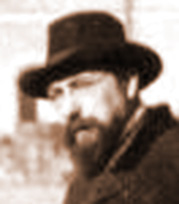
(1873 - 1955, son of Dmitry Bonch-Bruevich; photo: W. Boncz - Brujewicz in Moscow, October  1918. 

Children of Dmitrij Brujewicz: Michail / Michal Boncz Brujewicz and his wife Eudokia Dobrowolski daughter of Porfir / Porfirion Dobrowolski. She was born 1870, d. 1943. Michail b. 24 Febr. 1870 in Moscow, died 1956 in Moscow, too. Second son of Dmitrij - Wladimir Boncz Brujewicz, b. 1873 in Moscow, d. 1955 in Moscow. Wife Wiera Wieliczkina, in Geneve, Switzerland. Wiera was born 1868. His second wife Anna Tinkier vel Tynker daughter of Semen / Zenon Tynker. Anna Tinker was the first wife of Solomon Czernomordik son of Isajew / Izak. 

Children of Michail Brujewicz: Tamara b. 1896, Konstantin with wife Sofia Winogradow; Konstantin Boncz-Brujewicz born 4 Febr. 1898, in St Petersburg; Georgij Boncz Brujewicz son of Michail Brujewicz, born 1900, died 1923. Alexandr son of Michail, died 1981. 

Child of Wladimir Boncz Brujewicz: Elena b. 1904 and died 1985 in Moscow, husband Leopold Awerbach son of Leonid Awerbach

Dmitrij that is Dymitr Brujewicz with the Boncza coat of arms, was son of Afanazy who was born 1798 in Kulgajewka, the Klimowicze area (Dmitry Bonch-Bruevich was born in Prusino, but rather in Kuligaevka, which now is merged with Prusino in a village; now these villages - Kuligaevka / Kulgajewka and Prusino - divides only river; Kuligaevka belonged the Bonch-Bruevich family and two brothers Michail and Vladimir came here in the summer and played with local children; Dmitry Afanasievich Brujewicz with Boncza coat of arms, lived here in his home, and here he died; he was buried in the local cemetery on the outskirts of the village but an ancient cemetery has not been preserved like the tomb of Bonch-Bruevich)

Dymitr was born 26 October 1840, died after 1904. The first wife of Atanazy / Afanazy (b. 1798) was Irina Osipowna Liepieszynskaja vel Irena Lepeszynski died 1839 in Prusinowo, the Klimowicze county, the Mohylew government, daughter of Jozef Lepeszynski (Prusinskaja Buda 6 km east of Kasciukovicy / Прусинская Буда but Prusino / Прусино that is Prusinowo 2 km east of Kostiukovichi in the Костюковичский район and south of Klimovichi). 

Afanazy Brujewicz son of Andrzej, born 1798 in the Klimowicze area, his second wife Olga Reszkowicz born 1814 or 1818, daughter of Pavel Reszkowicz; first wife Irena Lepeszynski was daughter of Jozef. Andrzej Brujewicz the 'second', b. 1768 and son of Kirill Brujewicz, d. 12 July 1819 in Kulgajewka, the Klimovichi county, the Mohylew by Dniepr government; Andrzej was owner of Kulgajewka village, but all villagers were taken by Ignacy Ciechanowiecki and removed on new places. The first wife unknown, 2nd wife 1799 Fiedosja Kuzminicz who d. 1830 - 1st married with Filipp Platkowski son of Jan Platkowski; Andzej has got 2 sons: Afanasij / Afanazy / Atanazy and Fiodor. Kirill Brujewicz son of Andrzej the 'first' Brujewicz with Boncza coat of arms, b. 1735, d. circa 1804 / 1805, with wife Anna Sawinicz (Kirill Brujewicz was owner of part of Samotiejevichi in Krzyczew area / Krichev / Кричев that is Самотевичи south - west of Kostiukovichi and south of Krzyczzew, now the Moghilev oblast but Kostiukovichi belonged to Vladimir Tichonowiecki and his family 1799 to 1917; Kirill was owner also Kulgajevka / Kulgaevka in Klimovichi county, a house in Kostiukovichi 1783, inf. on him 1805 in the Klimovichi court). 

Kazimierz son of Jan vel Ivan Brujewicz was died 1705 and was father of Andrzej the first. Jan was son of Fedor. Fedor was son of Jan the first).

Above named Wladymir i.e. Vladimir Bonch - Bruevich / В. Д. Бонч-Бруевич was publisher and one of Lenin's closet associates. Curiosity! Lenin signed certificate for V. Bonch-Bruevich on July 7, 1920 because of a month's holiday and travels to Kulgaevka / Kulgajewka village in the Klimovichi county, Moghilev / Mogilev province, when the Red Army went on the general offensive - begun on July 4, 1920 - against Poland. Wladymir i.e. Vladimir Bonch - Bruevich had got a cabin in autonomous Finland and Lenin had hiding place there when Zinoviev claimed that Lenin had discussed the question of the take-over in the Tauridian Palace on the 3rd (16th) of July 1917. This was incorrect, since Lenin was in Bonch-Bruyevich's villa in Finland then, and returned only on the 4th (17th) of July 1917, acc. to: Mikhail Heller and Alexander Nekrich, 'Utopia in Power', London 1986, p. 30. Lenin had hiding place there in period July - October 10th, 1917 [Old Style] i.e. to 23rd October; Vladimir Bruevich was administration manager at the Council of People's Commissars from November 1917; cf. F. Antoni Ossendowski, "Shadow of the bleak East", edition of 1919 and 1921, p. 57 - 58: he was known to sphere of Petersburg high society, Polish "old nobleman", secret chieftain of  socialists; he concealed of Trocki - Bronstein in Petersburg A.D. 1905 and also directed Chrustalow - Nosar or Chrustalov - Nosari in 1905.

The second brother, older - general Michail (III) Boncz Brujewicz / Bonch - Bruevich either Bonch - Bruyevich Mikhail Dmitriyevich or Michal Bonc - Bruevic, see - if you read Russian - here:  http://history.tuad.nsk.ru/index.html (b. 1870 - died 1956; son of Dmitry who stayed in Moscow) who was tsarist general. Mikhail Dmitriyevich Bonch - Bruyevich from 1892 to 1895 served as an officer with the Lithuanian Guards Regiment at Warsaw. He was in command of the 176th Perevolochensky Regiment, based at Chernigov in 1914 and had known Russian aviator Pyotr Nesterov. The chief of staff and deputy commander of the Russian Northern Front and commander of the Northern Front from 29 August 1917 to 9 September 1917. Next he was chief of staff of the Supreme Commander after November 1917. Mikhail Dmitriyevich Bonch - Bruyevich was the military director of the Supreme Military Council and chief of general field staff of the Red Army (field staff of the Revolutionary Military Council) in 1918 - 1919.

Mikhail Dmitriyevich Bonch - Bruyevich was the specialist in take a pictures from airplanes and organized the first technical office of aerial photograph in 1925; he wrote "The aerial photograph" in 1931 and similar book in 1934 (and  Grigorij - his son Mikolaj (2nd) b. 1896 was general of the Soviet air force)

Curiously enough: 

new military intelligence under different names operated from October 21, 1918. At this time the Red Army was already a huge and powerful body but after October, 1917, Bolsheviks faced with many difficulties, including the collapse of the army. Therefore, reorganizing the old army, they left in the War Department that is the People's Commissariat for Military Affairs - General Directorate of the General Staff (GUGSH) and this body consisted the 2nd Division of the General Quartermaster in December 1917, which was the central organ of intelligence and counterintelligence services of the armed forces of Russia. So by the end of 1918, Soviet military intelligence in full was as the legal successor of the pre-revolutionary military intelligence. GUGSH headed General V. V. Marushevsky (Polish?) who refused to cooperate with the new government. 

Then Quartermaster-General Nikolai Mikhailovich Potapov was new chief of the military intelligence (in 1915-1917, Potapov was the Main Director of the General Staff at the office of General Quartermaster. However, according to some reports, he - from July 1917 - collaborated with the military organization of the Petersburg bolshevik Committee. In November, 1917 to May 1918, Potapov served as Chief of Staff, and acting as assistant manager of the Military Department; in June 1918, he became a member of the Supreme Military Council, and from July 1919 Chairman of the Military Legislative Council). 

Colonel Yudin was the bolshevik Commissar and Peter F. Ryabikov, after the coup, was had remained in the office because the Bolsheviks did not touch the military intelligence, as opposed to counter-military intelligence, which they immediately dispersed, as it was involved in the campaign of charges the Bolsheviks was spying for Germany in the summer of 1917. Crisis of foreign intelligence commenced with the end of December 1917: colonel Andrey Stanislavsky (Polish?) entered the service for the French intelligence, and intelligence reports from the allies - the French military mission in Moscow - came to the end in July 1918. In February 1918, the country faced with bloody civil war, and in March 1918 the Soviet government established the Supreme Military Council for the organization of the armed forces of Red Army with a military leader, former tsarist general M. D. Bonch-Bruevich and two political commissars Shutko and P. Proshyan. On March 17, 1918, the Supreme Military Council included: a military leader, his assistant, Quartermaster-General with several assistants, and intelligence chiefs, a field inspector of artillery, and others; on March 19, 1918: Chairman - People's Commissar for Military Affairs Leon Trotsky, the Council members and above named General N. Potapov. In June, 1918 the Supreme Military Council was reorganized and included: a military leader Bonch - Bruevich, chief of staff and staff occupied by former officers, the deputy of the military leader appointed a former Major General of General Staff Alexander Alexandrovich Samoylo, an assistant Chief of Operations of the Supreme Military Council was Colonel Alexander Kovalevsky (Polish? April - May 1918). Kovalevsky, soon will move to the South, where he headed the mobilization management of the North Caucasus Military District; here he with General Nosovich (Polish?) were arrested by Stalin, but after Nosovich was fleeing to the 'white', Kovalevsky was again arrested and shoted.

The family of Aleksander II Brujewicz or Bonc - Bruievicius of the Boncza arms lived in Zbyszyn or Sbychin near to Tschetschewitschi since 1876 / 1880, 39 km SE away from Miezonka and the big estate had 5548 hectares, he lived next door Gresmer or Greszner family (according to a map edited by A. Brantner of "K.u.k. militar - geographisches Institut" in Wien 1896) and Mr Witold  Bulhak home (the Bulhak noble house of  the Syrokomla arms, verified in Minsk A.D. 1802, possessed also in the government of  Minsk: Matewitschi  = Maciejewicze i.e. Macevicy 14 km SW of Miezonka, and Zuki, Budzilowka and Kondratowicze); villages Woncza / Vontcha,  Borki and Rogi - which Florian Czarnyszewicz described in a book "Nadberezyncy" i.e. Berezyna's Riverside Inhabitants - were situated close by the Zbyszyn estate: 3 and 7 km; besides a certain Aleksander (IV ?) Brujewicz purchased village Mistow and neighbourhood in the Congress Poland on 25 January 1861 but I haven't yet any firm evidences if it's the same Aleksander (2nd) Brujewicz who settled himself in  the Zbyszyn  property - I  am searching information.

They derived from Michal I Brujewicz who was born 1762 and stayed in the Minsk  province and all  following   generations (all his sons: Aleksander I, Mikolaj I, Bazyli, Wiktor, Piotr, Pawel, Fiodor) served in Russian army at a later date;  the Brujewicz  family  was in   Mahileu   A.D. 1718 and in Krycau  A.D. 1745, Sladzin or Sladziniec  in Mahileu region in 1761

Brujewicz of the Boncza coat of arms (or Boncz - Brujewicz, possessed Bohdanowka 1st in the Mscislau  district since 1870 - 10,5 km  Nord of Jurkowschtschina i.e. Jurkowszczyzna - and also Poplatyno in the district  since  1870;  Petrulin in the region of Cerykau; Muryn -  Bor  or Bor near to Holynski's Michiejevitschi / Michiejewiczi,  i.e. 12  km  NW of Klimavicy since 1870; and Sieliszcze 18 km E-S-E of Cavusy  or  Czausy  - since 1876)


We stayed in 

St Petersburg and Moscow

"Duflon, Konstantynowicz & Co." 

abbreviated as 

DEKA 

Grand Duke Alexander Mikhailovich - Sandro / Sasho was a key figure in the development of the Russian  air force; well-bred in

Georgia  /  საქართველო  /   Sakartvelo  

Grand Duke Mikhail Nikolayevich born 13 / 25 October 1832 in Peterhof, Field Marshal and on December 6, 1862 was appointed governor in the Caucasus and commander the Caucasian Army, with all rights chief of the army to July 23, 1881. Initiator of the compilation of the 'Caucasian Collection', published in Tiflis in 1876-1912. In marriage he had six sons and one daughter, among others Alexander Mikhailovich (Sandro), b. 01 April 1866 in Tbilisi died 1933, Nice, France. Chief of the Commercial navigation and ports (1902-1905), during the First World war was in charge of the aviation in the army: paid much attention to the development of aviation industry in Russia, on his initiative, established flight schools, began preparing the first national flight training and 1914 appointed head of the organization of aviation business in the armies. Mason, and called himself Philalethes. Receiving education at home in Georgia, often went for long voyages: 1886 - 1889 made a voyage round the world on the corvette 'Rynda' and in 1890 - 91, at his own yacht 'Tamara' traveled to India, described in his journals. In 1892 he commanded the destroyer 'Revel', in 1895, was a senior officer of a battleship and in 1899, on the battleship 'Admiral Apraksin', then transferred to the Black Sea Fleet, where he commanded the battleship 'Rostislav'. With the beginning of the 1st World War, in fact, led the fleet of Russia. In 1915, Admiral, with the December 1916 field inspector - general of military aircraft; after February 1917 was in the Crimea, and in 1919 went into exile. Since 1903 an honorary member of the Nikolaev Naval Academy, was also the chairman of the Eng. Technical Society. In exile, was the honorary chairman of the Union of Russian military pilots and he was the patron of the National Organization for Russian scouts. He was in France in 1909 and next established the Volunteer Aerial Association under his presidency (All Russian Aero Club)  and set up the  first  military aviation school in Sebastopol in 1909 or 1910 -  finally formed at Sevastopol (Sebastopol) for  the  winter 1912 and in Gatchina for  the  summer 1912; near to Russian military intelligence.   The  Duke,  Freemason, Vice-Admiral was appointed Commander-in-Chief of the Russian  Military Air Fleet  in 1914 or 1915  and  he  became Inspector of Aviation; aide-de-camp to Nicholas II, an old friend of the Tsar and  married to  his sister Xenia.

1892
At the beginning Louis Franzevich Dyuflon founded technical office in the 2nd half of the 19th century in Moscow. L. Duflon / Dyuflon acted in the St. Petersburg branch of the 'Breguet' Company.
At present the Montres Breguet SA is a member company of the Swatch Group of western Switzerland in L'Abbaye (L'Abbaye is a municipality in the canton of Vaud, Switzerland; around 30 km north - west of Lausanne). It was founded by Abraham-Louis Breguet in Paris in 1775. Abraham-Louis Breguet or Bréguet b. 10 January 1747 and died on 17 September 1823, born in Neuchâtel, Switzerland; his son Louis-Antoine Breguet. His ancestry was French but his family were Protestants so they fled to Switzerland after Edict of Nantes in 1685. He met Abraham-Louis Perrelet and Xavier Gide. In 1795 Breguet returned to Paris. Circa 1807 Breguet brought in his son, Louis-Antoine (born 1776) as a business partner, and from this point the firm became known as Breguet et Fils. He sent his son to London to study with the great English chronometer maker, John Arnold. Abraham-Louis Breguet died in 1823 and it was carried on by Louis-Antoine to 1833 (he died in 1858), and after the business continued under Abraham-Louis' grandson Louis François Clément Breguet who was born on 22 Dec. 1804 in Paris (Louis Francois Clement Breguet work in the early days of telegraphy, educated in Switzerland; in 1870 he transferred the leadership of the company to Edward Brown; he collaborated with Heinrich Ruhmkorff, George Daniels and Professor Thomas Engel; he had one son Antoine b. 1851 and he met Alexander Graham Bell and obtained a license to manufacture Bell telephones for the French market; he was grandfather of Louis Charles Breguet, aviation pioneer and aircraft manufacturer). His great-grandson Louis Antoine b. 1851 d. 1882, was the last of the Breguet family to run the business. So he took on noted English watchmaker Edward Brown of Clerkenwell to look after the Paris factory. London-born Edward Brown became the factory manager, his partner - 1870 - and, after Breguet's death, the owner and head of the company. His sons Edward and Henry Brown headed the firm into the 20th century. By Michael Weare at http://clicktempus.com/turning-points-in-time-breguet: under Brown and his descendants, Breguet remained a niche Parisian watchmaking boutique for the next century. Edward Brown died in 1895, and was succeeded by his two sons Edward and Henry, of whom Edward retired in 1920. Thus Henry Brown became the Head of Breguet's Firm. The watching making firm continues to market itself under the name of 'Breguet'. The electrical instrument business trades first under the name of 'Breguet fabricant' and from 1881 - 'Maison Breguet'. The Brown family owned the Breguet watch brand for 100 years, five years longer than the Breguets. The complicated watches were built by the Joux Valley's leading watchmakers including the Victorin Piguet workshops.
Above named Louis Charles Breguet b. 1880 in Paris died 1955, was a French aircraft designer and builder, one of the early aviation pioneers. In 1902, Louis married Nelly Girardet, the daughter of painter Eugene Girardet. In 1905, with his brother Jacques, and Charles Richet, he began work on a gyroplane / helicopter. In 1912, Breguet constructed his first hydroplane. Louis-Clement's grandsons, Louis and Jacques Breguet were France's aircraft pioneers, from the 1917 'Breguet 14' fighter-bomber helped turn the tide of war on the western front. Louis Breguet was one of the co-founders of Air France in 1933.
Engineer Louis Franzevich Dyuflon / L. Duflon, a Swiss 'Breguet' Company representative (he was very young, only aged 23), was Stefan Drzewiecki friend (the Polish family from the Volhynia government), and circa 1884 was searching of the structure of a dromoskop. Dyuflon sometimes was invited to have breakfast with Drzewiecki. Drzewiecki (Drzewiecki Stephane lived after in France: 5, rue Gustave-Zede, Paris) occupied luxury apartment in the house No 6 at Admiralty Seaside. In the evenings, the usual Drzewiecki guests were brothers
Paul and Peter Solomonovich Martynov
(Lyubov Orlova-Denisova married to Nikolai Trubetskoy, she b. 1828, d. 1860. Her brother Fedor / Fiodor born 1802 or 1806 with wife from the Nikitin family. Sister of above Lyubov nee Orlova-Denisova married Trubetskoy: Nadiezda / Nadjezda / Nadine Orlov-Denisov married to Michael / Michail Andreevich Katenin, he born ? and died before 1868, Major-General, ataman Orenburg Cossacks - his parents: father Andrew / Andrej Katenin 'youngest' b. 1768 and d. 1835, wife - Irina Lermontov. His grandfather Fedor Katenin and his great-grandfather Ivan Nikitich Katenin d. 4 December 1723. Mother of above named
Michail Andreevich Katenin - Irina Lermontov / Lermontow b. 1771 d. 1818. His brother Alexander A. Katenin, b. 1800 Kluseevo or Polovtsov in 1803 with wife Barbara I. Vadkovsky from Jan Wadkowski family. Above Michael / Michail Andreevich Katenin daughters: Mary or Maria
[Prince Nikolaoz / Nikolai Ilyich Gruzinski b. 7th August 1844, Governor of Vilno 1899 and Vice-Governor 1896 - 1899, married in 1868 to Princess Maria Mikhailovna - daughter of Colonel Mikhail Andreivitch Katenin, and Countess Nadejda Vasilievna, second daughter of General Count Vasili Vasilievitch Orlov-Denissov. He d. 1916, having two sons and four daughters: Prince Mikeli / Mikhail Nikolaievitch Gruzinski, b. 1886, a govt. official in Minsk in 1914, m. daughter of Ivan Bzhozovskii / Jan Brzozowski; Princess Mariami / Maria Nikolaievna, first wife of Andrei Alexeivitch Tregubov; Princess Nadina Nikolaievna / Nadejda Nikollaievna, married second time to Lieutenant-General Alexei Mikhailovitch Kauffman, cdt. Grodno Hussars of the Guard, third son of General Mikhail Petrovitch Kauffmann, Engineer-General of Russia, d. at Warsaw, 30th October 1901; Princess Anastazia / Anastasia Nikolaievna Gruzinskaya, 1917 - she emigrated to Dvinsk / Daugavpils in Latvia, where she participated in the Greek-Catholic movement]
and Sofia d. 1908 married
Martynov. At margin: Martynov Dmitry M. born 1760 and his brother Martynov Solomon Mikhailovich b. 1774, d. 1839 or after 1840; a wife of above Martynov Solomon Mikhailovich: Elizabeth M. Tarnovskaya / Elzbieta Tarnowska daughter of ?, Polish - but we know only Michal Tarnowski b. 1782 d. 1831 and his parents Jan Jacek Tarnowski b. 1729 and Rozalia Czacka - she b. 1783, d. 1851; her children: Nikolai Martynov Solomonovich 1815 / 1816 - 1875 / 1876 who in 1841 killed Lermontov in a duel, his family related to Kolirovsky and Romeiko - Hurko (Polish); Michael Solomonovich 1814-60; Ekaterina Martynova Solomonovna married Rzewska (Polish) / Rzhevskij Michal; Dmitry Martynov Solomonovich b. 1824 and died 1909; Elizabeth; Natalia b. 1819; Julia married Gagarin, b. 1821; also Pawel and Peter Solomonovich Martynov - friends of Stefan Drzewiecki, Polish nobleman but about Pawel and Peter no any inf.; above named Sofia d. 1908 and married ca 1880 to Viktor Martynov / Wiktor Martynow b. 1858 d. 1915 - his father, Nikolai Martynov Solomonovich b. 1816 and his grandparents: Solomon M. Martinov and Elizabeth M. Tarnovskaya b. 1783),
engineer Breguet (Louis Antoine Breguet that is Antoine Breguet b. 1851 - died 1882, was engineer and his son Louis Charles Breguet b. 1880, d. 1955, was aircraft manufacturer and was a French aircraft designer and builder, one of the early aviation pioneers who - in 1905, with his brother Jacques Breguet - began work on a gyroplane, the forerunner of the helicopter, with flexible wings - like Igor Sikorsky and prof. Bothezat; Jacques Bréguet that is probably Mr Breguet who was the engineer of 'Dyuflon and Konstantynowicz', company representative, Swiss citizen and friend of Stefan Drzewiecki; Louis and Jacques Breguet, of the famous clock- and watch-making family, were interested in aviation from an early age and on 19 September 1907, they, in cooperation with Professor Charles Richet, created the first helicopter),
Dyuflon,
botanist professor Poirot,
K. E. Makovsky (Konstantin Yegorovich - that is son of Георгий or Юрий - Makovsky, b. Moscow in 1839 and died in Petrograd / St Petersburg on 30 Sept. 1915, painter, 1891 had become a member of the newly formed 'St Petersburg Society of Artists'),
and the pretender to the Serbian throne, prince Karageorgievich, who formerly served in the French Foreign Legion (Arseny Karageorgievich b. 1859, d. 1938, who served until 1916 at the Russian military; the son of Serbian Prince Alexander Karadjordjevic and Princess Persia; was educated in Paris lycee and graduated from the 2nd Konstantinovskoye Military College in 1888; wife 1891/2 - 1896 of above Arseny Aleksandrovich Karageorgievich / Arseny prince Karageorgievich: Aurora Pavlovna Demidova di San Donato, b. 15 November 1873, Kiev; her mother Helena Petrovna nee Troubetzkoy, b. 1853 and married to Pavel Pavlovich Demidov; her grandfather Peter Nikitich Troubetzkoy born 1826, her great-grandfather Nikita Petrovich Trubetskoy, b. August 18, 1804; her great - great-grandfather Peter S. Troubetzkoy b. 1760 died 1817; her great-great - great-grandfather Sergei Troubetzkoy Nikitich b. 1731 died 1812).

In 1892, Swiss citizen, L. F. Dyuflon / Duflon built in St. Petersburg plant for the production of electrical equipment and opened in St. Petersburg 'Electrical studio'. In the same year 1892 he concluded a cooperation agreement with Moscow businessman A. Konstantinovich / Apollon (Apollo, Palemon, Apolon) Konstantynowicz /  Константинович son of Wasyl / Wasilij Константинович, the owner of the technical office.

Together they take on more complex projects, and soon the company taken the first military orders. Since 1896 the enterprise was owned by trading house, after by co-operatives and in 1901 it was transformed into a corporation.

1895 

The third company in Russia in terms of the
electronic products supply. Created 8 June 1901 by converting the firm 'Dyuflon and Konstantynowicz' (Дюфлон, Константинович и Ко., ДЕКА) based in 1892. Founded in 1893 as a factory of electrical installations by 'Dyuflon and Konstantynowicz / Константинович'.
Founders: Swiss citizen of French origin, Louis Edward Anton Dyuflon / Дюфлон, his Swiss friend
Yu Dizeren

(Jean Dizerens or Disserens / Diserens / diSerens from Switzerland; they were aristocrats who fled from Paris to Switzerland - Cully in Vaud, Lutry and Lousanne - during the Fr. Revolution, where they first settled in Lutry; they were originally Italian noble family with last name diSerens or Diserens.
Also L'Abbaye, is a municipality in the canton of Vaud, Switzerland, town from where the Breguet family came to Paris; around 30 km north - west of Lausanne.

The father of above Louis Edward Anton Dyuflon / Luis Edouard / Louis Eduard Anton Duflon / Lun Eduard Anton Duflon, who was born 1861, a Swiss citizen - was probably Francis Dyuflon / Frances Duflon / François Louis DUFLON b. approx. 1824. His wife was Jeanne Louise Susanne CUÉNOUD born 1826; her next of kin from families: Mercanton, Jenny, Milliquet. Her parents: François-Louis CUÉNOUD and Jeanne-Françoise CHAMPRENAUD (Jeanne-Françoise CHAMPRENAUD b. 29.03.1792 in Grandvaux, the Vaud province in Suisse; died in 1864). Mother of Jeanne-Françoise CHAMPRENAUD: Jeanne-Louise RICCARD was born approx. 1757. Father of above Jeanne-Françoise CHAMPRENAUD: Jean Pierre Champrenaud. Father of above François-Louis CUÉNOUD: Jean David Cuenoud (Jean-David CUÉNOUD born 24.09.1774 in Grandvaux, Vaud province, Suisse and died on 13.02.1816 in Lutry, Vaud, Suisse; maried to Jeanne Abetel on 14 August 1795 in Lausanne of Vaud province in Suisse).
Riex from Lutry 5 km distance only and east of Lausanne, 10 km. The DUFLON family 1745 - 1815 was living in Riex of the Vaud province / Vaud canton, Switzerland / Suisse. CHAMPRENAUD in 1748 also was living in Riex, Switzerland / Suisse. Riex close to Lavaux in Switzerland. CHAMPRENAUD in 1822 was living in Villette close to Lutry, too. CUÉNOUD in 1774 in Grandvaux close to Lutry and Riex. Disserens / Diserens / diSerens from Switzerland in Cully in the Vaud province, Lutry and Lousanne. Marie Elisabeth DUFLON b. 1690 in Riex, District de Lavaux and married in 1714 in the Canton de Vaud. The Duflon surname has ancienne origin: de Fluvio. Surname DEMONTET dit TAVERNEY in 1646 was in Corsier sur Vevey of District de Vevey in Canton de Vaud. The DEMONTET family was near by DUFLON in 17th century. Barbara or Varvara Demonet or maybe DEMONTET from Vaud province was daughter of Carl de Monet's that is DEMONTET or Charles Demonets / Monnette or Demonsi.
Villette in the Vaud province. Cully is near to Riex. Villette or Lavaux close to Lutry and Cully. All on east of Lutry and east of Lausanne / Lozana. Vaud is the third largest of Swiss cantons by population and fourth by size. It located in the French-speaking western part of the country.
See http://www.gen-gen.ch/CUÉNOUD-CHAMPRENAUD/Jeanne-Fran%c3%a7oise/1232358
)

and Moscow engineer A. V. Konstantynowicz / Константинович. In December 1895 they bought land in Lopukhinsky Park in St. Petersburg to build its own plant.
Lots of houses No 7 and 8 at Pavlov Street (Lopukhinsky road or lane Lopukhinsky in 1887 has got a common name, Lopukhinsky Street) in St Petersburg in 1895 bought L. F. Dyuflon / Duflon / Louis Edward Anton Dyuflon and his companions Y. K. Dizeren / Yu Dizeren and (inf. about first names, father's name of Apollo(n) Константинович and middle names need to be check, on Yu = Y. K., L. F. = Louis Edward, A. = A. V. / A. W.) A. V. (A. W.) Konstantynowicz / A. Konstantynowicz for the electrical company (since 1922 the Petrograd State Machine-Building Plant 'Electric'; in 1923, the factory designed the first Soviet welding generator). The site houses No 9 and 12 Pavlov Street got the Prince of Oldenburg. The house No 14 in 1909 - 1910: factory building for 'The Russian Society of the wireless telegraph and telephone', in 1923 created Central Radio Laboratory - here was located the center of the main domestic radio industry (L. Mandelstam, N. Papaleksi, D. Rozhanskii, V. P. Vologdin).
A note dated September 21, 1895 from the Ministry guarantees that the plant 'will be to have a free hand for quick ... execution of its most difficult and painstaking work...'.
Domestic firm 'Dyuflon and Konstantynowicz' (Константинович) which was a representative of the French 'Sautter and Harle', under a contract of December 4, been making 11 sets of electric winches for battleship's elevators and to additional elevator for 'Rurik', winches ordered directly to firm 'Sautter and Harle' (the 'Rurik'-I keel was laid in the Baltic Works in St. Petersburg, May 19, 1890).
Fuller was an order given in March 1905 to the company 'Dyuflon, Konstantynowicz and Co.' immediately by 24 portable electric fans of 300 m / hr. 'Navarin' / Наварин, based on the British Trafalgar-class battleship, was built in St. Petersburg, 1889 to 1896;
in September 1893, as planned 'Duflon and Konstantynowicz' factory was appointed date of move of 'Navarino' to Kronstadt for completion of equipment and accessories.
To build a 'Громобой' / 'Stormbreaker' ship in the new dock of the Baltic plant started on June 14, 1897, and on December 7 of that year this new cruiser called 'Gromoboi' was enrolled in the fleet; guns delivered from the Obukhov plant, and a winches from 'Dyuflon and Konstantynowicz company'.

1896
In December 1896 at Lopukhinsky Street in St Petersburg, now -
Copyright by http://rdp4v.livejournal.com/1449841.htmlAcademic Pavlov Street No 8, opened the first-born in St. Petersburg electrotechnical industry, the electromechanical plant facilities owned joint-stock company 'Dyuflon, Konstantynowicz and Co.' (Дюфлон, Константинович и Ко., ДЕКА), a large role in which played the French capital. The 'Duflon, Konstantynowicz and Co.' office was situated at Aptekarski Ostrov in St Petersburg, now Saint Petersburg State Electrotechnical University is also located on the island. The Lopukhinsky road or lane Lopukhinsky in 1887 has got a common name, Lopukhinsky Street, also found writing Lapuhinskaya; lots of houses No 7 and 8 in 1895 bought the L. F. Dyuflon and his companions Y. K. Dizeren and A. Konstantynowicz / Константинович for the electrical company.  Alexander Stepanovich Popov, pioneer in the invention of the radio was associated Google map of old Duflon and Konstantinovich plant in St Petersburg at Medikov Street. Copyright by http://www.skyscrapercity.com/showthread.php?t=576093&langid=5 with the island; on March 24, 1896, he demonstrated transmission of radio waves between different buildings in St Petersburg and he demonstrated ship-to-shore communication over a distance of 6 miles in 1898.
From the report of the Vologda city council member, F. N. Ovechkin, we know about question on the electric lighting in the city of Vologda in 1896 when the owners of the electromechanical plant of 'Dyuflon and Konstantynowicz', addressed to the Chief of the province a proposal to build in the city of Vologda electric lighting.
Nelly Bogorad in a newspaper 'The St. Petersburg Rush Hour' in 2002 was writing 'The Case Dyuflon will live': "In December last year the plant, 'Electric', the sources of which were enterprising Frenchman and a Pole, created in 1896 by joint-stock company 'Dyuflon and Konstantynowicz', has got 105 years old. But the big date, ... at the company was not mentioned. ... It was the culmination of a period of confrontation of the two shareholder groups, each pursuing its own interests. ... Both groups of shareholders began buying shares in the factory ... in the course of privatization got a 60 % stake. ... Member of the Board of Directors of JSC 'Plant Electric' Andrey Stepanenko, representing a major shareholder, ... explained why he and his colleagues have undertaken to preserve the enterprise. ... As noted by Mr. Stepanenko, ... is not more than four years to modernize and reconstruct capital assets, depreciation is not less than 70 - 80 % ... and Mr. Stepanenko and his comrades are waiting for the expansion of welding equipment in the U.S., Germany, Sweden and Finland".

1897
Founders: Swiss citizen of French origin, Louis Edward Anton Dyuflon, his friend Swiss Yu Dizeren and Moscow engineer A. V. Konstantynowicz / Константинович. In December 1895 they bought land in Lopukhinsky Park in St. Petersburg to build its own plant with name 'Duflon, Konstantynowicz, Dizeren and Co'. In 1901 it was transformed into a corporation.
Service of lighting in Irkutsk proposed 'Erikson' and the firm 'Duflon, Konstantynowicz', the Russian electric company 'Union' and General Electric Company and other contractors but on December 10, 1901 City Council received an offer from the Universal Company.
The new plant, received the name 'Plant of the electromechanical Structures', was opened 14 December 1896.

At the beginning of 1897 the company was renamed in partnership, and in 1901 the plant has been transformed into joint-stock company 'Dyuflon, Konstantynowicz & Co.' (DECA), with a capital of 750 thousand rubles.

1901 

The third company in Russia in terms of the
electronic products supply. Created 8 June 1901 by converting the firm 'Dyuflon and Konstantynowicz' based in 1892. Founded in 1893 as a factory of electrical installations by 'Dyuflon and Konstantynowicz'.
Founders: Swiss citizen of French origin, Louis Edward Anton Dyuflon, his friend Swiss Yu Dizeren and Moscow engineer A. V. Konstantynowicz / Константинович. In December 1895 they bought land in Lopukhinsky Park in St. Petersburg to build its own plant.
The new plant, received the name 'Plant of the electromechanical Structures', was opened 14 December 1896.

At the beginning of 1897 the company was renamed in partnership, and in 1901 the plant has been transformed into joint-stock company 'Dyuflon, Konstantynowicz & Co.' (DECA), with a capital of 750 thousand rubles.

DEKA founded in 1901 on 08 June, as the transformation of the company Duflon and Konstantinovich / Константинович, which was founded in 1892 by Luis Edouard son of Frances Duflon / Louis Eduard Anton Duflon son of Francis Dyuflon or Lun Eduard Anton  Duflon, born 1861, a Swiss citizen and Polish engineer - technologist Apollon W. Konstantinovich, the Russian citizen. In December 1895 they bought the land in Lopuchinski Park in St. Petersburg. This factory was opened December 14, 1896. At the beginning of 1897 the factory turned into the Association and soon the 'Deca' began to receive government contracts, in particular for electrical equipment for naval artillery.
Louis E. Dyuflon was graduated of Zurich Polytechnic and starting as an engineer at the factory of electrical products, he soon became the official representative of the French electrical company of Breguet / Brown in Russia, where he met with the engineer Apollo Konstantinovich / Константинович - a representative of the same company in Moscow. Edward Brown from London became a partner, and later the owner and the head of the Breguet Firm; Edward Brown died, aged 66, in 1895, and was succeeded by his two sons Edward and Henry, of whom Edward retired in 1920.

In 1901, the 'Deca' plant becomes a joint stock company DEKA. Capital 750 thousand rubles. In 1913 radio - agreement with French company SFR and it becomes a branch ot the SFR in Russia. In the second half of 1901 Veklemishev was in Paris for equipment to Copyright by http://qrok.net/9442-podvodnyj-flot-rossii-chast-1.htmlRussian submarines with co-operation with Duflon and Konstantynowicz Company. Main engine - petrol four-cylinder engine of the Otto-Deyts 160 hp, enough fuel reserves to 30 hours. The motion of the water provided the electric motor of 70 hp and battery power capacity of 1900 Ah and were made ​​in Philadelphia, USA. Equipment ordered factory 'Dyuflon and Konstantynowicz' from St. Petersburg. The submarine torpedo boat No 113 was built during the winter 1901 and summer 1902. However, the assembly of the battery to plant 'Dyuflon' delayed until late autumn, did not meet the contractual terms (accumulators and batteries were manufactured in 'Deka' plant after 1908); 1903 - it was finished making the submarine motor.
Also tests of the Valentin Vologdin radio oscillator at the battleship 'Andrew' was successful; Marine Office was made an order for another twenty radio stations, which include a new power supply antennas. Order execution was entrusted to the plant by 'Dyuflon, Konstantynowicz and Co.' for twenty ships. All of them are installed on warships of the Navy, have shown high efficiency.

1904 - 1907 
The beginning of a Duflon Company in Switzerland and France in 1904 (L. F. Dyuflon from 1908 resided in Switzerland). Within a few months in Russia and in
1901 / 1907 the beginning of the DEKA Joint Stock Society (Duflon,  Konstantynowicz & Company JSC). In this years a business started to operate in Aleksandrovsk / Zaporoze when DEKA JSC bought land in order to changeover of activity (see December 1915) in 1907 at address: Zaporozje, Motorostroitelej 15. On 15 November 1907 the City Council of Alexandrovsk allocated land for the construction of the brothers Moznaim / Moznaimov iron foundry and machine factory but this factory was bought by joint-stock company 'Deca' from Moznaimov in 1915 and reconstructed for the production of aircraft engines; today, the 'Motor Sich', one of the most famous in the global avia industry (the Dyuflon and Konstantynowicz Company manufactured Salmson engines, Gnome, Ron - a production under license and by 1917 the production of the engines in all Russia reached 700 per month; about 250 were collected from the western parts; the Decka Company began to produce engines in 1913). Until December 1915 it made agricultural machinery and tools to perform different machining, cast iron and copper.
 

The "Credit Lyonnais" Bank in Geneva has got records, assessments and accounts for the Swiss country with reference number DEEF 30136  relating to "Duflon, Konstantynowicz & Company", that is  "Company of the Electromechanical Factories of Constructions" called DEKA of 1904 - 1916; researched in 1921.

The DEKA Company produced agricultural machineries and tools, various machines, a cast iron; the factory in 1907 - 1911 (iron foundry) cast copper pieces and iron equipment. Ukraine organized a Celebration Committee in 2007 on the occasion of the one hundred anniversary of the "Motor Sich" CompanyDEKA Joint-Stock Company.

The joint stock Copyright by Moikrewni.pl. Bogdan Konstantynowicz / Константинович details.company 'Duflon and Konstantynowicz' Polish and Lithuanian roots. Copyright by Bogdan Konstantynowicz / Константиновичfrom St Petersburg and Moscow was co-property of our Mscislau branch of the male-line descendants of Dominik Konstantynowicz and our old ancestry:

Apollon (Apollo, Apellon) Wasylewicz Konstantynowicz / Константинович who b. ca 1862 - son of Wasilij Константинович / Wasyl Konstantynowicz who was born ca 1840. The wife of Apollon was Anna Armand, oldest - Anna nee Armand was born on 19 August 1866 in Moscow - daughter of Evgenii / Eugeniusz Armand - Eugene born about 1842.

Wasilij / Wasyl Constantinowitz / Konstantynowicz, was general of the Russian Army,
and Leon Bakst (1866 - 1924) is our far kinsman: his relatives, families  TretyakovBarsak, Klyachko and Manfred. His grandfather Baxter, probably English (mother side), acc. to http://www.leon-bakst.com/ - Collection Constantinowitz. Leon Bakst always lived with his family in St. Petersburg. Leon Bakst had two sisters, Sophia and Rose, and brother Isaiah.

April 28 in 1866 Leon Bakst was born in Grodno. His grandfather was a tailor in Paris and ca 1876 came to Russia, to St Petersburg. In 1878 Leon Bakst won a drawing contest at school and after he decid to leave college. When his grandfather died, his parents divorced. Kanaev, his friend, found him a job with Albert Benois, Alexandre Benois, K. Somov, W. Vroubel, D. Filosofov and his cousin S. Diaghilev. Alexandre Benois has friend - Count Benkendorf; Count put him in touch with Gran Duke Vladimir; Duke was President of the Imperial Academy of Fine Arts. 1903 Leon Bakst married L. Gricenko, widow of a painter, the daughter of P. Tretyakov. 1914 thanks to Count D. Benkendorf's support, Leon Bakst was elected as a member of the Academy of Fine Arts.
Above Dmitry A. Benkendorf / Benkendorf, Dmitriy Alexandrovich / Mita, born 1845, died 1917 or 1919; in 1910 became chairman of Academy of Fine Arts. State Councillor; in 1882-94 Secretary of the Embassy in Berlin, and later a member of the Council of the Russian Bank for Foreign Trade, the 'Russian Society of Sea, River ... and warehouses', 1903 - the Mariupol Mining and Metallurgical Society; amateur painter, graphic artist. His brother, Alexander, 1848-1915, Lieutenant General.
1924 Bakst meet Ida Rubinstein.

Nephew of Leon Bakst that is son of his sister Rose Samuilovna Rosenberg / Samuel Rosenberg was born in Germany (Zakhar L. Manfred worked as a lawyer in St. Petersburg, during the Civil War was a teacher in the Saratov province, then in the Pskov province; Rosa Samuilovna Rosenberg - a translator, sister of the artist Leon Bakst, died in 1918) and Zachary Manfred, was historian Albert Z. Manfred (1906-1976) who born in St Petersburg (acc. to Eugene Konstantynowicz / Константинович - son of Apollon Konstantynowicz, Polish, and Anna Konstantynowicz / Константинович nee Armand, Polish roots - and his children living in Switzerland and Paris, France, that is grandchildren of Anna nee Armand, and great-grandchildren of Varvara Karlovna Demonsi / Demonets or DEMONTET; this Eugene Konstantynowicz, as a patient, was treated in Switzerland, there he became acquainted with Marusya, who cared for her uncle Leon Bakst, along with Sophia, Bertha, Paul and Emily). See: the Constantinowitz Museum in Meudon.
Meudon is a municipality in the southwestern suburbs of Paris, in the département of Hauts-de-Seine. Chalais-Meudon was important in the pioneering of aviation, initially balloons and airships, but also the early powered craft (in 1880 Charles Renard and Arthur Krebs).
Klyachko, Maria Markovna (1895 - 1994), married name Constantinowitz / Marie Constantinowitz (1895 - 1994), daughter of Léon Bakst’s sister, Sophia Klyachko / Sophie nee Bakst (1869 - 1944). All information about Léon Bakst’s relatives are culled from 'My recollections of Uncle Lyova', the memoirs of Maria Klyachko-Constantinowitz and Manuscripts department, Tretyakov Gallery, fund 111, items 2632, 2636, and from Nikolai Constantinowitz, Irina Albertovna Manfred, Maria Markovna Klyachko who married a musician – a cello player Yevgeny Constantinowitz / Eugene Constantinowitz (1890 - 1977). She met her future husband in Switzerland, when she was tending to the sick Bakst. Her two sons became architects - Nikolai and Pyotr Constantinowitz (Mikolaj Konstantynowicz and Piotr Konstantynowicz; but also is inf. about 3 children of Maria nee Klaczko / Maria Markovna Klyachko and Yevgeny Constantinowitz / Eugene Constantinovich / Eugeniusz Konstantynowicz) and 'Collection of the Constantinowitz family' is in Paris (among correspondence of Howard D. Rothschild were letters of Constantinowitz Marie in 1976-1980; Howard Rothschild born 1907 and died 1989 in New York). Constantinowitz, Pyotr Yevgenievich (Kанстантинович / Kanstantinovich / Constantinowitz Pierre was born 1928 and address: Orée du Bois Brûlé, 78380 Bougival) and Constantinowitz Nikolai Yevgenievich (born 1931 - Nicolas, 45B Route des Gardes, Meudon). Constantinowitz, Yevgeny Apollonovich (Eugeniusz Konstantynowicz son of Apollon Konstantynowicz; born 1890 - died 1977) was a cello and piano player; he was receiving a treatment at the same resort as Bakst. And also we know about Carole Constantinowitz.
Copyright by http://www.leon-bakst.com/php/famille.php?lang=ru

Inessa Armand born in Paris on 8th May, 1874. Name variations: Ines Stéphane / Eлизавета Фёдоровна / Ines Elisabeth Stephane / Elise / Elisabeth / Elisaveta / Стеффeн / Steffen / Comrade Inessa and Elena Blonina. Born Elizabeth Stephane, was daughter of Theodore Pecheux d'Herbenville and Nathalie Wild; married Alexander Armand, Oct 3, 1893.
Alexandre Dumas points to Pescheux d'Herbenville / Pecheux and Ernest Duchatelet were involved in political trials at the time but the person who shot Alfred Galois (a duel) was by the initials L. D., a member of the Society of Friends of the People (La Societe des Amis du Peuple, in France created in 1830, fighting for a republic and for political enlightenment of progressive workers. After the 1833 trial, the society ceased to exist, acc. to 2010 The Gale Group, Inc). And after - when she was only five - Elizabeth Stephane or Ines / Inessa was brought up by an aunt - new governess and grandmother living in Moscow - around 1880. Anna Asknazi vel Askenazy was friend of Inessa Armand in Moscow of 1909 and also doctor N. N. Pechkin, Boris Armand, Anna Evgen'evna Konstantynowicz / Konstantinovich / Константинович who helped out financially, Natalia Emil'evna, the twin Brilling brothers-in-law, Alexander Armand. At the age of eighteen she married
Alexander Armand, the son of Evgenii Armand, a successful textile manufacturer in Pushkino near by Moscow. At the age of 19 she knew only two languages until as adult she learned German and Polish.

Who was Inessa Armand? "Date of birth: May 8th 1874, according to Eglish Wiki, and April 26th 1874 – to Russian. Her father, a singer, is described almost identically everywhere, but her mother, Nathalie Wild, is called simply 'a comedian' in English Wiki, a 'half-French, half-English Jewish actress' in Russian. Other Russian-language sources mention only that her parents were 'actors', another one informs us that, possibly, her parents were not officially married at the time of her birth...".

Now few details about life of Inessa Armand. Source: http://creakypavillion.wordpress.com/.
Date of birth: May 8th 1874 or April 26th 1874. Her father, a singer, and her mother,
Nathalie Wild, a comedian or half-French, half-English Jewish actress. Inessa's mother, Natalie Wild, also came from a French family that had settled in Moscow, although her roots was from Franche-Comte of France. Her father was a language teacher, and the Wilds naturally came to know the Armands. Natalie back from Moscow to live with a French, Theodore Stephane, and Ines / Inessa had been born in Paris 1874, as the eldest of three girls, born four months before her parents were married. In Pushkino, the Wilds had friends.
In 1879 her father's contract with the Grand-Theatre in Lyons ended. The notices of his performances in such operas as The Thief of Baghdad, Rigoletto, and even Faust were often good. They returned to Paris, where he rejoined the Théâtre de la Gaietie, but the marriage with Natalie had become troubled, and they parted, leaving Natalie, pregnant. Natalie's mother and her sister, Sophie, visited Paris in 1879, probably to help Natalie. They took Inessa back with them to Moscow. Sophie was a tutor to various Moscow families, possibly at times to the Armands as a governess, and she and her mother educated Inessa at home. Inessa's father, by his death certificate, lived on, for six years - to 1885 - after she had left Paris in 1879. In 1889. doesn’t mention her sister, Inessa appeared in Russia again. Inessa had moved to Moscow with family and she moved directly into house of her future husband, Alexander Armand, because her aunt was employed there. In 1891, when Inessa was seventeen, her grandmother died, and mother Natalie brought her other two daughters to Russia to live in the Moscow apartment, probably near Kouznietsky-Most.
She and her sister played pianoforte; her aunt provided all her schooling and she received perfect education in Paris ? and Moscow. "Some say her aunt was forced to become a teacher to provide for her nieces", and she didn’t have a place for them to stay. Inessa and Renee just visited Armands and were acquainted with this family; next Inessa, also was a governess in Armand family.
Inessa had married when she was 19 in 1893 in Moscow. She married Alexander and her sister married into Armand family, with Boris or Nicolas. Inessa forced Alexander to marry her. Together with husband they opened a school for peasant children. She used her husband’s money for charity for prostitutes. She falls in love with his younger brother Vladimir, leaves Alexander. She never married Vladimir becasue she never formally divorced Alexander.
She became a member of a bolshevik organisation in 1904 or in 1903! In 1908 she jumped bail which her first husband Alexander paid for her, about 5000 rubles, and left Russia illegally. She joined Vladimir in Switzerland. She met Lenin in Paris or she met him in Brussels!
Inessa Armand was to become Lenin's lover, but without her marriage and husband, she might never have been to meet Lenin. The Armand family home was extraordinary. Originally four separate houses. Alexander's father, Eugene-Evgenii Evgenevich Armand lived with his two brothers, Emil and Adolf. Alexander's ancestor Paul was killed and Paul's son, Ivan, started a wine-import business. It was Ivan's son, the first Eugene, who founded the Armand fortunes. Alexander's father, also named Eugene, was converting from the Roman Catholic faith to Russian Orthodoxy, and Alexander, like most of his brothers and sisters, was Orthodoxy.

At least of 10 December 1908 Inessa Armand wanted to attend the First All-Russian Women's Congress in St Petersburg with her sister-in-law, Anna Evgen'evna Konstantinovich / Konstantynowicz / Константинович. Inessa was lover of Lenin since 1909 or 1910, but according to 'Correspondence of Lenin and ... organizations. 1903-1905 years', Volume 3, the first book, we know that Lenin sent a cliche of 'Iskry' / 'Sparks' at Dyuflon address in Yekaterinburg (p. 332, here also name of Konstantynowicz!) in 1903. "Inessa Armand. Revolutionary and Feminist" by R. C. Elwood, p.74 - Inessa was on her honeymoon with Lenin who showed up in Copenhagen without his wife Krupskaia. Inessa spent the time with her sister-in-law Anna Konstantinovich / Константинович, whom she apparently visited in Leipzig during the month of August 1910. Inessa and Anna would finish the summer by attending the Conference of Socialist Women in Copenhagen. Inessa very likely was accompanied by her sister-in-law Anna Konstantinovich, rather than by Lenin during the days of the 1910 congress. On Sunday 28 August 1910 after the Women's Conference had closed, Inessa and perhaps Anna Konstantinovich attended the opening ceremonies of the Eighth Congress of the Second International using two guest tickets obtained for Armand by Lenin in Copenhagen, according to P. P. Bulanov, Moscov 1925, 75. Dr. Edward Reilly from Australia when was visiting Marijampole, Lithuania, in Oct. 2003, had seen the grave of Lenin's (??) son, Guards Captain Andrej Armand, who fell in Oct. 1944 as the front Lenin, Anna Konstantynowicz / Константинович and Inessa Armand in train from Switzerland, Germany, Sweden to Finland, April 1917. Copyright by http://www.pseudology.org/Bank/PlombVagon85.htm pushed towards Prussia. 


When Lenin was writing to Inessa Armand to Moscow by 16 February 1920, asked her about any products which were sent to Konstantynowicz (according to 'Lenin in his life. ...' by Е. Н. Guslarov; address of Inessa: Nieglinnaja street, house 9, flat No 6; s. 226). 

Anna Konstantynowicz, Lenin Ulyanov and Inessa / Ines Armand in a sealed train, April 1917 The coup d'etat by Lenin in 1917 Lenin and his money

The Armand noble family

Paul Armand was born probably in 1770, acc. to unpublished memoirs of David L. Armand. Paul Armand with wife Angelica daughter of Charles (1765 in Alsatia - 1813 in Moscow) and with 14-year-old son, Jean (Jean / Ivan / Jean-Louis Armand born 1786 or 1798 - died 1855 in Moscowwent to Moscow in 1812, when Napoleon was in Moscow but this family has appeared in Russia at the end of the XVIII century, an escape from the terror of the French RevolutionWhen Napoleon had to withdraw, Paul had no choice to withdraw together with the French army (author Svetlana Alexandrovna Krylatov, a descendant of the family Kurtener, during a meeting of the descendants of the merchant families in the former Merchants Club in Malaya Dmitrovka in 1990). Evgeny second / Eugene-Louis Armand was b. 1809 and died 1890, was a son of Jean Armand / Ivan and his first wife Elizabeth Osipovna (born 1788, died 1817) called Sabina, and the second wife was Marie Barbe, born Kolinon (1780 - 1872) who had a daughter Sophia, later married a Swede, Osip Hecke / Hekke. Sabine father has name Evgen the 'first'.

Sophia was the daughter of Ivan from his second marriage and was born c. 1830, she was granddaughter of Paul that is Pavel. She married a Swede - Joseph Hekke (Hauke?) about 1850. No data about this Swede. From this marriage was the oldest Maria Osipovna that is daughter of Osip / Joseph. She was born about 1851. The second child was 12 years later, and was born about 1863 - Sophia Osipovna. And about 1864 Alexandr son. When their parents died c. 1866, a guardian was appointed - uncle Evgeny 'second'. He put children in his office in the Old Square and Evgeny hired a governess for the children about 1867.

In the second half of the 19th century lived with the Armand family a governess, girls Inessa and Rene Stefan, both were married to two brothers Armand, Alexander and Nicholas. Inessa Fedorovna in 1903, leaving her husband, lived with his brother Volodya and after escaping from exile in 1909, Inessa Fedorovna went to Switzerland, where she was waiting for Vladimir / Volodya.  Alexander went to Belgium, graduated on engineer to manage a factory of his father. After collectivization in 1930 he appealed to Alechinsky farm and lived until 1943.

Maria Osipovna was a musician and student of Nicholas Rubinstein (Nikolai Grigoryevich Rubinstein b. 1835 and was a Russian pianist, the younger brother of Anton Rubinstein; with Nikolai Pietrovich Trubetskoy / Prince Nikolai Petrovitch Troubetzkoy born 1828 died 1900, was the founder of the Moscow Conservatory). Sophia, daughter of Joseph was graduated from high school. Amateurishly painted. She was  in love with the youngest of the cousins ​​- Emil, third son of Eugene / Evgeny and soon married about 1883. The Catholic Church blessed the couple. Alexandr son of Joseph, wanted to become a monk, but he went to the army, and eventually became a police officer. 


Evgeny Armand Ivanovich / 
Evgeny second / Eugene-Louis Armand
Evgeny Armand Ivanovich / Evgeny second / Eugene-Louis Armand was b. 1809 and died 1890, was a son of Jean Armand / Ivan and his first wife Elizabeth; was married to a Polish woman, Catholic - Mary Frantsevna Pashkovskaya / Maria Paszkowski (Пашковские) daughter of Franciszek. She was born 1819 died 1901 and was highly educated, c. 1840 studied painting in France; she was a woman of strong and humble disposition. Maria had a tender heart. In contrast to the position of her husband, his wife was educated, and drew quite well, in France she drew the ruins of castles and really liked them; Evgeny built in a park such ruins.  

Need to be check - she was next of kin of general Franciszek Maksymilian Paszkowski with the Zadora coat of arms who was born 12 October 1778 in Brody - d. 11 March 1856 in Cracow, friend of general Tadeusz Kosciuszko.

It's amazing that the October Revolution in 1917, which swept the Russian Empire, allowing the reconstruction of Poland, broke out just on the anniversary of the death of Tadeusz Kosciuszko, exactly the 100th anniversary of his death, and around Lenin appeared figures of the Polish nobility, which adopted a sense of the Kosciuszko Polish patriotism. "Instead, after the fall of Napoleon's empire in 1815 he met with Russia's Tsar Alexander I in Braunau. In return for his prospective services, Kosciuszko demanded social reforms and territorial gains for Poland, which he wished to reach as far as the Dvina and Dnieper Rivers in the east". On October 15, 1817 Tadeusz Kosciuszko / Thaddeus Kosciusko died. But a underground movement led by Jozef Pilsudski had in that case great deals to take in hands, behind the scenes, all revolutionary Lenin movement of the Bolsheviks, between about 1909 - 1917, and even longer to 1920, when Inessa Armand perhaps was poisoned, and even to the year 1921, when it was still marked a influences of Bruevich brothers of noble Boncza arms. Inessa Armand controlled all Bolshevik work as a secretary of Lenin and she has influence on the directions of philosophical - political considerations, which diverged from reality, and their possible introduction in the life would be - if not as an experiment - even doom for the Russian Empire. The purpose of Jozef Pilsudski was not only gathering information about enemy - Russia, and not only the smuggling of weapons for his organization, but primarily for Pilsudski was the goal to Lenin seized power and overthrew the Tsarist authorities. This was to allow the recovery of independence by Poland. Stalin was here the enemy, because he wanted to rebuild the Russian empire, just as the Soviet Russia - a communist state. Lenin wanted a European communism, the total fiction and the absurd. Pilsudski had to put Lenin at the head of the new Russia, and at least Pilsudski conducive to this Lenin's communist movement did not collapsed. Wrangel, Denikin, Kolchak were number one enemies.

Dominik Paszkowski
born 1783 in Brody, the Lwow province; his father Jan Paszkowski was born c. 1750 and has got the Zadora coat of arms; married c. 1770 / 1777 and Franciszek Maksymilian Paszkowski, general, was 
his first son.
His family:
colonel Jozef Paszkowski 1787 - 1858.

Franciszek Paszkowski
(Franciszek Jozef Wladyslaw Paszkowski) was born 1818 and died 1883, painter - who was studied painting in Rome 1839, acc. to J. Pachonski, and after was living in Cracow; here was member of the Science Cracow Association since 1848 - after 1873; his father Dominik Paszkowski was born 1783 in Brody and was brother of general Franciszek Maksymilian Paszkowski (b. 1778).
Jan, the grandfather of above named Franciszek - painter was living in Brody and was born circa 1750.
Father of Franciszek - Dominik Paszkowski (at a portrait) and brother (at a portrait) Jozef Edmund Paszkowski. The same Jozef Edmund Paszkowski b. 1817 and died 1861, poet and translator. Franciszek was a nephew of general Franciszek Maksymilian Paszkowski b. 1778 and the nephew of Wojciech Paszkowski, who was member of the independent authorities of Galicia in 1809; also he was the uncle of Franciszek Paszkowski, lawyer, b. 1853 died 1926.
Józef Franciszek Daniel Paszkowski
with coat of arms of Zadora was born 3 January 1817 in Warsaw and
died 1861 in Warsaw, too; son of Dominik Paszkowski (father was born 1783 in Brody); he was related with Stompf family, the Lasocki from Lasocin with coat of arms of Dolega,  Kulikowski, Niemojewski, Gzowski families, his son Leon Ignacy Józef Paszkowski was related with Niemojewski and Falkiewicz.
Addition: Michal Paszkowski colonel of militia, died after 1819.

Maria Paszkowska that is Paszkovski has got three sons: Eugene / Eugeniusz the 'third', Adolph / Adolf and Emilie that is Emil Armand / Aрманд (Eugene born about 1842, Adolph b. circa 1845 and Emilie about 1847). All the sons had taken the house close to Pushkino factory c. 1875. The elder son, Eugene / Evgeny was a merchant of the first guild and trading - manufacturing advisor. His wife, Barbara Karlovna Demonets had 12 children, all the sons were married and all the daughters married: it was told about 39 grandchildren Eugene and Barbara Karlovna (all 42 cousins). His wife, Barbara Karlovna  - a woman of extraordinary kindness and care, shelter under his wing all. The brothers received education in Moscow, in France and Germany, mainly in the textile business and dyeing of fabrics. 
Evgenii Armand and his wife Varvara Karlovna (Barbara daughter of Karl Demonet / Carl de Monet's that is Charles Demonets or DEMONTET from Vaud province / Monnette / Demonsi Monnet) Demonets also had a very large family. Anna nee Armand was born on 19 August 1866 in Moscow and in 1869 next child Alexander. Elizabeth-Ines Fedorovna Stephane fitted in nicely with her new family: Anna and Alexander Armand were slightly older than she, while Vladimir born in 1875, Evgeniia b. 1876 and Boris born 1878 were somewhat younger. According to: 'French settlers in Moscow and some of the descendants: Collection', the author-composer V. Egorov, Fedosov, ed. Moscow, 2005, p. 200-210 and Copyright © Institution 'Museum of entrepreneurs, philanthropists and benefactors', powered by Vadim Tretyakov: Evgeny and his wife Barbara Karlovna nee Demonsi had 12 children: Anna (1866 - 1932), Mary (1868 - 1942), Alexander (1870 - 1943), Vera (1871 - 1942), Nicholas (1872 - 1936), Vladimir (1874 - 1875), Eugene (1876 ​​- 1920), Boris (1878 - 1920), Sophia (1881 - 1941), Sergei (1882 - 1945), Barbara (1882 - 1966), Vladimir (1885 - 1909). Vladimir Armand joined a Social Democratic propaganda group in Moscow and was arrested but his sister Anna Evgen'evna helped finance party organizations. They lived in Pushkino,  according to JoAnn Ruckman, 'Moscow Business Elite...', edit. 1984, p. 61 and by Egor Nazarenko - a great grandson of one of Evgenii Armand's brothers. They owned house in Moscow, but in summer lived in Finland
The Eugene family intermarried with the families: Demonsi-Shnaubert-Mathiesen-Bunkin-Tsitsin, Konstantynowicz / Константинович and Manfred, Kohl-Osipov, Papmel-Mazing, Vdovin, Stepanov, Stephen, Wild, Karasev, Fedosov, Egorov, Zhurin, Pichnikovyh-Shaposhnikov-Zilina, Cardo-Sysoev, Fallen, Shapiro, Romas and others.
     Adolf and his wife, Alexandra, nee Lengold had three children: Andrew (1875 - 1884), Helen (1876 - 1958) and Margaret (1881 - 1882). They intermarried with the families of Repman, Gauthier, Doble, and others.
     Emil E. was married to Sophia nee Osipovna Hecke (Hekke). They had six children: Leo (1880 - 1942), Natalie (1881 - ?), Mary (1883 -), Sophia (1885 - 1923?), Paul (1887 - 1892), Eugene (1890 -). They intermarried with the family Kindinger and others.

As a young man, Evgeny Armand was a clerk - official at a German factory in Vanteevke near by Bolshevo about 1845, i
n 1853 Evgeny bought dyeing factory in Pushkino, Moscow Province, from the French owner, Favard; in 1859, Evgeny build a second factory close to this one; c. 1865 Evgeny built a house and made it his residence. In addition there were houses in Moscow, four-story office in the Old Square, at the corner Varvarka, an apartment house in the German market, the trading house on Vozdvizhenka street near the Arbat Square. They were co-owners of the Firm 'E. Armand and his sons', and two textile factories in the Moscow suburb, owned houses in Moscow and estates in the suburbs, were members of the charitable community organizations.  

A brothers Brilling, Nicholas R. and Eugene R., big engineers of engines, operating in the Soviet era and even after World War II, Nikolai Romanovich was a famous theorist, honored worker of science, the brothers were married to two sisters Armand. There were another of the next of kin, Dr. Kohl and K. Fedosov and KonstantynowiczThe middle brother, Adolph E. was, in contrast to his elder brother. Three brothers lived lavishly, but these great bourgeois clan Armand began to decline but t
he 'Evgenii Armand and Sons' Company by 1912 had two thousand employees. However, in the late nineteenth and early twentieth centuries, all Armand continued to live in Pushkino and Nicholas Vladislavovich Ivinsky was here as governor.  

1909 - 1910 

Battleships 'Sevastopol', 'Petropavlovsk', 'Poltava' and 'Gangut' were laid in June 1909 in Petersburg and the construction of new battleships required the use of private businesses: 'Kulebaki association Prodamet', 'Metal',  'Putilov', Obukhov, 'G. A. Lessner' and of course for electrical equipment, plants 'Dyuflon, Konstantynowicz & Co.', 'Volta', 'Universal Company of Electricity', 'Geisler and Erickson'.
Acc. to: R. M. Melnikov, 'The battleship "Emperor Pavel I" 1906 - 1925', "... the beginning of all this work (with 'Emperor Pavel I') relates to 1906, when the plants have started to implement orders in mine arms, and until 1912 the ship is in a period of buildings and testing. During this time, were made all the principal mine works, equipped with facilities, installed devices, pumps, duct, radio, floodlights, alarm systems and all electrical installations. Since 1912, the ship enters into ... fleet ... Ship's electrical systems ... the ship in 1911 taken from plants: the Baltic, Volta, Geisler, 'Dyuflon and Konstantynowicz' and from the Kronshtadt port. ... In 1911, on the march back from Kronstadt to Revel was acceptance ... electric steering device, manufactured by the 'Volta'. ... there are two portable electric water turbines made by 'Dyuflon and Konstantynowicz' tested in 1912 ... Two electric winches ... were installed at the ship and manufactured by 'Dyuflon and Konstantynowicz' in 1911. ... shunt motor for polishing metal capacity of 1 kilowatt ... in 1911 made by the 'Dyuflon and Konstantynowicz' and installed on a ship ... In 1912, from the plant of 'Dyuflon and Konstantynowicz', were two 90-cm. projectors of Sotter with gilt metal parabolic reflectors. Spotlight placed on the anterior and posterior bridges on the rails, which can be rolled from side to side...".

Curiosity: on 28 August 1909 a robbery at a very mysterious circumstances, committed in the night of August 14 at the factory company 'L. Dyuflon, Konstantynowicz and Company' on Lopukhinsky Street. The plant was guarded by night watchmen, but from the office was stolen 5000 rubles. The money were intended for delivery to the workers. One key had got a porter, the other an accountant and no traces on the walls.
In 1910 reveals 'Aeronautic Division' of 'Dyuflon, Konstantynowicz and Co.' in St. Petersburg to deliver a business aviation on an industrial basis.

1892 -  1910 


"In 1892, Swiss citizen, L. F. Dyuflon / Duflon (built in St. Petersburg plant for the production of electrical equipment and) opened in St. Petersburg 'Electrical studio'. In the same year 1892 L. F. Dyuflon / Duflon concluded a cooperation agreement with Moscow businessman A. Konstantinovich / Константинович / Apollon (Apollo) Konstantynowicz son of Wasyl / Wasilij Константинович, the owner of the technical office. Copyright by Encyclopedia of Russian Merchants, E-mail: okipr@yandex.ru © 2004 ОБЩЕСТВО КУПЦОВ И ПРОМЫШЛЕННИКОВ. Apollo / Apollon Konstantynowicz / Константинович with wife Anna Armand
Together they take on more complex projects, and soon the company was the first military orders. Only a few years, and its mechanisms and electrical devices are mounted on Russian shipyards, battleships and to coastal artillery batteries ... in 1896 Konstantynowicz and K. Dyuflon build a new plant and establish joint-stock company 'Dyuflon, Konstantynowicz and company'. The firm 'Deca' in addition to the main office in St. Petersburg, which was headed by Dyuflon opens branch in Moscow (headed by Konstantynowicz / Константинович). Soon the production of 'Deca' is widely known, and representative of JSC appear in Kharkov and Yekaterinburg / Ekaterinburg, address: Main Avenue, the Izboldin house, ... industrial regions of Ukraine, Tavria, Volga and Ural. Business are growing along with demand for high quality equipment. It is planned to open offices in Kronstadt, Revel (now Tallinn), Nikolayev and Sevastopol. For the development of new products plant 'Deca' in St. Petersburg is equipped with latest imported equipment specially purchased in France, England and America, but do not stop and his own. Beginning of the twentieth century marked ... the conquest of the air disaster. There are first guided balloons - airships and fundamentally new type of technology - the airplane. While this is not transportation, but rather fun. Undertake the construction of single-aircraft enthusiasts. ... of 1910 reveals 'Aeronautic Division' in St. Petersburg to deliver a business aviation on an industrial basis. In 1912 JSC 'Deca' is participating in the tender for the construction of airships for the military departments of Russia. The airship was constructed in full conformity with technical specifications and tested in 1913. The experiment was considered successful and commercially viable, and in the same year was founded a specialized aviation workshop as a structural part of the company 'Deca' (shareholders are thinking about such promising areas as aeronautics and aviation and aircraft engines). When the First World War broke out, JSC 'Deca' has received a loan to expand aircraft production under the production of airplanes and engines, from domestic materials. But space, material and manpower resources to carry out new plans in the Russian capital was not enough, and we had to consider options for building a new plant in the province. Among them was a small town Aleksandrovsk in Ekaterinoslav province" (Copyright 2006 - 2011 by 'Science & Technology', No 10 (53), 2010). 
The 'Duflon and Konstantinovich' Company Board of Directors in St. Petersburg, Apothecary island, Lopukhinsky Street, No 8:

Evgeny / Armand Evgenii / Evgenij Evgienievich Armand - Chairman, hereditary honorable citizen, counselor, chairman of the Board of the Association of woolen goods factory 'Eugene Armand and his sons'; chairman of the Society of electromechanical installations 'Dyuflon, Konstantynowicz and Company'; Maria Paszkowska / Paszkovski has got three sons: Eugene / Eugeniusz the 'third', Adolph / Adolf and Emilie / Emil Armand / Aрманд (Eugene born about 1842, Adolph b. circa 1845 and Emilie about 1847), Eugene / Evgeny was a merchant of the first guild and trading - manufacturing advisor; his wife, Barbara Karlovna Demonets / De Monets or DEMONTET had 12 children,
Nikolai Danilovich Liesienko
who represented the interests of the company in St. Petersburg
1906 - 1914,
Louis F. Duflon who lived since 1908 in Switzerland,
Alexander E. Armand /
Armand Alexandr, hereditary honorable citizen and candidate for Board Member of the Association of woolen factory 'Eugene Armand and Sons'; a board member of the Society of electromechanical installations 'Dyuflon, Konstantynowicz and Company',
count Sergei von Gernet son of Pavel Gernet from Estland province, Von Gernet S. P., a nobleman, a retired captain and board member: the Company 'Bahmugskaya salt' / society 'Bahmutskiy salt', the Society of electromechanical installations 'Dyuflon, Konstantynowicz and Company' and the Company of metallurgical, mechanical and shipbuilding plants 'Becker and Co.',
Emil I. Ramseyer - Swiss citizen, the board member of the St. Petersburg Discount and Loan Bank, chairman of the Board of the 'Atlas' Society in St. Petersburg; his brother Ramseyer Y. I., Swiss citizen was also the board member of the St. Petersburg Discount and Loan Bank and Director of the Company 'Sormovo',
count Albert R. de Gern / Gernet ? / де Герн граф Альберт Романович Earl, member of the Russian-French Chamber of Commerce, Board Member: The Russian-French Commercial Bank and the Society of the Bryansk factories; the secretary of French society 'Russian Mining and Metallurgical Union', the French agent in Russia, and member of the board of 'Duflon and Konstantynowicz' Company,
Masse Ph. Charles / Masse Carl son of Philibert was Vice - Chairman of the Society of electromechanical installations 'Dyuflon' in St. Petersburg (then L. L. Nobel succeed him) and a member of the Board of Nabpolts (Moscow),
Nobel L. L. (descendant of Ludvig and Edla Nobel),
 Ludvig Alfred Lullu Nobel, 1874 - 1935, hereditary honorable citizen, Director of the Company 'Gear-Tsitroen' (Citroen) and board member of the Society of electromechanical installations 'Dyuflon, Konstantynowicz and Company' and a machine factory of Company 'Ludvig Nobel',
Zhurnollo L. A. (Dziurnollo?), engineer and commerce adviser, factory director and board member of the Society of electromechanical installations 'Dyuflon, Konstantynowicz and Co.', a board member of the Society of Tver city railway,
Mr Breguet - the engineer of 'Dyuflon and Konstantynowicz', company representative, Swiss citizen and friend of Drzewiecki.
And others top members of the 'Duflon...':
Azbelev Peter Pavlovich, b. Febr. the 27, 1868 in Vologda, a retired major-general of the Russian fleet, P. P. Azbelev also was Director of the Electromechanical Plant of the Society 'Dyuflon,  Konstantynowicz and Company'; a board member of society 'Bahmutskiy salt',
Fedor Illarionovich Stupak - in 1898 he was appointed to the plant manager and in 1911 to the position of chief engineer of the plant 'Dyuflon, Konstantynowicz and Co.' in St Petersburg (to 1916),
Valentin Petrovich Vologdin, 1881 - 1953, Valentin Petrovich was working as technical director of 'Duflon...',
Nikolaj Romanowicz Brilling, elaborated aeroengine with two opposite pistons when acted as chief in DEKA factory (Duflon either  Duflou or Dufflon & Konstantynowicz) in Zaporozhye 1916 - 1918

1912 

blimp1912

 Only five of airships had been built in Russia before 1914 and we exactly constructed (the fifth in order) to Russian Army in the plant of DEKA an airship named "Kobchik" type "Blimp" as early as 1912 (with two engines 45 hp, and length 48 m; speed 50 km/h according to "Taschenbuch der Luftflotten", 1st Issue 1914, Vol. 1 "Airships" by F. Rasch and W. Hormel, published in Germany, worked out by Thomas Heinz  http://www.internetelite.ru/aircrafts/airships.html; the picture from: http://info.dolgopa.org).

Airship i.e. an "aircraft  that consists of a cigar-shaped gas bag, or envelope, filled with a lighter-than-air gas to provide lift, a propulsion system, a  steering mechanism, and a gondola accommodating passengers, crew, and cargo. (...) NON-RIGID airships, now commonly  known as blimps, are the most common type in use. The non-rigid airship has no frame and the envelope holds its shape due to  the pressurized lifting gas inside." The DEKA company owned an infrastructure for airships i.e. a  hangar, workshops and warehouses in St Petersburg before the First world war. War,  revolution and civil war interrupted further development until 1920, when the Soviets built their first small blimp. 

   June, 1912: Vote of 150 aeroplanes (140 to be built at home); November, 1912: Military trials results: 1. Sikorsky in a "Sikorsky";  2. HABER in a "M. Farman"; 3. Boutmy (BUTMI) in a "Nieuport".  December, 1912: Aeronautical school re-organised; 15 pupils  per school at a time - course made seven months. A one month course in aeroplanes, aerial motors, etc. Of the pupils, 10 to be  selected for aeroplanes. New flying school established at Tashkent  in TURKESTAN. Only in Army Aviation in March, 1913: new schools established at Moscow, Odessa and OMSK. At the end of 1913: the number of actual military pilots was 72. There was a  special volunteer corps of about 36 private aviators; total to 108 in Russia. In Navy Aviation: July, 1912 - Lieut. ANDREADI, did a  flight from Sevastopol to Petersburg.  

1912 
In 1912 JSC 'Deca' is participating in the tender for the construction of airships for the military departments of Russia. The airship was constructed in full conformity with technical specifications and tested in 1913. The experiment was considered successful and commercially viable, and in the same year was founded a specialized aviation workshop as a structural part of the company 'Deca'.

1914 

1912 -  1913 
In April 1913 DECA has entered into a cooperation agreement with the French radio company 'Societe francaise Radio-Electrique' (SFR) and became a branch of it in Russia. 'Radiolectric French Company' was one of the first radiotelegraphic companies, founded by Émile Girardeau in 1910 and it supported the production of the Radiola - radio receivers. 'Dyuflon and Konstantinowicz' has entered into a cooperation with 'Sautter, Harle and Co.' from Paris and also with a factory 'Gabriel and Anzeno' (Paul Lemonnier engineer, bacame a partner in the business of Sautter, at 26 Avenue Suffren in Paris 1867. Beginning in the 1860s Sautter started the study of the use of electricity. In 1869, Henri Harle who had married into the Dolfuss family, started as an engineer. In 1890 Henri Harle became a full partner in the firm, which was now known as Sautter Harle. In late 1915, the company name was changed to the 'Anciens Etablissements Sautter-Harle'. The Company produced electrical equipment: searchlight / floodlight, generators, compressors and diesel engines. The Sautter Harlé at present has name the Alsthom Company).

In 1912 released the first high-frequency machine for wireless telegraphy and telephony by Duflon and Konstantynowicz Company.

When the First World War broke out, JSC 'Deca' has received a loan to expand aircraft production under the production of airplanes and engines, from domestic materials. But space, material and manpower resources to carry out new plans in the Russian capital was not enough, and we had to consider options for building a new plant in the province. Among them was a small town Aleksandrovsk in Ekaterinoslav province (Copyright 2006 - 2011 by 'Science & Technology', No 10 (53), 2010).
The third company in Russia in terms of the electronic products supply. 

We manufactured an electrical accessory and magnetos for aero engines in the  beginning of  the First world war. A SwissFrench share (since 1904) of DEKA Joint Stock Society with brand name  "Duflon in  St  Petersburg manufactured  electric accessory for naval fleet of Russian army, but also  for other defensive enterprises. The Russian - Japanese war in 1904 - 05 and the First world war were  with the best years, according to http://konkretno.ru/  and shareholders had taken up the advantage of  this prosperity. Total employees rose over 3 times only in "Duflon" proper in heyday 1914 - 1916, and  the production - 6 times. The factory manufactured radio sets and broadcasting stations (see about the  Boncz  Brujewicz  family), engines for automobiles and for planes. The "Duflon" had opened a branch in  Aleksandrovsk  / Zaporozhye that later on manufactured the "Zaporozhets" cars in "Zaporozhskiy  Avtomobilnyi Zavod" (Auto Works of Zaporozhye in Ukraine)!

1915 

DEKA JSC in December 1915 bought buildings and equipment in a town   Aleksandrovsk  in order to changeover of activity. 

During the First World War the firm DECA was one of the best electrical companies in the country, was equipped with American equipment and have trained engineers, technicians and production staff. For 1914 - 1917 value of the new equipment has increased from 473 thousand to 2.5 million rubles; in 1897 one ruble = 0.774 grams gold. 

The monthly production volume in July 1914 to December 1916 increased by 6 times.

On 24 October 1917 value belonging to the plant property, plant and equipment was estimated at 5.5 million rubles

To 1917 plant was a wide-venture and had 6 major divisions: the ship and shore-based tower systems, searchlight, aviation, mechanical, magneto and telegraph technology, in which there were 17 workshops (a searchlight or spotlight is an apparatus that combines a bright light source with some form of curved reflector or other optics to project a powerful beam of light ... By 1907 it was using to assist attacks against torpedo boats, enemy ships at greater distances, were also used by battleships and were installed on many coastal artillery batteries). 

DECA paid good dividends on the market in 1913: 500-ruble share of the Company was assessed at the St. Petersburg Stock Exchange at 850 rubles

The capital of 750 thousand rubles as 1500 registered shares by 500 rubles, only in 1903 had given net profit totaled 62.1 thousand rubles. In 1913, fixed capital - 1.5 mln rubles, that is 1500 shares at 500 rubles and 7500 shares at 100 rubles; balance - 4.181.995 rubles; dividend - 12 % per share for 500 rubles and 3 rubles 12 kopeek per share for 100 rubles.

From June 1901 to October 1917 Joint-stock company 'Deca' has received about 3.5 million rubles net profit.

In June 1918 the company was nationalized. 'Dyuflon and Konstantynowicz' in Petersburg - the number of workers in 1900 - 1910 year: 170 and in 1911 - 1917: 250 or in January 1905 - 179 workers; in January 1914 - 240; 1917 - more than 820. The factory produced an electro-mechanical equipment for the Navy of Russia.
Around the same time, i.e. in the summer of 1915, Joint Stock Company 'Duflon, Konstantynowicz & Co.' (or 'Deca') offered an airplane with a bullet with 'a four-sided feathers'. The bullet was cast from solid lead alloy, the stabilizer was made of tin. Bullets 'with feathers sided' with the other models under the guidance of Professor Zhukovsky were purged in the aerodynamic laboratory of the Imperial Moscow Technical School and received the highest rating-known scientist. The bullet 'Deka' or 'DK' has the best aerodynamic performance. In the end, that since the end of 1915 the company 'Syromyatnikov, Ovchinnikov, Shatsky & Co.' and JSC 'Duflon, Konstantynowicz & Co.' became the main suppliers of such weapons for the Russian Army, launching a large-scale enterprises in their production. Bullets, 'DK' have been designed so well that no change had existed prior to the 20s of the 20th cent., survived war and civil war. The tests took place in this time showed complete failure of an engineer V. V. Dybovsky / W. Dybowski design of bullets and a bullets from foundry of E. E. Novitsky / E. Nowicki. Copyright by http://www.nt-magazine.ru/nt/node/7009 and 'НиТ' / 'Nauka i Technika', 8 (75), 2012 by Мороз С. Г. / Moroz S. G.
"...Our magazine printed articles about the world's first heavy bomber 'Ilya Muromets'. ... more recently the editors received archival documents that shown new light on some of the events of World War I on the unique heavy airplane of Sikorsky and enterprises of JSC 'Motor Sich', which was called in those days 'Dyuflon, Konstantynowicz and Co. / Дюфлон, Константинович...', or abbreviated DECA. These materials have been provided courtesy of the Museum of the plant 'Motor Sich'... Such opportunities have factory 'Dyuflon, Konstantynowicz and Co.'. By the time the plant passed the reorganization and was named 'Company of electromechanical structures', but the old mark of DECA continued to be used, as has been widely known for about twenty years. Its managing director Peter P. Azbelev signed on September 9, 1915 contract with the military-technical management, taking the following commitments:
'1. Reference samples ... and the exact basis of general conditions and the annexed lists, and specifications that will be subsequently given to the Company by the Chief Military-technical management, manufacture and deliver ... a) one hundred types of Benz motors 150 HP at 16,200 rubles for the motor, and b) one hundred sets of spare parts for 1,570 rubles per set, and c) twenty additional kits to them / 12 / 15.250 per set, and d) twenty five engines like Mercedes 100-150 HP at 11,340 rubles for the engine, and e) twenty five complete sets of spare parts in 1500 per set, and e) five additional sets to them 14,000 rubles per set, and the total amount of two million four hundred and seventy three thousand (2.473.000) rubles.
2) Testing of engines produced by the supplier according to the rules that will be given to the public by the Office.
3) The company shall manufacture the aforesaid engines and spare parts for Russian factories and present at the factories for inspection and examination of the selection committee: motors of 150 HP, the first five engines and five sets of spare parts and an extra set of spare parts after ten months of the issuance to the Company of the sample, while the remaining 150 HP engines and sets of spare parts for them ... in the next delivery for the first eight months (and) the last month of 11 motors and 14 sets of spare parts. Engines Mercedes by the 100-105 HP - the first one motor, a spare parts kit and one extra set of spare parts in ten months from the date the sample ...
4) On receipt of engines and spare parts supplier undertakes at its own expense sealing and delivering them to the central warehouse near by the aeronautical school, or at one of the railway stations in Petrograd as directed by the Engineering Department, as well as to send them - if you need - to (at no extra cost to the Treasury) - on the proposals of the military department - a place as directed by the Engineering Department...'. Copyright by http://www.nt-magazine.ru/nt/node/7009 and журнал НиТ: №8(75), 2012 г.

The contract was signed from the War Department by the head of the Technical Department, Major General GVTU Bolotov.
Company Dyuflon and Konstantinovich possessed relatively large and well-equipped production facilities, in addition having major plants in St. Petersburg and Moscow, and several more branches in major provincial centers of the Russian Empire, but they were loaded with military production, and had no opportunity to place another order ... requiring the development of two new products. In search of the site for the new production ..., called attention to the company of brothers Moznaim in Alexandrovsk in Ukraine (now a city of Zaporozhye). His owners could not find the military orders... Case the brothers were not going well ... and soon the plant changed owner. On the organization a motor branch of 'Dyuflon and Konstantynowicz' in Alexandrovsk and the modernization of the company told the 'S & T' / 'Nauka i Technika' number of January 2011 ... We remind the reader only two dates in the history of the company in December 1915 signed a bill of sale, and in April 1916, had already been built new production buildings with modern - purchased in the U.S. and delivered through Archangel and Vladivostok - equipment. Next were built and other buildings, as well as construction, the specifics of which was related to the future profile of the company. ... began testing station, a large building with a spacious stand, necessary utilities, electric lighting and ventilation. Following the expansion of the plant is the largest enterprise in Russia ... and one of the best equipment ...
The first five-row six-cylinder engines, 'DECA' M-100 with parts and an additional set had to pass by the end of August 1916. It was very difficult: the German construction 'did not fit' with either adopted our technology ... or with the ... Russian and American machines. It was necessary to understand the materials used by German designer and pick up a replacement of domestic production ... the effort to 'adapt' engine 'Mercedes' to our manufacturing taken engineer Vorobyov, and the development of more powerful 'Benz' ... engineer Kireev. ... but the first step has been taken - and in August 1916 the motor 'DECA' M-100 was presented to the control tests. Major General Pniewski reported in St. Petersburg: '...the first engine made entirely of Russian materials, was set in motion and gave satisfactory results'. The plant began to implement the agreement in full. So, the issue of engines was started.
And although by the time the Office of Air Force managed to establish some order to force manufacturers to make this airplane, according to their calculation, the production of the aircraft has failed. And in the following events in 1917, ... you can not find the information in the documents on what engines from Alexandrovsk were to installed to particular variety of aircraft "Ilya Muromets". ... In addition, the well-known book of V. B. Shavrov 'History of aircraft design in the USSR until 1938', states that the motor 'deka' (in the book it is called the M-101) was installed on the aircraft, 'Lebed XI'.
In 1917 began the turbulent events ... All year management and staff of the Alexandrov factory DEKA did everything possible to continue production of engines and save the company ... but 'Company' could no longer exist (after November 1917) in the same form and on December 24, 1917 the company was terminated / adjourned. Although less than a month, the Soviet government decree that plant was nationalized (January 1918), the Company under the circumstances was unable to work...".

1916 -  1917   

   
The Deka built up the military manufactory of aeroengines in a town
 Aleksandrovsk 
(i.e. in Zaporozh'e either Zaporoze or Zaporizhzhya / Zaporozhye) in 1916. The Stavka (Supreme High Command of the Russian Military)  and  Russian  military intelligence were interested in such experimental production with advanced  technology in  actuality and this headquarters laid down actual line of research into the Deka mechanical  powers for  aircraft, e.g.  general P. W. Pniewski ordered to enforce norms of special steel for aeroengines in  Petrograd at the end  of 1916.  Copyright by Техника - молодёжи 2007-10, страница 31
   The "Main war - technical board" under
W. A. Semkowski concluded a big contract with joint stock  company of electrical firms (i.e. particular, separate businesses from Duflon / Dyuflon, Konstantynowicz and Co.  abbreviated as  DEKA) from Petrograd on 01 February 1916 in order to construct in the plant of DEKA two  experimental  aircrafts of professor
Gheorghe Botezat 
by 01 or 20 October 1917 (with aeroengine "Renault" and  with a gyroscope  - wheel which, when spinning fast, keeps steady the object in which it is fixed - the first automatic pilot) but  the professor  has been gone abroad earlier.
   The
stock society DEKA received twice considerable government  subsidies on research & development in 1916 but the magnetos to aero engines produced here continuously in co-operation with the Petrograd  Polytechnic Institute (magneto i.e. electric apparatus for producing sparks in the ignition system of an internal combustion  engine). Copyright by Роман Гусаров Roman Gusarow and Жаннa Храмченко Zanna Chramczenko And it was soon built the section of aero engines in Zaporozhye = Zaporizhzhya under the general chief N. R. Brilling; an area of the factory had got 39 millions m² according to "History of building airplanes  in the  USSR" by B. V. Shavrov of 1985. In 1915, 'Deca' bought the plant of Moznaimov brothers and rebuild it under the issue of internal combustion engines and in particular - aviation; the first contract with the Government for an engine type '100' and 20 engines type Benz - Mercedes. The Mersedes (i.e. Mercedes) aero engines manufactured here in the  second half of  1916 and expected 10 - 15 engines monthly (e.g. the Mercedes - type 100 hp from DEKA factory and  "Deka M-100" in Zaporozh'e as early as 28 September 1916, at a later date DEKA 166/168/170 hp and it were produced here  ten aero engines   DEKA 129 hp with six cylinders monthly in the end of 1916, and DEKA M-170 hp in 1917; extra the "Benz"  and "Mercedes"   aero engines manufactured here also in 1917; the DEKA Company learned production of the piston engines  since September 1916: M-6, M-11, M-22, M-85, M-86, M-87, M-88, Ash-87FN, Ash-62JR
, often superior  and better than foreign engines
).  
   Major General
Pniewski said in parliament about the DEKA company in  November 1916: "This is the first aeroengine as a whole from the Russian materials of experimental line of 5 pieces by 100 hp". The day of complete success - DEKA M-100, the first Russian six-cylinder water cooled engine constructed on 15 / 28 September 1916. This date can be regarded as the birthday of Russian domestic air industry; before 1916 Russia only imported aircraft engines.

So incompetent paralleled researches into the Mercedes engines conducted Anthony Fokker in Germany who was from  Holland and Heinrich Focke b. 1890. About details and photos of the MERCEDES aviation engines or on the  Mercedes-Daimler Motorengesellschaft from Stuttgart-Unterturkheim, see: "Jane's fighting Aircraft of World War I", by John  W. R. Taylor, England 1919 and London 1990 ("Studio Editions").  


The War Department wants to procure large quantities an airplane's bullets and even in 1917 our Joint-stock company 'Deka' was commissioned 400 thousand 'bullets, to shoot from airplanes' but the plant in July passed this order the army.

At present in 2007 "LSR Group planned to open 3 new first class business-centers. Electric City business centre of 340 thousand square metres was designed by architects Sergey Choban and Evgeny Gerasimov in 10, Copyright by Кирилл Н. Кравченко, http://kirill-kravchenko.narod.ru/Medikov Prospect in St Petersburg, in the historic building of 'Duflon, Konstantinovich and Co' plant - 'Electric plant'. ... LSR Group founded in 1993, LSR Group is one of the leading real estate development, construction and building materials companies in Russia". Under copyright by Кирилл Н. Кравченко, http://kirill-kravchenko.narod.ru/

 I  will take pains to collect information on all and  somebody who reads  need to know about.  You don't need to thank me; I'm happy to help whenever I can. I think that we are all  agreed in this matter, and therefore there needs no more words about it..  

'Omsk Engine-Building Production Associationoriginates from the plant in Alexandrovsk /  Zaporizhia, a joint stock company 'Deka' and produces aviation piston engines of foreign models. Was restored in 1920. 


"The area covered by brick-made production buildings of this factory exceeded any of then available engine works in the tsarist Russia and it   was equipped as one of the best; the Mercedes-type 100 hp single-row water-cooled  six-cylinder  engine assembled here in September 1916 and designated Deka M-100 became the firstling of the  company; the date of its manufacture was accepted as the birthday of the Company (i.e. in Zaporozh'e =   Aleksandrovsk or Zaporozhye / Zaporizhzhya); later on the engine power has been increased to 129 hp and  then to 168 hp due to efforts of Deka experts who managed to do this" (quotation from Vyacheslav   Boguslayev, Chairman of Board and Director General Motor Sich JSC of 2001; this quotation without the Author's  written permission, so see: http://www.globalsecurity.org/military/world/ukraine/motor-sich.htm); the engine was  installed to power several modifications of four-engine "Ilya Muromets" aircraft (with the Argus engine  too; for the first time attempted to produce "Benz" and "Argus" engines in the Russian Baltic Railroad Car Works that  evacuated from Riga to Petersburg in 1915 but 10 months waited for steel in 1915/16; more than 70 military versions of  the "Ilia Mourometz" were built for use as bombers within 1913 - 1917; in all, 75 bombers were delivered, and roughly half of them saw combat; twenty similar airplanes had  been produced in 1916 and five built in September 1916 were not noticed by military command - were probably with engines of experimental line of 5  pieces Deka M-100; 15 March 1916 the 1st Aero Squadron begins operations) developed by the famous Polish aircraft designers Igor I.  Sikorsky and  his collaborator eng. Witold Jarkowski; outliving the fires of Civil War - sequestration by the Bolshevik authorities in January  1918 - "the  factory has commenced to repair and then to manufacture the parts for Renault aircraft engines" after 1921.   The section of aero engines in  Zaporozhye =  Zaporizhzhya employed as workers for years: in 1916 - 191 employees, 1917 - 420, and at the beginning of 1918 - 416 persons.  

   Завод ''Дюфлон, Константинович и Ко.' 1914  арх. М. М. Чижов, Улица Академика Павлова, 8; проспект Медиков, 3.

   Employees of ours

Nikolaj Romanowicz Brilling
elaborated aeroengine with two opposite pistons when acted as chief in DEKA factory (Duflon either  Duflou or Dufflon & Konstantynowicz) in Zaporozhye 1916 - 1918.
 Brilling i.e. Briling; Russian, b. 1876, Russian and Soviet expert of aeroengines after  completion  of the Moscow Polytechnic, twice under arrest due to distribution of Lenin's  "Iskra", 1907 doctor in field of engines, 1908 - 1915 professor of the Moscow Polytechnic and chief of a special engine lab here, 1911 wrote thesis about internal combustion engines;  Zaporoze, DEKA Company - Copyright by Двигатель №4 (58) 2008 г_ СТАНОВЛЕНИЕ КОНСТРУКТОРСКОЙ СЛУЖБЫ ОАО МОТОР СИЧ

"
the Soviet Council of Labor and Defense issued instructions for the creation of a Commission for Organization of the Design of the Aerosled = KOMPAS in 1919, and the membership of the commission included such leading designers as N. E. Zhukovskiy - its scientific director and N. R. Briling, who  was  selected (according to  Valeriy Potapov; this quotation without the Author's written permission) as director of KOMPAS - it was Briling  himself who had laid the foundation for aerosled design shortly before World War I  in 1912 - mass production of  transport aerosleds was begun in the Russo-Balt i.e. Russian-Baltic Plant in Tsarist Russia". The 'DEKA' company gave work and bread for many future communists:
Antyuhin Fokich Ivan (1894-1938), Mavrin I. F., A.I. Ionov, Michail Georgievich Belov (1881-1936), Skorokhodov Kastorovich Alexander (1880-1919), Sutkevich Pavel Antonovich (1871 - 1919) and Alexander Alexeyev Yemelyanovich in St. Petersburg - then become a draftsman, designer, and finally, an assistant manager at the plant 'Duflon'.


Wladymir Jakowlewicz Klimow
 
after completion of the Moscow Polytechnic in 1917 worked as trainee in DEKA factory in  Zaporozhye, he designed a certain aero engine of his own here in 1917 and received an award at professor N. R. Brilling's  hands (Klimow i.e. Klimov; Russian, b. 1892, main constructor of the Soviet aeroengines since 1935). 

In August 1916 was a test of the first aircraft engine 'DECA M-100'. Inline six-cylinder water cooling, such as 'Mercedes'. His drawings created under the direction of engineer Vorobyov from
Alexandrovsk / Zaporozhye Plant of St. Petersburg stock company Dyuflon, Konstantynowicz and Co., abbreviated as DECA but "in this study involved a student of the Moscow higher Imperial Technical School - Vladimir Klimov - the future chief designer of engines 'VC', founder of the OKB-117 (now JSC 'Klimov', Saint Petersburg), which took place at the time as the factory practice".


Bedrich  Urban  

(born 1880, d. 1940?)  

signed on with the Konstantynowiczs in year 1908 and he worked for  "Duflon & Konstantynowicz" 1908 - 1911 in St Petersburg. Urban has got experience from "Tallinn Volta" 1904 - 1908.  

Bedrich Urban was  engineer  constructor  and after 1911 - 1918 worked for Siemens  - Schuckert  factory in St Petersburg as  director manager according to Rain  Vaikla. 1918 came back to Estonia and he was owner of the 'Bureau Ins. B. Urban & Co.' for technical products and metal products business, tools, engines, steam engines, turbines and Skoda car factory representation in Estonia. 'Siemens-Halske' played a key role in the formation of the St. Petersburg electrotechnical industry before the First Warld War but in this city were other businesses: 'Universal Company of Electricity', 'United Cable Plants', 'Schuckert and Co.', 'Dyuflon, Konstantynowicz and Co.', 'Society battery factories Tudor'. From 1898 'Plant of dynamos Siemens-Schuckert' and in 1895, Erickson launched the company 'NK Geisler and Co.', which has American roots. 'Glebov plant' really was the only Russian electromechanical company in Petersburg. All the rest were foreigners, mainly British and Germans but however, one plant was with mixed capital: 'Dyuflon and Konstantynowicz' so-called 'Deca', but it was mainly French. 

http://www.okipr.ru/encyk/view/236 Copyright by Encyclopedia of Russian merchants: Dyuflon and Konstantynowicz Company

According to JOHN SPARGO an  author  of   "RUSSIA  AS AN AMERICAN PROBLEM", ed. NEW YORK  and LONDON  in 1920 by Harper  & Brothers

"The four  principal  manufacturers of electrical machinery in Russia were   Siemens - Schuckert, General Electric  Company,  Siemens &  Halske, and Duflon,   Konstantynowicz & Co. These companies  made  practically all the generators and transformers   produced in  Russia, the first two companies  named  producing two-thirds of the whole. Of the four  companies named three were simply Russian  branches  of  German concerns, the  last   named, the   Duflon-Konstantynowicz firm, being French. These  factories were quite unable to meet the demand for   generators,  transformers and  other electrical   machinery even before the war".


Russian aircraft factories in the Russian Empire in 1915: 1. Rusian - Baltic Plant (RBVZ): departments of aviation in Riga and St. Petersburg. In 1910 Sikorsky built C6, C10, C12, C22. 2. Zavod 1st All-Russian Association of aeronautics (Shchetinin). 3. 'The aeronautics company (Lebedev, from 1913 to Petrograd). 4. Zavod V. Slyusarenko, 1912 Riga, Bleriot aircraft. 5. Fabrika A. A. Porohovschikova, Petrograd in 1914. 6. Company 'Dux' since 1910 aircraft Farman, Voisin, Deperdyussen. 7. Aviatsionny plant F. F. Mosca. 8. Masterskaya I. I. Steglau in 1911 Petrograd. 9. Zavod A. A. Anatra 1913, Odessa, Simferopol. 10. Company Mathias, from 1914 Berdyansk, the Schütte-Lanz airships. 11. 'Dyuflon and Konstantynowicz', Aleksandrovsk in the Ekaterinoslav province, the Argus engines for sale under license. 12. Russian factories Daimler. According to: P. D. Duz, 'The history of aeronautics and aviation in Russia': 1. Russian-Baltic Shipyard (RBVZ) manufactured liquid-cooled engine capacity of 166 liters; RBVZ type-6 Argus have been designed by RBVZ in Riga. The evacuation to Petrograd loss of skilled personnel, equipment and system of production and finance. 2. Plant 'Motor': in the summer of 1915 from Riga to Moscow was evacuated the plant of 'Motor' association which already had experience in building of rotating engines. 3. JSCompany of P. Ilin; producing of engines to cars was involved in workshops of the Ilin company in Moscow. 4. the aviation company in Simferopol; it was created as a branch of the Aviation Plant A. Anatar located in Odessa by the beginning of 1917. 5. Deka in Zaporoze / Aleksandrowsk / Alexandrowsk. 6. In Rostov-on-Don was the Agricultural Machinery Plant 'Aksai' began to create the aviation department and has received an order for monthly production of 30 engines of the 'Mercedes'; 7. and many related industries as Singer in Podolsk.  

Comment on Gheorghe Botezat  

Gheorghe Botezat either doctor George, Geogrij, Georges A. de Bothezat or Georg A. Botezat, Botezatu, was born in Iasi i.e. Jassy in Romania 1883 or 1882 - died in Dayton, Ohio in USA 1940 (photo from http://www.hill.af.mil/museum below). Botezat learnt in Sereth, next graduating in 1908 at Kharkiv Institute of Technology, and two years of study at the Sorbonne in Paris in 1911, was a doctor in field of aviation; a Russian  aeronautical engineer and  mathematician; professor of the  Petrograd Polytechnic  Institute in the beginning of the First world war; worked for DEKA in  Petrograd / St  Petersburg 1914 -  1917 and next he stayed in Iasi at the  turn  of 1918; Copyright by Bogdan Konstantynowicz / Константинович. Prof. Bothezat from Romania.wrote (1918) letter and report "General Theory of  the  Screw" (air-screw i.e. propeller of an aircraft); at a later date he wrote off to Subcommittee on Buildings, Laboratories and Equipments in  Feb. 1919 and ( by http://avia.russian.ee/vertigo/bothezat-r.html ) the US  Army Air Corps awarded a contract in January 1921 to Dr. George  de  Bothezat and Ivan Jerome (i.e. Eremeeff, Jeromiejew or Jerome - after a  millionaire   inventor from Long Island and next owner of the Massapequa Farmers Market, the 59-year old Jerome was arrested in 1955, freed on $100,000 bond, he  jumped bail and disappeared; there were reports he had been   seen everywhere from Russia to South America, but he was never found; by   http://www.newsday.com/extras/lihistory) to develop a vertical flight  machine; this helicopter, designated the Engineering Division H-1  and designed by George De Bothezat and Ivan (Eremeeff) Jerome,  made its first public flight on December 18, 1922; George de  Bothezat's Army Helicopter Number 1, nicknamed "The Flying  Octopus", possessed 1 x the 180 hp Le Rhone radial engine (Rhone 134 kW).
Copyright by http://www.okipr.ru/encyk/view/236 Документальные источники: Duflon and Konstantinovich Company


Count Albert R. de Gern / Albert Gernet ? / де Герн граф Альберт Романович Earl, member of the Russian-French Chamber of Commerce, Board Member: The Russian-French Commercial Bank and the Society of the Bryansk factories; the secretary of French society 'Russian Mining and Metallurgical Union', the French agent in Russia, and member of the board of 'Duflon and Konstantynowicz' Company. His neighbours at I. Lidvall / Lidval house in 1912 - 1916 in St Petersburg: G. Bunge, a retired engineer, member of Russian locomotive and mechanical plant in Kharkov, Management Board of Russian-Belgian Metallurgical Society; M. Weiss, the daughter of Vice Admiral, Grotkus Anna von Erne baroness and Grube, Ernest Charles, the Discount and Loan Bank of Persia - Chairman, Board of Siberian Commercial Bank in St. Petersburg, Committee of the Sisters of Mercy of the Red Cross in 1912; Ramseyer ? / Рамзай К. А. / Ramsay K. A., gentleman, office in the Ministry of Imperial Court.
After Revolution the family of Gern (von Gernet?) stayed in the St. Cloud in France. Even in St. Petersburg, Lina de Gern was acquaintance of Anna Pavlovna Pavlova second, a dancer of Russian ballet. Youngest son Nicholas, Frenchman was released from the Marine Corps in the spring of 1917 with the rank of warrant officer and was assigned to the cruiser. The Minister of Marine, Grigorovich has sent him in fall of 1917 to America on charges of ordering new ships. In New York he fell in love with some actress and decided to marry her. In 1918, shot himself. The eldest son Sergei, from post-war Paris, in 1920 went to America. They all were Catholic. Count de Gern for a long time was married to the daughter of the Marquis de Segur, and the Catholic Church does not recognize divorce; the count went to the family estate in the north of France. The consequence of loss of personal funds was that the Count appeared in St. Petersburg as a representative of the French capital invested in the steel factory Makeyevka in southern Russia. De Gern on August 19, 1906 second time married, lived close to Kozelsk and in St. Petersburg. Acquaintance of the Gern family: the family of Zapolsky, Sergei N. Aksakov with son of Boris and daughter Xenia, Peter V. Blokhin and Princess Nadezhda Vyazemskaya from Mogilev, Alexei Nikolayevich Yergolsky from a estate south of Kozelsk.

M. S. Sitnikov employees of ours. 

Nikolay Mikhailovich Shvernik born 1888, was a Russian politician and employees of ours - 1902. Masse Ph. Charles / Masse Carl son of Philibert was Vice - Chairman of the Society of electromechanical installations 'Dyuflon' in St. Petersburg (then L. L. Nobel succeed him) and a member of the Board of Nabpolts (Moscow). Nobel L. L. (descendant of Ludvig and Edla Nobel: Ludvig Alfred Lullu Nobel, 1874 - 1935) - hereditary honorable citizen, Director of the Company 'Gear-Tsitroen' (Citroen) and board member of the Society of electromechanical installations 'Dyuflon, Konstantynowicz and Company' and a machine factory of Company 'Ludvig Nobel'. The 'Duflon...' Board of Directors in St. Petersburg, Apothecary island, Lopukhinsky Street, No 8: Evgeny / Evgenij Evgienievich Armand - Chairman, Nikolai Danilovich Liesienko who 1906 - 1914 represented the interests of the company in St. Petersburg, L. F. Duflon who lived since 1908 in Switzerland, Alexander E. Armand, Sergei Gernet son of Pavel and Emil I. Ramseyer - Swiss citizen, the board member of the St. Petersburg Discount and Loan Bank, chairman of the Board of the 'Atlas' Society in St. Petersburg; his brother Ramseyer Y. I., Swiss citizen was also the board member of the St. Petersburg Discount and Loan Bank and Director of the Company 'Sormovo'. Also: W. W. Kiriejew engineer in Aleksandrowsk (Benz engines) and Alexander Medvedev born 1900, the People's Commissar of Internal Affairs BASSR - he began his career in 1913 at 'Dyuflon' in St. Petersburg. Zhurnollo L. A. (Dziurnollo?), engineer and commerce adviser, factory director and board member of the Society of electromechanical installations 'Dyuflon, Konstantynowicz and Co.', a board member of the Society of Tver city railway. Mr Breguet - the engineer of 'Dyuflon and Konstantynowicz', company representative, Swiss citizen and friend of Drzewiecki. And from the Tomsk Province Basil Bunkov since 1915 in St Petersburg


Valentin Petrovich Vologdin
1881 - 1953.
According to Jan Schneiberg / Ian Shneyberg: "Valentin Petrovich Vologdin was born 1881. His father, Piotr A. Vologdin worked as a mining superintendent of the Kuva Metallurgical Plant. ... After moving this family to Perm, Valentin ... enrolled in 1892 to Perm real school. ... In 1900 he successfully passed the examinations to the Petersburg Institute of Technology. ... participated in the demonstrations of the revolutionary ... students. ... he was arrested ... Through the application of a professors of Technology Institute, he was enrolled in the engineering corps soldier ...". V. P. Vologdin began his work after return to St. Petersburg. His real activity began in 1910 in the field of the construction of Russian-built generators for radio communications. "V. P. Vologdin created several original designs, the first of which was built in 1912 for naval stations. ... in 1912, has developed its own ... radiogenerator ... to the naval radio station, manufactured by the factory of Glebov. A year later, in 1913, Vologdin creates a more powerful machine (6 kW at a frequency 20 kHz), which was used for radiotelephone between crests and the main port of Admiralty in St. Petersburg at a distance of 5 km". He worked for the French - Russian plant in 1912 - 1918, now part of the Admiralty shipyard, the plant  “Duflon & Konstantinovich” (Deka)
he designed a certain generator at the plant Electrik (former Deka) in St. Petersburg, and also an high frequency alternator for radio engineering purposes in Russia, with 2 kW, 60 kHz for the Navy and planned to work on much larger machines for radio stations and (1915) on heavy aircraft Ilya Murometz by Igor I. SikorskiIgor Sikorsky airplane with co-operation of DEKA.Prof. Valentin Petrovich Vologdin played an outstanding role in radio engineering and electrotechnology. "V. P. Vologdin becomes head of the technical bureau at the plant 'Dyuflon and Konstantynowicz' near by St. Petersburg. The company produced the high-power generators, which were cheaper than foreign and reliable in operation. ... representatives of foreign firms invited him to work, but he rejected all the proposals and wants to create own research laboratory. During the ... war ... Valentin Petrovich was already working as technical director, produced not only high-frequency machine radios, and generators for airplanes, different equipment for military installations". "He played a special role in the development of the Russian radio industry initially as an expert in power conversion technique and then as one of its organizers. Vologdin is also a pioneer of high frequency electrotechnology" (see: research by Vladimir I. Roginskii, published in 1981, Leningrad). Valentin Petrovich Vologdin was the founder of the industrial use of  high-frequency current technology including shipbuilding, with Michail Boncz Brujewicz (Bonch-Bruevich), the foremost expert in the radio valves in the tsarist Russia. In 1918, Valentin Petrovich Vologdin in Lower Novgorod set up scientific Electrotechnical Laboratory to create radio Science Center, founded the summer of 1918. He has built two transmitters spark station at Tsarskoe Selo and Khodynskoe field in Moscow together with M. Bonch-Bruevich, creator of the world's first electronic tube generator with a copper anode, cooled water.

Azbelev Peter P. , b. Febr. the 27, 1868 in Vologda, died after 1927, the Soviet Union. From the hereditary nobility. A retired major-general of the Russian fleet and when the first Russian ocean armored cruiser 'Dmitriy Donskoy' carried out investigations off the coast of the Korean Peninsula in 1896, the crew of the cruiser gave names to islands, capes and bays in honor of the members of the crew: P. P. Azbelev, A. A. Bek-Dzhevagirov, G. I. Butakov, Vitgeft, Gildebrandt, Govorlivyy, Dundukov-Korsakov, G. S. Zavoyko, Semenov V. I. and Shtorre. We can to see familiar names given by the Russian sailors on German maps of Korea published in 1904, according to Nikolai Komedchikov of the Russian Academy of Science. His father Paul B. Azbelev, d. after 1901, a retired Councillor of State, lived in St. Petersburg, Kolpino No 7. Brothers and sisters: Nicholas d. 1912, major-general of the Admiralty, Ivan b. 1862, died in Ekaterinburg 1931, Alexander d. 1913, Constantine b. 1895 died after 1920, Julia d. after 1913; wife Elizabeth F. d. after 1913, lived with her husband in St. Petersburg, Apothecary No 6. Son Paul b. 1900, St. Petersburg d. after 1932, arrested 1932. About the family of the above named Azbelev: 1. Azbelev, I. P., 'Yaponiya i Koreya', published by A. Levenson, Moscow, 1895, 276 pp. 2. Acc. to Yuan Tung-Li: Azbelev, Nikolai Pavlovich, d. 1912. P. P. Azbelev also was Director of the Electromechanical Plant of the Society 'Dyuflon,  Konstantynowicz and Company'; a board member of society 'Bahmutskiy salt'.

Armand Alexandr / Alexander E., hereditary honorable citizen and candidate for Board Member of the Association of woolen factory 'Eugene Armand and Sons'; a board member of the Society of electromechanical installations 'Dyuflon, Konstantynowicz and Company'. Armand Evgenii / Evgeny E., hereditary honorable citizen, counselor; chairman of the Board of the Association of woolen goods factory 'Eugene Armand and his sons'; chairman of the Society of electromechanical installations 'Dyuflon, Konstantynowicz and Company'. Von Gernet S. P., a nobleman, a retired captain and board member: the Company 'Bahmugskaya salt', the Society of electromechanical installations 'Dyuflon, Konstantynowicz and Company' and the Company of metallurgical, mechanical and shipbuilding plants 'Becker and Co.' Alexander Kastorovich Skorokhodov, a worker-Bolshevik, in Petrograd 1916 and he worked at the plant 'Dyuflon'.

Fedor Illarionovich Stupak - the history of creation and organization of production of the first Soviet vacuum tubes is going to Bonch-Bruevich and to the outstanding Soviet technologist F. I. Stupak; after moving to St Petersburg, 1896 he met Vologdin; in 1898 he was appointed to the plant manager and in 1911 to the position of chief engineer of the plant 'Dyuflon, Konstantynowicz and Co.' in St Petersburg (to 1916).
  
Pavel Antonovich Sutkiewicz son of Antoni Sutkiewicz. Born 8 / 20 September 1871 in Saratov, nobleman, the Roman-Catholic, Polish, died 24 August 1919. He left a lot of articles in 'Elektrichestvo', by Russian Imperial Technic Society. P. A. Sutkievich was living in Samara and in 1892 Odessa, and after 1892 studied at the St Petersburg Politechnic Instytut, to 1897. Since 1897 worked for 'Duflon and Konstantynowicz Company' in Petersburg (office job), 1898 was living in Lower Novgorod. Acc. to A. G. Udincew.
Ian A. Berzin / Janis Berzinš b. November 29, 1890, died April 14, 1938. Soviet trade unionist. In 1915, Ian A. Berzin began working in the plant of General Electric Company. The First World War forced the government to evacuate some of the plants from Riga to Petrograd. Together with other workers, Jan Berzin goes to the Russian capital, Petrograd and to factories of Puzyrev, Dyuflon, Rakovitski, Geri, Siemens-Schuckert.

Cooperant of our factories 

Igor I. Sikorsky (or Sikorski) born 1889, he spent three years at the Naval College in St. Petersburg 1903 - 1906; Sikorsky's success  helped win him a job as head of the airplane division of the Russian Baltic Railroad Car Works in Petersburg 1912 - 1917, that is where he  developed his first major new airplane design.  The R-BVZ manufactured trains, airplanes, engines and automobiles, and it was run by M. W.  Szydlowski, who had insight into the importance of aviation's future; the engineering and technical staff at the R-BVZ was expanded by  Sikorsky  who brought many of them along with him from Kiev; the first airplane built by Sikorsky and his staff at the R-BVZ was the S-6B  which was a modified version of the S-6A (by Carl Bobrow this quotation without the Author's written permission). In 1920 a business - company of 'Sikorsky - Ukraine', was half of state company, started to operate. 

1917

Comment on  Zaporozhye / Zaporizhzhya  

Announcement on autonomy of Ukraine in April 1917 and the first Declaration of   independence  by Ukraine on 20 November 1917 involved Zaporozhye but shortly assumption of power by the Soviets in January 1918. In 1918 the 'Deca' factory in Zaporozhye was nationalized and in 1923 was renamed on the 'State Aircraft Plant No 9 Bolshevik' - 1995 as JSC 'Motor Sich'. "The Peace of Bread"  concluded by Germany,  Austria - Hungary and  Turkey with the Ukraine:  acceptance of the Ukr. state on 09 February  1918, and Treaty of  Brest-Litovsk  on 03 Mar. 1918 recognized the Ukraine as ind. state and  thus the Austria -  Hungarys Army occupied Zaporozhye since April by November 1918, next Skoropadsky and the Ukrainian Directory since November 1918 by March 1919, general  Denikin since May  1919 by December 1919; general Vrangel by October 1920 and conquered  by the Red Army  then. 


Around that time many others the Polish in Russia were involved in studying flights 

1. eng. Theodor Kalep / Kalepa or Kalepas, Estonian by birth, in "Motor" works which evacuated from Riga to Moscow in 1915  (by  http://latvianaviation.com/Pioneers.html here constructed the first Soviet aeroengine in 1919),  
2.
Nikolay Yegorovich Zhukovski i.e. Zukowski (1847 - d. 17 March 1921) called "the father of Russian aviation" wrote about stability of  motion and hydraulic shock in water pipe, one of the world first wind tunnel was built in 1902 at Moscow University under his  supervision and First Europe Aerodynamics Inst. was established in Kuchino in 1904,
3.
Stefan Drzewiecki (1844 - 1938) son of Karol, worked in Paris (here edited a handbook in 1916, and died in 1938) and  Petersburg. Drzewiecki met with Breguet - the engineer of 'Dyuflon and Konstantynowicz', company representative, Swiss citizen. The usual guests of Drzewiecki were brothers Paul and Peter Solomonovich Martynov, Dyuflon, botanist Professor Poirot, K. E. Makovsky, Serbian Prince Karageorgievich. Drzewiecki presented his theory in a detailed report of the Technical Society in April 1884 and published under the title 'The airplanes in under way, the theory of flight experience'. His parents were noble, an ancient clan of the Poles, who owned large estates in the province of Volhynia and a piece of land in Odessa, houses in Warsaw, and so his parents more part of living were in Paris, where he was educated at home and in Lycee St. Barbe.
4.
L. Z. Markowicz who edited handbook in St Petersburg in 1911/1913,  

5. major general P. W. Pniewski, chief of the Russian air force who kept  in touch with the Supreme High Command of the Russian Military  and chief officer of  the "board of directors on aerial - war fleet" in 1916 (the Pniewski family of Rola  arms verified themselves in Kaunas  A.D. 1799: Maciej son of Stanislaw, and also in 1861: sons of brothers Augustyn and Stanislaw; Ignacy Pniewski son of  Szymon possessed Tarucie estate in the  Kaunas government in 1889)

6. W. F. Adamienko, owner of an air factory in Moscow,  

7. O. W. Olechnowicz  (lieutenant Alechnovitch) has beaten many records on the small Sikorsky aeroplane; see www.alexanderpalace.org/.../flyingmen.html,  

Stanislaw Dorozynski (the first flight of Russian Naval Aviation at Kulikovo Pole airfield near Sebastopol with pilot S.F.Dorozhinski on 16 September 1910),  

Dybowski, Sredinski, Heyne, Makowiecki, Malynski,  Bronislaw Matyjewicz - Maciejewicz (he studied in France in 1910, died 01.05.1911 near Sebastopol),  

Grzegorz Piotrowski (or Petrovski, he studied in France in 1910),  

Michal Scipio del Campo (or Campo - Scipio, b. at Polesie area in 1883, did a degree in Polytechnic of Lille, his first flight was here in 1905, he studied in France still in 1910, Scipio flew on a plane constructed by Czeslaw Zbieranski & Cywinski in summer 1911),  

Otto Segno (or Henryk Segno, he studied in France by the end of 1910),  

and at a later date B. J. Rossinski, M. G. Lerch, A. J. Rajewski /  A. E. Raievsky (the first Polish to fly in a Bleriot monoplane was a young student, Raievsky) and G. W.  Jankowski /  Yankovsky (when Sikorsky started to build machines of his own, Yankovsky became his pilot)  -  experimental pilots (the Polish were 33 % of Russian pilots in 1911, and besides Lew Maciewicz died in 1910; the others Polish pilots in Russia who served under general Dowbor Musnicki 1917/1918: Norvid Kudlo in Babrujsk 1918, captain Zygmunt Studzinski in Minsk 1917 - 1918; besides Stanislaw Jakubowski in Odessa 1917 - 1918 and lieutenant Waldemar Narkiewicz in Odessa 1918 - 1919);

8. W. Hurko - chief of the Committee on Air Force since 1915  and the member of the imperial State's Cabinet

9. eng. Butmi, Giedrojc and eng. W. W. Bartoszewicz (i.e. V. V. Bartoshevich, chief of the assembly of aeroplanes; Farman-IV aircraft was built in series under supervision of engineer  Bartoshevich)  at  "Dux" factory in Moscow,  

10. eng. Pozezinski elaborated project of aeroengine in September 1915,  

11.  M. Adam Haber - Wlynski (i.e. Gaber - Vlynskij, b. 1883 - died 1921 in Lublin, he studied in France by the end of 1910 and worked in "Dux" factory near by Alexander station in Moscow; he    flown the most common modification of Russian Farman - IV and had set several ceiling records e.g. April 13th, 1913; next fought in the Poznan province 1919),  

12.  Nagorski (i.e. pilot J. I. Nagurskij did the world  first  flight in Nesterov's  flying boat on September 17th, 1916 twice with a passenger; the international record was registered by the Airclub counsel   on  November 16th, 1916),  

13. Raczynski - in his big estate in the Smolensk government constructed an airplane factory in 1917,  

14.  patents for aeroengines received during the First world war: D. Wiszniewiecki, captain Jablonski, colonel P. A. Gelwach, lieutenant Fajwiszewicz;  

15. W. A. Semkowski was in command (1916) of the "Main war - technical board of directors" where  was an air section; the section was the base of the "board of directors on aerial - war fleet" under major general P.  W. Pniewski (war supply and orders) in 1916, 

16. major general Michal Szydlowski (Sydney Gibbes - who was after appointed English tutor to the Tsar's children in 1908 - spent the summer of 1901 with a family called SHIDLOVSKY = Szydlowski; he was taken on as tutor to two boys and lived in St Petersburg and in their country "dacha" according to "The Romanovs & Mr Gibbes (...)" by Frances Welch, ed. London 2002; see also below) an ex-navy man with connections to the Russian military and who was near connected with W. Hurko in 1916, died 1918

17. Feliks J. Biske or Biskie was born in Plonsk 13.11.1874 and next lived in Warsaw 1912, physicist and air expert in 1915, in Rostov by Don 1916, Izum in   Ukraine 1924,  

18. Stanislaw Ziembinski manager of aerodynamics lab near by Kiev and director of "Gnome" aeroengines factory in Moscow by June 1915; here captain  Wojtkiewicz, lieutenant Radawski and captain Golubicki also worked in May 1916,  

19. W. J. Sredniewski, expert of aerial photograph,  

20. eng. Wladyslaw Zalewski (chief of the Central air constructional office in Warsaw since 1925) and Franciszek Kaczynski carried out designes of planes in 1915

21. Jerzy Jankowski and S. Czerwinski acted as air experts,  

22. Hipolit Lossowski after completion of the Aerial Navigation School (since 1907) commanded the School of Pilots in Moscow since 1916 and the 7th Air Park in 1917, served under general Dowbor Musnicki 1917/1918,  

23. Gustaw Macewicz after completion of the first Course of pilotage in 1911 commanded the 7th Air Squadro since 1914, served under general Dowbor Musnicki 1917/1918, the Polish general 1919,  

(The White Corps of General Dowbor Musnicki (Dovbor - Mus'nicki) was composite of the Polish from Russian Army.  Polish society had known in 1918 only  about  nine tsarist Generals, Poles - according to Baginski: Gen. Michaelis, Dowbor Musnicki, Bylewski, Symon, Latour, Jacyna, Lesniewski, Olszewski and  Osinski. According to Olechowski, during the First world war in the tsarist Army served 800.000 Poles (20.000 officers and 102 Generals in November 1917) but only a couple of a dozen or so had gone through to Polish Corps (the 1st, 2nd and 3rd) in 1917 - 1918. According to Szczesny in Lithuanian Army (in 1919) as many 60 % officers came from the 1st Polish Corps, e.g. commands and orders in the Birzai regiment made in Polish (spring 1919). According to Gen. Bylewski (data of April 01st, 1917) 119 Generals - Catholics - mainly the Polish, 20.000 officers and 480.000 - 700.000 private soldiers served in Russian Army and besides 100.000 prisoners of war - Poles. According to Alexander Lednicki in June 1917 in Russian Army served only 314.000 Poles, and according to Gen. Dowbor Musnicki were 300.000 the Polish

24. eng. Wsiewolod Jan Jakimiuk next acted in Poland,  

25. Jerzy Rudlicki carried out designes of plane in Odessa in 1910 and Tadeusz Heyne in Kiev 1910, too

26. colonel Aleksander Wankowicz was expert in balloons in Russia

27. the eldest Pole among above military figures was general Jan Jacyna who served in a "Main technical committee" of Navy Ministry in St Petersburg since 1891; at a later date he acted, 1901 - 1917 as member on "the board of directors of government armouries" of the Navy Ministry (next War and Navy  Ministry) in Petersburg; since then he was near to problems of war industry in Russia, especially during  - 1914 / 1917 - the First world war; then (since 1915) he co-operated with "Military - industrial committee" composite of war industry's representatives and he ran up against suggestions of aeroplanes deliveries and aerial inventions (confer Jan Jacyna memoirs, vol. 1, p. 71); he was the most known general in all Polish environments of St Petersburg at the beginning of the 20th  cent., amidst military and industrial activists, social workers after the Bolshevik revolution, and also among the Polish active politicians in Russian parliament  since 1905/06; he was near to the imperial Russian court; general Jan Jacyna evaluated figure of Wladymir Boncz Brujewicz wholy negative when paid a  call on Lenin at the end of January 1918;  

(general Jan Jacyna kept in touch with  e.g. Michal Szydlowski and Karol Jaroszynski = Karol Yaroshinsky, who managed with a big loans especially  during  the First world war; about Jaroszynski see Shay McNeal, "The Plots to Rescue the Tsar", ed. London 2001  

[Karol Yaroshinsky "(...) died in near poverty in 1928. His last years were spent in pain as a result of a poison needle having been jabbed into him at the opera in Paris at almost the same time as Sidney Reilly disappeared in the Soviet Union (in the 1920s). (...) Before the Revolution, he had fallen in love with one of the Tsar's daughters (...). Near to Krivoshein - the man who brought Yaroshinsky into the Allied banking scheme. (...) Yaroshinsky was the financial benefactor to the Romanov family during the last days of their captivity in Tobolsk and Ekaterinburg in 1918. The man was involved with Henry Armitstead and Jonas Lied, who had been paid through the British Secret Service for activities in Northern Russia (1918)."]).

The Duflon and Konstantynowicz Company co-operated with the St. Petersburg Discount and Loan Bank. According to V. S. Solomko at http://www.encspb.ru/ this St. Petersburg Discount and Loan Bank was a joint-stock commercial bank, opened in 1869, cooperating especially closely with the St. Petersburg International Bank by taking part "in the military industrial group to build submarines for the Baltic Navy. The group included Lessner's Plant and Nobel's Plant in St. Petersburg, which played a leading role in the group, as well as Fenix, Atlas, and Gatchinsky Ironworks". Guchkov Alexander Ivanovich b. 1862, political and public figure, banker and businessman, was Director of Moscow Discount Bank. In 1907 and 1915, he was elected Member of State Assembly representing Industry and Trade, heading a defence Commission 1907-10. In St Petersburg, he was a member of St Petersburg Discount and Loan Bank's board. From 1915, he was Chairman of the Central Military-Industrial Committee and a member of Special Meeting for defence. At the end of 1916, he designed plans for dynastic coup, acc. to A. G. Kalmykov and http://www.encspb.ru. The 'Duflon...' Board of Directors in St. Petersburg, Apothecary island, Lopukhinsky Street, No 8: Evgeny / Evgenij Evgienievich Armand - Chairman, Nikolai Danilovich Liesienko who 1906 - 1914 represented the interests of the company in St. Petersburg, L. F. Duflon who lived since 1908 in Switzerland, Alexander E. Armand, Sergei Gernet son of Pavel and Emil I. Ramseyer - Swiss citizen, the board member of the St. Petersburg Discount and Loan Bank, chairman of the Board of the 'Atlas' Society in St. Petersburg; his brother Ramseyer Y. I., Swiss citizen was also the board member of the St. Petersburg Discount and Loan Bank and Director of the Company 'Sormovo'.

Lenin's funds in Russia and the German military intelligence service - part 2: Alexander = Helphand vel Parvus (from Berezyna / Berezino) and also Hanecki and Mecheslav Yulevich Kozlovsky (Mieczyslaw Kozlowski son of Julian, a Bolshevik attorney, died in 1927, was described as the chief recipient of the German money that was transferred from Berlin through the Diskonto-Gesellschaft to the Stockholm Nya Banken and thence to the Siberian Bank in Petrograd) had been working for Parvus, Sklarz in Berlin, Karinsky, Bonch-Bruyevich, Lenin, Radek, and Vorovsky; Eugenia Mavrikievna Sumenson (Eugenia daughter of Maurycy, a woman relative of Hanecki), Svenson vel Hans Steinwachs, Alexinsky.

28. Eng. professor Witold Jarkowski born 1875 - died 1918, took a degree in Paris, he next worked in the St Petersburg Technological Institute; and Jan  Jarkowski i.e. engineer Jan T. J. Jarkowski son of Jozef who verified himself with his sons: Aleksander, Witold, Jan and Wladyslaw M. Jarkowski in MINSK in  November 1894 (they owned village Rusaki - near by Hlybokae in the Dzisna district - since 1840 and they were related to the Szendzikowski family);  

29. naval general Aleksander Fedorowicz Mozajski (Russian, 1825 - 1890; probably from Polish-speaking Ukrainian nobility, who were Roman Catholics; "the Russian nobles, named Mozhaysky (and alike), have originated from the ancient Volhynian Mozhayski-Mozarowski family" according to http://freepages.genealogy.rootsweb.com/~mozhayski/teksty/fammemb.html) began to design an aircraft in 1880 and he constructed it in 1883;  

30. Captain Zabski i.e. Shabskij constructed in 1908 the blimp called "Uchebnyj" (1500 m cub.) belonged to the Russian Army. In 1908, the firm 'Duflon' produced two electric motors but the commission found it is not practical enough.  

1918

"The Russo-Baltic Wagon Company had a director Michal Szydlowski who was an ex-navy man with connections to the Russian military and he managed to convince the Imperial Russian Air Force (IRAF) to utilize the "Murometz" for reconnaissance and bombing purposes; in December 1914 Szydlowski himself, with the rank of Major General, took over command of the "Squadron of Flying Ships" known as the EVK (Aleksander Serednicki; captain Jozef Baszko died in Riga 1946 - son of Stanislaw from the Vicebsk goverrnnnment; captain Robert Nizewski b. 02.05.1885 as Catholic and captain Kazimierz Zagorski were pilots here, according to my research work); Szydlowski (...) brought Sikorsky to his base and together they managed to overcome the teething problems; (...) the pre-war Murometz was designed to use German-built engines, which obviously were not available and Sikorsky experimented with a range of Russian (DEKA aeroengine according to me) and British engines, but never achieved the desired level of performance; these problems, together with the low level of Russian manufacturing, meant that only 75 (or 70 - 80) of this outstanding aircraft were produced during the war; Szydlowski decided, after the revolution, that he had no future in Russia, and he convinced Sikorsky to leave also; Szydlowski together with his son, was captured trying to cross the border into Finland and they were shot, Sikorsky was luckier and from Murmansk he managed to escape by ship to London" (quotation from ARI UNIKOSKI; this quotation without the  Author's written permission).  

Russia also had the first aviation research center in the world, the Kouczynski (i.e. Kuczynski) Institute and B.C. Steczkin was the author of the theory of the jet-engine.


Curiosity: the first plant which the Germans built in the Soviet Russia was "Junkers - Werke" in File near by Moscow in 1922; operated till 1925. The Junkers company  activated its branches in Rostov by Don and Turkestan in 1925 and also airline "Deruluft". The Soviets increased import of the BMW aeroengines from Munich in Germany  after 1925, and in 1928 bought a licence on production of the BMW aeroengines, which the German engineers - from Technische Hochschule in Berlin - assembled in Russia  after 1931 (according to professor Andrzej Peplonski of 1996).  

Do you know? In Poland after second world war was a proverb about DEKA Company that any bad car with defective  engine is "deka- wka / dekawka / decavca", i.e.  proverbial junk!  By  all means! ... in an imagination of our  "worshippers"...  


From the other hand we can look at the Orlov Denisov family from Vasily Orlov vel Orlov-Denisov, born 1775, count and his children:
1. Sophia Orlov Denisov b. 1817 and married to Vladimir Pietrovich Tolstoy, countess;
2. Mikhail Orlov-Denisov born 1823 with wife from the Chertkov family, graf;
3. Lyubov Orlova-Denisova / Orlov - Denisov married to Nikolai Trubetskoy, she b. 1828, d. 1860;
4. Fedor / Fiodor born 1802 or 1806 with wife from the Nikitin family;
5. Nadiezda / Nadjezda / Nadine Orlov-Denisov married to Michael / Michail Andreevich Katenin, he born ? and died before 1868, Major-General, ataman Orenburg Cossacks. His parents: father Andrew / Andrej Katenin 'youngest' b. 1768 and d. 1835, mother - Irina Lermontov. His grandfather Fedor Katenin and his great-grandfather Ivan Nikitich Katenin d. 4 December 1723. Mother of above named Michail - Irina Lermontov b. 1771 d. 1818. His brother Alexander A. Katenin, b. 1800 Kluseevo or Polovtsov in 1803 with wife Barbara I. Vadkovsky from Jan Wadkowski family.

Above Michael / Michail Andreevich Katenin daughters:

Sofia d. 1908 and married Martynov
(Martynov Dmitry M. born 1760 -
that is Martynov Dmitry Michajlovich b. 1760. Captain (or Major?). He was a Kirsanov district (in Tambov Province) leader of the nobility. His brother Solomon Martynow 1774-1839.
Victoria nee Martynov / Wiktoria Matriniwna second voto Krasnickaja was born ca 1796 and died on December 6, 1862 in Kiev, she was daughter of Major (or Captain? Martynov Dmitry Michajlovich probably) Russian army Martynow, her second husband - Krasnicki.
Above named Sofia Katenin d. 1908 and married ca 1880 to Viktor Martynov b. 1858 d. 1915 - his father, Nikolai Martynov Solomonovich b. 1816 and his grandparents: Solomon M. Martinov and Elizabeth M. Tarnovskaya b. 1783);
his second daughter Mary / Marija Michailovna Katenin b. ? and died 1903; married 1868 or 1869 to
His Highness Prince Nikolaoz / Nikolai Ilyich Gruzinski / Nikolai Ilyich Bagration Gruzinskij of Georgia

(b. 1844, d. 1916, his father Elizbar / Ilija Bagration-Gruzinskij who was b. 1790 and died 1854 son of
Georgij XII Bagration - Kachietinskij who born 10 October 1746 and died 28 December 1800;
from
1. Iraklij 2nd Bagration b. 1720 d. 1798, 2. Tejmuraz 2nd Bagration b. 1690 d. 1762, 3. Iraklij 1st Nazar Ali Chan Bagration b. 1643 died 1709, 4. David Bagration b. 1612 d. 1648, 5. Tejmuraz 1st Bagration b. 1589, 6. David 1st died 1602, 7. Alexandr 2nd Bagration b. 1527 d. 1605, 8. Levan 1st Bagration Kachetinskij b. 1503, 9. Georgij 2nd Zloj / Bad Bagration Kachetinskij born 1469, 10. Alexander 1st Bagration Kachetinskij b. ca 1455, 11. Georgij VIII Bagrationi).

Prince Nikolai Ilyich relatives
Orbeliani, Chavchavadze and Sviatopolk-Mirsky. Child of Nikolai Bagration: Maria Nikolaevna Bagration Gruzinskaja married Tregubova, Princess.


Georgij XII Bagration - Kachietinskij

according to http://www.royalark.net/Georgia/kakhet6.htm and Copyright ©Christopher Buyers.

Key note

Among relatives and next of kins of our Mscislau branch appeared the Zarako Zarakowski family in the second half of 19th cent. and in the 20th cent.; 

the Spychalski family was related to kinsmen of our lineage at the turn of the 20th century and in the middle of the 20th cent.; 

the Jaroszewicz family had connection to our line in the middle of the 20th cent. (the Jaroszewicz house derived from the Vicebsk province and had Prus the 1st arms, they possessed here the Ostupiszcze estate from Gruzewski family since 1710 to the end of the 18th cent.; Jerzy Piotr Jaroszewicz with Kwaczynski nickname was an officer here in 1713 - 1714 and somebody here in 1716; related to Kownacki, Rymaczewski and Kopakowski according to Jan Ciechanowicz, vol. 3; among others several of the Jaroszewiczs died in Old Bychow in 1655; priest Manuel Jaroszewicz in Sluck A.D. 1666, Roman Jaroszewicz in Mahileu in 1682, and Jan Jaroszewicz in Vilna 1720 - 1722, another Jan Jaroszewicz and also his son Jan lived in Szaule near by Mejszagola in 1753, Ludwik Jaroszewicz lived in the Mscislau province in 1764; the Jaroszewiczs were related to Jankowski, Olszewski and Chodasiewicz families in the Dzisna district and also they served Radzivill family in the Minsk government at the turn of the 20th cent.; Dmitrij Jaroszewicz son of Konstantin, Russian admiral)

the Swierczewski family was near socially associated with us, for instance in the sixtieth of the 20th century. 

Some Generals, Prime Minister, the Head of State and one marshal of the communistic Poland - creators of the Soviet   transitory administration 1943 / 1990 - derived from these families. Relatives of our Konstantynowicz / Константинович branch kept in touch  with  Jozef  Pilsudski, Michal Zymierski and Wladyslaw Sikorski at the moment in the first half of the 20th century - marshals  and  General with different political views. 

It wonder that three Marshals and General - military prosecutor died with natural death but three remaining Generals died with tragic one. Generals of communistic People Polish Army: Karol Swierczewski, Piotr Jaroszewicz and Marian Spychalski (later on the Marshal) in the fourties of the 20th century were deputies of Michal Zymierski - Marshal and communistic Minister of Defense. The genealogy of my Mscislau "inlet" of the Konstantynowicz ancestry point out long and strong connections with the Imperial Russian Army and Russian military intelligence since the seventies of the nineteenth century  and after  when they served in tsarist Georgia / Sakartvelo  but especial at the turn of the 20th century. It was the tsarist military technology intelligence at the beginning of the 20th century.  

This connections fade away probably at the end of the 20th century. Anyway it relate to Poland only, and not to our easterly neighbours, e.g. Russia and Belarus. This is exciting subject for our family and to historians for the sake of connections with a couple of intelligences, and also it's the example of a genealogical tree on which based the important military structure of communist Poland for 50 years. Very broad, general information on these reciprocal connections was published for the first time in 2003 at my websites after researches ongoing 10 years and it was possible just after complete destruction of previous political system. Particular families of our ancestry didn't know mutually each other and they didn't know general image of this military genealogy up to 1995 (in piece) / 2003 (better in detail). This strange configuration in the genealogy and surprising family relationships give evidence to military service of somebody from our Konstantynowicz family in Soviet Union.


COPYRIGHT BY BOGDAN KONSTANTYNOWICZ / Константинович 

March 2003 / 06th December 2011 / 15th  January 2013 

This all paper is sold subject to the condition that it shall not, by way of trade or otherwise, be lent, re-sold,  any public performances,  hired out, or   otherwise circulated without the publisher's prior consent in any form of binding or cover other than that in which it is published and without a similar condition including this condition being imposed on the subsequent purchaser.  Warning:   this paper / all website  is sold for  private home use only.  

© All rights reserved. No part of all this work covered by copyright hereon may be reproduced in any form or by  any  means - graphic,  electronic, or mechanical - including photocopying,  recording, downloading,  uploading, taping, or storage in an information  retrieval system, without the  prior written permission of the copyright owner  - © author Bogdan Konstantynowicz / Константинович


This is who is who among the family of Konstantynowicz / Константинович in short. That isn't a family tree.
Many people have helped me with this paper. The author is greatly indebted to  all those who kindly supplied information. Especially acknowledgement  for a military archives in Poland and  England and a civil  archives in Argentina. I inform all readers about  statistic  at my ex-main website  bog4konsta 18898 times on August the 31st, 2009 and this page  was  made 6 years ago on March 9th,  2003; my  five "geocities" 42533 times  (only single openings of index.html), and were made in March 2003. Many thanks for your help. 

We bear in mind that the website was made up in memory of my father Edward Gwidon Konstantynowicz who died on 03rd  November 1987 in very strange circumstances so this is independent website thanks to USA host  Yahoo!

In search of genealogy. It is of greatest importance to me. 

I am looking for all information about my grandfather Marian or Jerzy Konstantynowicz / Константинович and about his family from Moscow and the parish of Berazino (Berezina, Berezino or Berezyna).  He belonged to one of the old noble families from the farthest eastern reaches of the Grand Duchy of Lithuania. Those lands were also the first to be taken by tsarist Russia as the result of the partitions of Poland. 

Those near and dear (families at the beginning of the 20th cent.) in the Berazino parish (Mother of God of Mercy catholic church), Riga, the Dryssa ujezd, Moscow, Viljandi and Tallinn in Estonia (Эстония) and elsewhere:

1.

Malkiewicz

Old Svolna, Miezonka, Moscow and the Jauji farm (i.e. Jowce or Javci in LATVIA; 49 km north - east of Vilani in the Ludsen = Ludza district  formerly) www.surnameweb.org/registry/m/a/l/malkiewicz.shtml

2.

Nieciejewski

in farms Hrynica / Griniza and Usochy in the Ihumen district, Moscow and also village Luszewska Slobodka in the Rahacou district (345 ha., here a family of Gorski lived, too) since 1881; the Russian and Soviet general, count  Bronislaw Nieciejewski  who was  born c. 1870 in the Berazino parish came from Hrynica, and his  daughter worked as translator and interpreter as early as November 1917 (after completion of the  University of  Paris)  at the first Council of People's Commissars under direction of Wladymir (Vladimir) Boncz Brujewicz  who was the chief of the Lenin's office 1917 - 1918; either Nieciejovski or  Niecijevskij, Nicijewski and  Nieciovski, too  

3.

Uminski 

or Uminskas with Cholewa arms in the Vilna and Vicebsk provinces (Manulki farm A.D. 1672), Bruslevo (or Bryjelov, Brialewo in the Berezina parish) and Smolarnia - Florian Czarnyszewicz has written the book "Nadberezyncy"  about this village; Smolarnia was situated next to Krasny Brzeg in the Babrujsk district,  property of the Korzeniewski  family and also of Wincenty Stanislaw Koziell Poklewski - he was born 1853 and died 1929, son of Alfons Koziell Poklewski 1810 - 1890, who was a member of the State Administration of Trade 1907 - 1912 according to Tatiana Pietrovna Mosunov and he was related to Hotowski i.e. Gatovskij, Slotwinski from Ravanicy and Malkiewicz, too.
The second son of Alfons Koziell Poklewski: Stanislaw Koziell Poklewski was born 1868 and died after 1930, in 1897-1901 Tokio, 1901-1909 London, 1909-1912/13 Persia, 1913 to November 1917 in Romania! His father Alfons Koziell Poklewski had 4 children: three sons (among others Wincenty Stanislaw and Stanislaw) and one daughter: Anna Poklewska - Koziell born ca 1860 married to Antoni Riesenkampff b. ca 1860 with daughter Aniela nee von Reisenkampf 1890 - 1963 married to Jozef Aleksander Wielopolski 1886 - 1961. Above Alfons, the Roman Catholic religion, was born 1809 or 1810 in the Bykov area of the Vitebsk District that is Bykowszczyzna, in the Vicebsk government, after high school in Polock, after in Vilnius, and St Petersburg, 1838 West Siberie and Perm, Ural, Tobolsk, Tiumen, Jekaterynburg (near to the Szumski family), Omsk, Tomsk, Czelabinsk acc. to Antoni Kuczynski. Died in 1890. His father name Фома that is Foma Koziell Poklewski, officer in Polock and was born ca 1780. His next of kin: Jozef son of Jan and Jozefa nee von Tolensdorff, was exiled to Siberie after 1863.
The Uminski family
was related to Sarnecki (
or  Sarneckis  from  Skierniow estate in the Trakai district) family with Slepowron arms. 

4.

counties Zarako Zarakowski

i.e. the Zarokovskij family e.g. during war 1878 - 1879; properties: Holubovo palace, Kniazievo village and the great Svolna / Swolna estate - the chief  military state prosecutor of communistic Poland  (after - see http://konstantynowicz.info/Septemberr_1939 - 1939 P. O. W. in Russia and next Military Attorney in Warsaw / Attorney General) and Soviet general, count Stanislaw Zarako Zarakowski  was born here in 1909 or November 1907; neighbourhood of them: Lipski Jan who  was the noble marshal of the Vicebsk government, Alina Rykow, Maryia Zabiella, famous Czerski by 1835,  Szczyt since 1725, Rudomin, Korsak, Dluzniewski;

Jan Zaraka(o) - Zarakowski / Ivan Zarako-Zarakovsky b. 08 / 21 February 1857, Russian general, died after 1930, the Roman Catholic religion, educated in the 2nd St. Petersburg military High School, graduated from the Nicholas Ing. School in 1877, Lt. Gen in 1913, the Siberian Division in 1913 - 1917, stayed in Vicebsk / Witebsk in June 1918, next Polish division general 1923, d. in Warsaw before 1934 according to T. Kryska-Karski;

Soviet and Polish general  Boleslaw Zarako -  Zarakowski was chief of the main staff of the Polish People Army in 1944, b. in Polack 1894  

5.

Zbieranowski

Igumen, Berazino (Michal born Berezino in 1882 son of Jozef Zbieranowski and his wife Zofia nee Witkowski, after Bobrujsk, Sluck and Riga / Ryga 1899 - 1904), Riga and Miezonka; they were relations of Sarnecki (or Sarneckis)  family  with Slepowron arms  

6.

Szostak

Miezonka and (acquaintances of  Raczkiewicz)  Babrujsk = Bobruisk or Bobruysk   www.surnameweb.org/registry/s/z/o/szostak.shtml

7.

Konstantynowicz

Miezonka 

(my family was living also in Omsk after 1929: Viktoria / Wiktoria born 1870/71 or 1873/1875 - daughter of NN Konstantynowicz and - ? - Maria Trubecki / Troubetskoy; she was probably sister of Wiktor Konstantynowicz from Tallinn but she was living in Miezonka with family of Antoni and Stanislaw Konstantynowicz; in Omsk also Konstantynowicz Walery (i.e. Valerij) son of Zygmunt (i.e. Sigizmund) and Eugeniusz / Evgenij / Jewgenij Konstantynowicz born 06. 12. 1982 in Omsk; in Miezonka: Burimsky Henry I. / Burzymski Henryk son of Jan, born in 1906, Berezinsky region, lived in Mezhonka, the  Zapolski region, Byalynichy district; arrested 02/23/1932 and 06/05/1932 sentenced to 3 years of labor camps, rehabilitated in 1989; next of kin Burimsky Ivan Vikentievich born in 1888, Berezinskii District and Burimsky Vincent I. who was born in 1876, Putkovo, Bobruisk district; Pole), 

Petersburg, Svolna = Svol'na or Swolna, Krycau, Daugavpils, Kovalki, Riga, Moscow, Tallinn, Viljandi / Fellin, Omsk, Kazan and 

(Pawel / Paul Konstantynowicz Adolfovich, b. 1885 in the Minsk Province, Igumen county, Borovin; Pole, individual peasant, place of residence: Tara district, M - Noble, Sibkraya after arrest on 02/10/1930, convicted 04/08/1930 at Sibkray on 5 years labor camp, sent to Siblag of the Omsk region, source: Memorial Book of the Omsk Region. See http://iberezino.ru/Represed2.html and http://iberezino.ru/Repressed10.html. Also about Konstantynowicz Tomasz son of Ludwig / Thomas Lyudvigovich; born 01/01/1893, Borovin in the Berezinskii district,  Pole, lived: Berezinski region, village Borovin / Borowina and arrested on September 25, 1937, sentenced: The Commission and the Prosecutor of the NKVD of the USSR December 17, 1937 for espionage, verdict: he was shot January 19, 1938 and place of burial - Cherven. Rehabilitated April 29, 1989 by the military prosecutor . We know now that Ludwig Konstantynowicz with the Fox coat of arms was born ca 1850 / 1860) Borovina.

Catholic families coming from the Berezino parish:

Adamovich, Aleshkevich of Borovinka, Anzheyachak / Andrzejak from Stare Koluszki close to Lodz, Anikevich / Onikiewicz of Berezovka, Ushanski, Antonevich of Rachyborak, Ambrazhevich / Ambroziewicz, Artishevsky / Arciszewski, Okulevich, Akulich / Okulicz, Askerko / Oskierko, Achapovsky of Zhabihav, Babitsky from Berezino and Knyazevka, Bobrowski of Borovinka, Borovsky, Borisevich, Bakhanovich of Kamen. Berag, Bedunkevich of Selishche / Sieliszcze, Brzezinski, Budnik from Buda, Burzhymski of New Koytsin, Butkevich from Berezino, Bychkovsky, Belyavsky of Mikhalev, Wasilewski of Staychanka, Voinilovich, Vaytekovski / Wojciechowski of Borsuki / Badger, Varaksa / Werakso, Vankevich of Belichany, Borovinka; Wankowicz of Kalyuzhytsa, Venglinski, Vernikovskaya from Berezino, Vintsarevich, Vilitkevich of Bozhyna, Miraslavka / Miroslawka, Witkowski of Berezino, Vitorsky, Wisniewski, Usovich, Vertinsky of Berezovka, Ushanski, Galievskaya, Gorodetsky / Horodecki, Goravsky of Bozhyna, Churchyard, Gorbatsevich / Horbacewicz from Kaplantsy, Garkusha of Knyazevka, Gedroits from Belichany, Germanovich from Rovanichi / Rawanicze, Glazko, Gorecki, Dalatovski from Asmalovka, Dalivayla, Doroshkevich, Dovnar of Bryyaleva, Dushevsky / Duszewski of Utseshyna, Yermolovich of Vyashevka, Yermolinsky from Smalyarnya, Essman, Zalenskii, Zakshevsky of Vyazychyn, Zaprudskaya of Miraslavka, Zuevskaya of Bryyaleva, Zholnerovich, Zhiznevsky, Zhukovsky, Zhuravskii from Yakshitsy, Korenevsky / Korzeniewski, Korpeko, Karpovich / Karpowicz of Berezino, Kovalevsky, Kanstantynovich / Konstantynowicz from Myazhonka / Miezonka and Borowina, Kochanowski of Dmitrovich, Klimantovich / Klimontowicz of Utseshyna, Korsak, Kilitkevich from Miraslavka / Miroslawka, Kisilevsky of Zhornovka, Krasovskii, Krachkovskii, Kublitsky in Berezino, Lapitsky of Utseshyna, Lipnitsky from Vasilevschina, Lihodievsky, Likhtarovich, Loyko, Mankovsky, Marcinkiewicz in Berezino, Masalsky of Belichany and Dubavrucha, Makhnach from Rachyborak, Mironovich from Neganichy / Niegonicze, Mirkulevich of Berezino, Narushevich, Nevedomsky of Belavichi, Nemirka in Vyazovka, Nitievsky / Nieciejewski, Nedvedsky / Niedzwiedzki, Radkevich / Radkiewicz, Romanovsky / Romanowski, Raparovich of Bozhyna, Rzhevutski from Borok and Berezino, Ralonek, Rogalevich in Berezino, Rudakovskaya, Raut / Reutt, Sobolewski of Borovinka, Saykovsky in Berezino, Knyazevka; Sokolovsky, Sventorzhetskih / Swietorzecki, Siblitski of Vyazychyn, Sinkevich / Sienkiewicz of Knyazevka, Slavinski of Neganichy / Niegonicze, Slyapko, Stanishevsky of Buda, Starinsky of Gorenichi / Horenicze, Sukhotsky, Sushytski, Suschevsky, Selitsky of Berezino, Potocki, Pashkevich of Rovanichi, Pekur from Padkamen, Petrashkevich of Rovanichi, Petrushkevich / Pietruszkiewicz from Myazhonka, Pitkevich, Tatur, Tisetski / Cisiecki of Asmalovka, Trubski of Yakshitsy / Jakszyce, Trusevich, Tumilovich / Tumilowicz, Tyszkiewicz, Umetski / Umecki from Kostavshchyna, Urbanowicz, Wroblewski of Dubrovka, Filkovski of Borovinka, Frantskevich of Utseshyna and Badger / Borsuki, Chmielewski, Tsybulsky / Cybulski, Shabunya of Belichany, Shumsky / Szumski, Shimanovich from Rachyborak, Chachkovski, Chulitskaya from Kotov, Eismont of Rachyborki, Yuzefovich, Yushkevich, Yanushevich of Kamen and Borok, Yarotsky from Kaplantsy and Yakubovich / Jakubowicz from Myazhonka. Full list of the Roman Catholic surnames at 'iberezino.ru/Romancatholic.html'.

The Roman Catholic history in the Berezino parish

- following Konstantynowicz  Konstantin, son of Alexandr /  Aleksander  Konstantynowicz / Константинович, b. in  Riga A.D. 1869 and died in  Uzkoje estate   ("Narrowly") near by  Moscow = Moskva in 1924, he was  member of the Ufa government  office 1904 - 1917 in Baschkirische /  Bashkortostan region,  married  Wiera  Puszkin in  1894 - she was born  1871, daughter of  Anatol Puszkin  (1846 1905)  and grandchild of  

Elzbieta  Zagrazski (Russian noble house of  Zagrashskije, for  the first time  information in 1493 - 1503. Jelisaveta Aleksandrovna Zagrjasjkaja / Zagrazski b. 15 December 1821, d. 9 April 1898) and  

Lev  Puszkin

(b. 1805  - died in Odessa 1852,  who was brother of famous writer; when Pushkin was young he communicated in French, not Russian, and he also wrote his first poetry in French.

Major-General of the gendarmerie
(counterintelligence and being the successor in office of Benkendorf; General Dubelt, Staff Commander of the Corps of Gendarmes 1835-1856)
Leonti V. Dubbelt / von Dubelt was owner of the factory Kuvshinovo, Tver region; he enjoyed high confidence and patronage of the king. Von Dubelt, Leonti Vasilyevich / Leonti Wassiljewitsch Dubelt (b. 1792 died 1862), born into a family of Vasily Ivanovich Dubbelt by his wife - Mary Grigorievna Shperter vel Medina Celli, Princess;
his brother Peter, Colonel.
Von Dubelt is the German noble family from Livonia since the beginning of the 18th century.
Ivan Dubbelt entered the Russian service. His sons, Vasily and Mikhail Dubbelt.
Above Leonti V. Dubbelt married Anna Nikolaevna Persian nee Mordvinov in 1818.
In marriage, had two sons:
Nicholas / Nikolai (1819-1874)
and Michail / Michael (1822-1900).
Michael Leontievich was Lieutenant-General (1897). Dubbelt / Dubelt Michael or Michail Leontievich who was born February 8, 1822 in Kiev, Russian cavalry Major General, he was commandant of the Tiflis Alexandropol / Aleksandrapol fortress 1887-1890. His first wife Nataly / Natalia Puszkin / Natalja Aleksandrovna Pushkin since 1853, born May 23 / 4 Jun 1836 in St. Petersburg, was the daughter of Alexander Pushkin, poet. This son - M. Dubelt in 1860, lost above named Kuvshinovo factory in gambler to hands of Peter Troubetzkoy Nikitich b. 1826 died 1880, the leader of the provincial nobility 

(Prince Troubetzkoy in 1869 sold it to Michael Gavrilovich Kuvshinov; his father Nikita Petrovich Trubetskoy, b. August 18, 1804 and his grandfather Peter S. Troubetzkoy / Trubetskoy born 1760: daughter of Alexander Gruzinsky - Princess Darejan or Daria Aleksandrovna Gruzinskaya died 1796, was married to Prince Pyotr Sergeyevich Troubetzkoy / Piotr Sergiejevich Trubeckoj (1760-1817) with four children, including Sergei Petrovich Troubetzkoy (29 August 1790 - 22 November 1860) who was one of the organizers of the Decembrist movement and was a freemason). 

Aleksandr Sergeyevich Pushkin b. May 26 / 6 June 1799 in Moscow, Russian poet; his paternal grandfather, Leo / Lev A. Pushkin was artillery colonel; father - Sergei L. Pushkin (1767-1848), a Pushkin's mother was a granddaughter of Hannibal. Brother of the poet - Lew vel Lev born 1805.
Nikolai Leontievich / Nicholas (1819-1874) was also Lieutenant-General (1864), commander 1852 - 1856 Belarusian Hussar Regiment.
Brother of Leonti Vasilievich - Peter V. Dubbelt (born 1794 in Mogilev, Belarus now), the Adjutant in 1822-26 of General N. N. Rajewski.
A cousin of Leonti Vasilievich - Ivan M. Dubbelt (born 1805, Riga), served in the Estonian Jaeger Regiment, took part in suppressing the Polish uprising of 1863-64.
His son Evgenii / Eugene I. Dubbelt, served from 1861 in Tiflis / Tbilisi
).
The Uzkoje  estate that was otherwise Uzkoje village, situated 15,5 km S-W-S of  Moscow core in  the suburbs of the capital i.e. 9 km from boundary of urban housing in 1917, and there are nowadays Litovskij bulvar Str. and Jasnogorskaja Str. near by Vitcevskij forest and also Tschertanovka river.

At margin (more http://baza.vgdru.com/):

1. Ivan Vernadsky born 24 or 26 May / 5 or June 7, New Style, 1821 in Kiev - died 26 or 27 March / 7 or 8 April on the Gregorian calendar, 1884 in St. Petersburg, father of Vladimir Vernadsky, grandfather of George Vernadsky. The first wife died in ten years after the marriage, leaving him a son, Nicholas. The second time, Ivan marries her cousin - the daughter of Ukrainian landowner Anna Petrovna Konstantynowicz, teacher of music and singing.

The genealogy of above named Anna Petrowna Konstantynowicz / Konstantinovich / Анна Петровна Константинович married Vernadsky / Vernadskij / Вернадская (Anna became the wife of Professor Ivan Vernadsky): b. November 11, 1837 in Kiev / Kyiv in Ukraine and died on November 7, 1898; her mother Victoria nee Martynov / Wiktoria / Виктория Мартыновна Константинович second voto Красницкая was born ca 1796 and died on December 6, 1862 in Kiev, she was daughter of Major Russian army Martynow, her second husband - Krasnicki. Anna's father: Петр Христофорович Константинович / Piotr Konstantynowicz son of Krzysztof Konstantynowicz, b. 1785 (date 1795 was error) and died on October 9, 1850 in Kiev, Baykove cemetery; Anna's brothers and sisters from Victoria nee Martynow:
Pawel,
Lew,
Elena,
Iwan - Jan Konstantynowicz,
Zofia - Sofija,
Wladymir,
Aleksandr,
Aleksandr second,
Elizawieta,
Piotr older,
Piotr younger.
Above Krzysztof Konstantynowicz / Christofor Konstantinovich was born 1741.
Петр Христофорович Константинович / Peter Hristoforovich Konstantinovich b. 1785, was Major General of the Russian army 1848. Grandfather of historian George Vernadsky. Peter Hristoforovich was a soldier to 1849. General Konstantinovich had 13 children, five of them died infants. Some of the children were also military. The greatest success in this field has achieved son Alexander Konstantynowicz. Peter / Piotr Konstantynowicz participated in many military campaigns of the Russian army: in 1812 near Smolensk and the Battle of Borodino. From 1836 he was commander of the Kiev garrison artillery. 1838 taken a possession in the Pereyaslavl county of the Kiev province.

Vernadsky Ivan was a teacher of Russian literature in high school; in 1847, in St. Petersburg, Ivan V. defended a master's degree thesis; after at the University of St. Vladimir; in 1850 he was transferred to the same department in Moscow University and was here from
1851 until 1856 as full professor; in the village Giant Shishaki in Poltava government Vernadsky had got a mansion, where all the family was living in summer. 

2. Константинович / Konstantynowicz / Konstantinowicz / Konstantinovich Anna Petrovna was a daughter of Brigadier-General Piotr H. Konstantinovich / Konstantynowicz / Константинович (b. ca 1785) and was the second wife of Ivan Vasilyevich Vernadsky. Anna Petrovna, nee Konstantinovich / Konstantynowicz / Константинович born 1837 - died 1898.  H. Konstantinovich that is Христофорович, son of Christofor / Hristofor Konstantinovich that is Krzysztof Konstantynowicz (here was error: Henryk, Gawrila, Havrila) born 1741.

3. Her brother, Ivan Petrovich Konstantynowicz / Jan son of Piotr Konstantynowicz b. 1818 died 1877, a professional Navy officer, after a cadet school - 1834 he achieved Captain 1st Rank in 1868, in 1875 he served in the Caucasian Army, died in Tiflis. Owned estates in the province of Poltava, the Pereyaslavl County, Voitovtsy village.
4. His daughter,
Alexandra Ivanovna Konstantynowicz born 1848 and died after 1912, was wife of L. N. Modzalevsky.
5. Another daughter Victoria Ivanovna Konstantynowicz / Константинович 1846 died 1899 or 1900; in 1867, she married M. P. Rehbinder, and after second husband O. E. Weimar

6. Sister of Ivan Petrovich, Elizabeth Konstantynowicz / Константинович married Mr Neyolov / Nieelov 1824 - 1889.
7. her daughter Lydia A. Neyolov, who died at a old age in Kiev during the German occupation in 1941 / 1942. 

8. Another sister Helena Petrovna Konstantynowicz / Константинович with her husband Kravchenko who was born 1831 and he was died no earlier than 1909, married to Kravchenko in 1859, lived in Piryatin

9. His brother Alexander Petrovich Konstantynowicz / Константинович. Константинович Александр Петрович was General-lieutenant, General-Governor of Bessarabia in Kishiniev 30 July 1883 to 4 July 1899. The Rogge noble family was close friends with the family Konstantinovich and Ippolit Rogge / Hippolytus born March 2, 1853 in Kerch, colonel in 1909, was baptized March 7, 1853 in St. John Church of Kerch; godfather - Lieutenant Adjutant Ivan Konstantinovich / Jan Konstantynowicz son of Piotr Konstantynowicz from Kercz / Kerch. All - Orthodox. A General List of noble families of Bessarabia includes the name of the Konstantynowicz Alexander in 1893 from the Poltava province. 

10. Ivan Vernadsky b. 1821 was a grandson of Ivan Nikiforovich Vernadsky (b. ca 1770), which was recorded in the local book of the Chernigov governorship as a gentleman, graduated from the Kiev seminary, was a priest of the village Tserkovschina.
11. Ivan Vernadsky b. 1821 was a son of a doctor Vasil or Basil Ivanovich Vernadsky and his wife Ekaterina Yakovlevna; in 1856 - 1867 worked at the Ministry of Internal Affairs; professor of Main Pedagogical Institute 1857 - 1859, St. Petersburg Institute of Technology 1864 - 1868, professor of political economy at Kiev and Moscow universtities and moved to Kharkov, where he served as manager of the Kharkiv office of the State Bank until his resignation in 1876.
12. His first wife Maria Shigaevo 1831-1860.
13. His second wife, Anna Petrovna, nee Konstantinovich / Константинович / Konstantynowicz 1837 - 1898.
14. Children: Nicholas 1851 (by first wife) - 1874; Olga - her grandson, Rynda Alekseev Dmitry Borisovich b. 1917 - 1941 ?, a student at the Leningrad Textile Institute, in July 1941, was missing; Catherine was married to Korolenko; Vladimir 1863 - 1945, his granddaughter was married to Fokin, Anatoly Mikhailovich 1892 - 1979. 

15. Modzalevsky Leo / Lev 1837 - 1896, the teacher, a graduate of History and Philology of St. Petersburg University. He worked in the schools of St. Petersburg and Tiflis / Tbilisi, the author of many works on pedagogy. His wife Alexandra Ivanovna nee Konstantynowicz / Константинович was born 1848. 

16. Mikhail P. Rehbinder, he studied at the St. Petersburg School of Jurisprudence and worked at the Law Faculty of the University; he lived in an estate Lyadno in the Novgorod province; he was trying to create together with peasants agricultural co-operative in his estate in the Novgorod province; he left his family and went to the USA in 1909; his wife Victoria Konstantynowicz / Константинович, daughter of Ivan / Jan Konstantynowicz; her son Alexander died d. 1906. 

17. Weimar Orest E., b. 1845 died 1885, prominent physician in St. Petersburg, the owner of orthopedic clinics; populist, organized the escape of Kropotkin from prison in 1876 acc. to 'Notes of a revolutionary' by Kropotkin; he was arrested in 1879 and sentenced to 15 years in prison; it was the Russian-Turkish war period and this prison shortened to 10 years; he died in prison at Kara; his wife Victoria Konstantynowicz daughter of Jan / Ivan Konstantinovich / Konstantynowicz - she was b. 1846 and died in 1899 / 1900. 

18. Kravchenko Ivan Ilyich 1829-1890, a assessor in 1867, lived and died in Piryatin in the Poltava area; his wife Helena Petrovna Konstantynowicz daughter of Piotr Konstantynowicz, she was born 1831 and died no earlier than 1909; her son - probably not only one - Sergey. 

19. Alexander Konstantynowicz son of Piotr / Petr,  born 1832 died 1903, was a professional soldier, in service since 1846, an artilleryman; the Colonel in 1867, Major-General in 1877, Lieutenant-General in 1889; conquest of Khiva in 1873, in 1878 to 1883 he was the military governor of Orenburg, and Commander of Turgay region; since 1883 to 1899 - Governor of Bessarabia, since 1889 member of the Minister of the Interior; awards Anne 1st Class, Vladimir 2nd degree, the White Eagle; his wife since 1856 Ilyashenko Sophia Antonovna 1840 d. 1896. 

20. some of his children: Olga b. 1858 or 1860 and died ?, daughter of Alexander P. Konstantynowicz, in 1878 she married Andrei Ivanovich Schmidt, who served in the Orenburg district court; she emigrated to Paris and USA. Michal Konstantynowicz / Michael b. 1860 and died in 1902, he was a district marshal of the nobility in Kovno Province in 1899, his children: 
Xenia nee Konstantynowicz b. 1889, Natalia nee Konstantynowicz born 1894, 

Catherine / Katarzyna daughter of Alexander b. 1863 died in 1942, in 1885 she married P. A. Galenkovski, and after her divorce in 1905 she married L. N. Chernoyarov; her daughter from her first marriage, Elizabeth married Suprunov

Sofia nee Konstantynowicz b. 1864 died 1942, in 1886 she married E. A. Mamchich, before the Revolution she was living in Chisinau - the Kremenchug area

Natalia nee Konstantynowicz 1867 d. 1938?, in 1889, she married Jerzy Bulacel / Gregory Pavlovich Bulatsel

Constantine / Konstantyn Konstantynowicz born 1869 and died no earlier than 1917, son of Aleksander P. Konstantynowicz, in the 90s of the 19th cent. he served in the office in the Bessarabian Province, the Akkerman district, in 1904 member of the Ufa provincial office on Peasant Affairs, he had property - land in the Sterlitamak county of the Ufa province (all inf. about Konstantyn Konstantynowicz need to be check). 

21. Ilyashenko Sophia Antonovna b. 1840 d. 1896, was daughter of a captain; her husband since 1856 was Alexander P. Konstantynowicz 1832-1903. 

22. Mamchich Eugene A. / Eugeniusz Mamczicz 1849 died 1917?, state councilor in 1908, not later than 1905, was elected to a honorary magistrate in Kremenchug county in the Poltava province

23. Bulacel / Bulatsel Jerzy / Grigory P., died in 1908, in 1899 the Chairman of the Vilnius Regional Court; his wife Natalia Konstantynowicz 1867 - 1938? 

24. Vladimir Ivanovich Vernadsky born February 28 / March 12, 1863 in St. Petersburg and died January 6, 1945 in Moscow, from the nobility, he was Russian scientist and encyclopedist, humanist, an expert in the field of Earth Sciences, philosopher and social activist, the member of the St. Petersburg Imperial Academy of Sciences, first president of the Ukrainian Academy of Sciences.
Once in October 1905, the Board of the University of Moscow, headed by Professor Vladimir Ivanovich Vernadsky (Vernadsky's mother was from the Konstantynowiczs of the Fox coat of arms) admitted women to listening of lectures, and Inessa Armand has made payment and went to law school. In June 1907, Comrade Inessa confirmed the intention to be student, but instead of studying at university she had to go for exile with Vladimir Armand. In late October 1908 she managed to escape.
We back to Vladimir Ivanovich Vernadsky: his mother, Anna Petrovna Konstantynowicz (1837 - 1898), father - Ivan Vernadsky (1821 - 1884), professor of political economy.
Letters by V. Vernadsky published in 2003 by Russian. In 1928 Vernadsky was at the University in Prague, 1928 on trip to Germany and Norway, research work in Germany, France, the Netherlands and Czechoslovakia, 1933 / 1934 Vernadsky was on a business trip to France, England and Czechoslovakia.
Vladimir Ivanovich Vernadsky in 1886 married Natalya Staritskaya (1862 - 1943), with whom he lived for more than 56 years; had two children - son Jerzy / George V. Vernadsky (1887 - 1973), professor of Russian history (lived in Perm; after in exile in Czechoslovakia and USA, since 1927 prof. Yale Univ.), the daughter Nina Vernadskaya - Toll (1898 - 1985 or 1986), a psychiatrist, both died in exile in the United States.
Nina Vernadskaya Toll / Nina V. Toll-Vernadskaya was second wife of Toll Nikolai Petrovich / Nicholas P., an orientalist archaeologist and art historian. His first marriage to Olga Petrovna Toll nee Syromyatnikov, both Orthodox on 17 August 1917 in a garrison of Samarkand, and cancel on November 9, 1925. Toll Nikolai Petrovich (1894 - 1975), member of a volunteer army of the 1st Kuban Ice campaign, in the armed forces in the south of Russia before evacuation of the Crimea. In exile in Gallipoli, after in Czechoslovakia. On January 10, 1926 in Prague, married Nina Vladimirovna Vernadsky b. 1898, daughter of Professor V. I. Vernadsky. Since 1939 in the United States, occupied the chair of Iranian studies at Yale University.
Vernadskaya Toll Nina b. 1898, in 1922 - 1939 lived in Prague, and later the United States.
Toll Tatiana born 1929, granddaughter of Vernadsky.
Von Toll family, the noble family of Baltic Germans, had the title of baron, from Reval now Tallinn in the province of Estonia (Эстония), Russian Empire and Dorpat now Tartu.

25. See also inf. about the Armand family from Moscow, Lenin and Inessa Armand 1909 - 1920 and on Izabela Horodecki - Malkiewicz b. Moscow 1908, Anna Konstantynowicz nee Armand, and Dyuflon / Duflon in Russia after 1884 / 1892. All inf. in my domain 'konstantynowicz.info'. 

The Sedoh / Siedoh / Sedykh / Седых / Siedych family in Estonia and in Tatarstan now.

Victor Konstantynowicz vel Wiktor Konstantynowicz or Wiktor Konstantynowicz Staroch Siedoch vel (nickname) Starych Siedych / Sedykh (acc. to me he changed the surname because Viktor Konstantinovich has the documents named Constantine and scans of Estonian passports with the Starych Siedych surname), was born on 20 October 1874 in Kazan, his father unknown name, but mother was Mary vel Maria nee Trubecki / Mary Trubetskaya / Maria Trubecka / Trubetskaja / Trubetzkaya born ca 1853 (or circa 1840). Wiktor Konstantynowicz was married to Alexandra Nikolaevna nee Starych Siedych / Sedykh / Siedoh, born 03 February 1877 in St Petersburg, her father Nikolai Ivanov Starych Siedych / Sedykh / Siedoh, mother Olga Ryabchinskaya / Riabczynski; on 09 June 1934 lived in Estonia, Nomme, the Harku street No (tn) 28-2 and buried in the cemetery Hiiu-Rahu (by the order of Nomme Small Town Council, Hiiu-Rahu Cemetery, which was established in 1919, is the smallest among the cemeteries in Tallinn) in Tallinn: Victor on 19 January 1945 buried by Rita Tunkel / Tungel, address Apteegi 14-2 and Alexandra - 09 December 1948 buried by Galina Tunkel.
Inf. among others things by Inga Ilves (she is from Moscow / Москва, Russia but with roots from Järva County and near by families from Odessa, Tallinn - Hiiu [Hiiu is a subdistrict / asum in the district of Nomme, Tallinn, the capital of Estonia], the town of Elva in Estonia) and 'http://forum.vgd.ru/'.

There are 10 people in Estonia with the Trubetskoi / Trubetskoy (Трубецкой и Эстония) last name now, in Harjumaa. Harju County or Harjumaa / Harrien / Harria, it is situated in northern Estonia, on the south coast of the Gulf of Finland; Tallinn, the capital of Estonia, is included in the county.
See also: 'genealogy.euweb.cz' acc. to Josef Zvonecka and 'http://en.wikipedia.org/wiki/Talk%3ATrubetskoy_family' "...but then the page was attacked by Polish nationalists who turned it into a mess, starting a bunch of unnecessary stubs with Polish names. They also extensively used the Trubetskoy genealogy which I had compiled and posted at 'genealogy.euweb.cz'. I am sorting this category and some of it's members have really more connection with Russia then Poland..." (?!). "Someone give a bibliographic reference for this genealogy" at 'http://en.wikipedia.org/wiki/Trubetskoy_family'. My correspondent was writing to me in June 2012: "...The Library of Congress as well as some other world libraries own the official Troubetzkoy family genealogies. The most recent one was published in 1976 and has full information about Princess Maria and was written by a nephew. In addition, there are 3 books about the descendants of that particular branch of the family, with the latest book published in 2006".

Bedrich Vilem Urban was born on March 18, 1880 in Senice in Austria / now Czech Republic and died 1955; in 1904 worked for 'Tallinna Volta' and 1908 for 'firmas Duflon ja Konstantinovitsch' that is the Dyuflon and Konstantynowicz Company, 1911 'Siemens-Schuckert'. In 1918 back to Estonia. His wife Amanda Wilhelmine Clara Urban; his children: Dalibor Dalka Urban, Jean Boris Urban, Zdanek Zdenya Urban; his parents: Marie Urban and Stepan Urban father. Above named his wife Amanda Wilhelmine Clara Urban nee Steinberg born on June 29, 1882 in Tallinn, Harjumaa county - her father Gustav Kustas Steinberg b. on March 2, 1850 in Üksnurme - Üksnurme is a village in Saku Parish, Harju County in northern Estonia, close to Tallinn, Üksnurme is 2 km south - west from Saku; Saku is 12 km south of Nomme, and 16 km from Tallinn. Saku is a small borough in Harju County, Estonia. Her mother: Anna Maria Steinberg nee Sa(a)lwelt / Saalwelt b. June 21, 1862 in Harku; Harku is 6 km west of Nomme, where lived the Sedykh and Konstantynowicz families, next of kin with the Troubetzkoy family. Wiktor Konstantynowicz was living on 09 June 1934 in Estonia, Nomme at Harku (the Harku street in Nomme located in north of the town, near to the Hiiu-Rahu kalmistu Tallinnas) tn 28-2 and buried in the cemetery Hiiu-Rahu. Nomme is one of the 8 administrative districts of Tallinn, the capital of Estonia. Harku / Hark is a small borough in Harku Parish, Harju County, northern Estonia. Anna Maria Steinberg nee Sa(a)lwelt / Saalwelt died in Tšehhimaa / the Czech Republic. And a grandmother of wife Amanda Wilhelmine Clara Urban nee Steinberg: Mina Salwelt nee Mamers b. on October 7, 1836 in Parmel.

An information from a database of the White movement:

Starych Siedych Victor Konstantynowicz born 1874, in service since 1904, an officer since 1912, 'ensign' that is praporschik by Admiralty,
in the North - Western Army of White movement enlisted on May 20, 1919 and in December 1919 at the headquarters of the 4th Infantry Division

(by Michael Kihntopf: 

'...The Russian counter-revolutionary Northwest Army ... had started near the Estonian and Russian frontier ... The Northwest Army had its origins in ... October 1918 in the occupied city of Pskov. ... the German General Staff authorized the organization of nearly 2500 prisoners of war and former tsarist officers who had sought shelter from the Bolshevik secret police in German occupied territory into a unit it designated as the Northern Corps. ... Konstantin Pats, the Estonian prime minister ... had formed a fledgling army of two 300 man companies. ... White movements, the Corps ...contained 36 former generals ... The first was General Aleksandr Rodzianko ...The second to rise to the top was a product of the revolution, Major General Stanislav Bulak-Balakovitch who styled himself as the Ataman of Peasants and Partisan Legions. He had begun his military career in 1915 as a private gaining an officership as a reward for organizing Polish guerilla units in German occupied territory. When the revolution came, he had thrown his support to the Bolsheviks only to desert with 1000 men, four machine guns, and 120 horses and join the Northern Corps at Pskov where he promoted himself from captain to major general. Bulak-Balakovitch became the corps' co-field commander. ... Rodzianko attached his men to the Estonians. On 4 January 1919, the Estonians (struck)... Rodzianko began to organize the liberated territory. ... nearly 5000 bayonets were added to the corps. ... British observers placed the corps numbers at just under 7000. The corps, considering its claimed numbers, declared itself the Northwest Army. ... Admiral Aleksandr Kolchak, the supreme commander of Russian counter revolutionary forces, gave his approval to Rodzianko and ordered General of the Infantry Nikolai Iudenich, who had escaped to Finland in 1918, to take over the administrative command of the army. ... he was relying on an army of 25,000 divided into six columns. ... Column D (4th Division) would advance east to Luga and column E's purpose was to cut the Pskov – Luga railway. Column F was to protect the right flank of E and (4th Division) D. Each of the columns consisted of a division ... The offensive began on 11 October 1919 all along the front. ... (4th Division) Column D captured Luga on 13 October ... For a few months, Iudenich was held under house arrest ... Iudenich left Estonia aboard a British ship ...' -  

Copyright © 2008 Mike Kihntopf / Michael P. Kihntopf at: kihnt@swbell.net. ... veteran of the U.S. Air Force. Published online: 06/27/2008).

In 1917 Wiktor Konstantynowicz was living in Peterburg / St. Petersburg but on June the 14th, 1924 they lived in the town of Viljandi. Daughter of Alexandra and Victor Konstantynowicz / Konstantinovitsch:
Galina nee Konstantynowicz born approx. 1900 / 1902 died in Nomme after 1968 and was married to a Latvian; she had two daughters, one married to a Latvian, another to a German (Irena?).

Below inf. by http://forum.vgd.ru/ September 2004 to August 2011, but with few mistakes:
Victor Konstantynowicz vel Staroch Siedoch Viktor Konstantinovitsch was born 1874, the husband of Ивановой Александры Николаевны / Alexandra Nikolaevna Ivanova, born in 1877, whose daughter Галина Седых / Halina Sedykh / Galina Siedych, born between 1901 and 1903, went from St. Petersburg in Tallinn, where she married to an Estonian and gave birth to two daughters, the youngest of whom was named Irene / Iren. Wiktor Konstantynowicz vel Victor Siedych, Navy ensign, who lived in Geslerovsky lane / Геслеровском пер. No 29, in Petersburg in 1917. The Geslerovsky lane now has the Chkalov prospect name. Victor Konstantynowicz / Konstantinovich was confirmed in a letter of 1944.
Galina Sedykh in 1968 lived in the center of Nomme, now Tallinn Nõmme.
Victor Starych Siedych Konstantinovich was born on 20th October 1874 in Kazan, his father Staych Siedych Konstantyn / Constantine, mother Mary Trubetskoy / Maria Trubetskaya; a sailor, Petrograd. And Alexandra was born on 02nd March 1877 in St. Petersburg, but her father Nikolai Ivanov and her mother Olga Ryabchinskaya / Ryabchinsky; resided on 09 June 1934 at Nõmme, Harku street No 28-2.
Above Victor Konstantinovich b. 1874, in service since 1904, an officer since 1912, ensign by the Admiralty, in the North-Western Army enlisted May 20, 1919, in December 1919 at the headquarters of the 4th Infantry Division.

About von Rebinder / Rehbinder / Ребиндер family from Estonia:
In Estonia in 1820, Count Carl Friedrich von Rebinder / Rehbinder / Ребиндер in the garden of his estate on the banks of the river Saku opened small brewery; since that time, local brewers use spring water, the best in Estonia and in the Baltic countries. Gustav Kustas Steinberg (Bedrich Urban's next of kin) b. on March 2, 1850 in Üksnurme - Üksnurme is a village in Saku Parish, Harju County in northern Estonia, close to Tallinn, Üksnurme is 2 km south - west from Saku; Saku / Саку in Эстляндия, is 12 km south of Nomme, and 16 km from Tallinn. Saku is a small borough in Harju County, Estonia.

Alexandra was buried by mentioned Rita Dunkel, and in the recording of Constantin is Galina Dunkel / Tungel or Tunkel. Both women lived in those years at Apteegi No 14-2 in the area Nõmme.
Konstantyn and Alexandra were buried at different sites; on the site of Konstantyn were: Lewashow Weera / Levashov Veera in 1933, 1972 and Kuznetsova Kalina 1976, Lewaschov Konstantin / Lewasow Konstantin 1936, Straro, Sedo or Straroh Sedoh Konstantin (Constantine) and Ma'nnik Eugen 1986. On the site of Alexandra: Aleksandra and Ivanova Maria 1991, Donskov Peeter 1993, Mary Grigorevna 7.11.1914 - 27.10.1911 and Peter / Pietr 09 January 1920 - 25 September 1993. It is possible that this place was sold to a new owner. A date : 11 September 1948 and 1991 not confirmed. Sedykh were Orthodox.
Dunkel Galina at the cemetery of Siselinna on 13 August 1982; here name of Rita Krause. Maybe Rita is a daughter of Galina, and Rita Irene and Rita are the same person. Rita Irene, daughter of Heinrich / Rita Irene Heynrihovna b. 1927 / Rita-Ireene at cemetery of Siselinna that is Krauze Rita-Ireene died on 21 November 1998.
Heinrich Dunkel, a father of Rita, Irene; captain.
From Riga, Latvia: daughter of Galina Sedykh / Dunkel was Irena. Sabine from Riga is the Sedykh family relatives. After Irene's death from Tallinn brought some pictures, among them there were, pre-revolutionary.

Sedih / Sedykh / Sedoh / Siedoch / Siedoh / Седых / Siedych family 
inter alia 
in Tatarstan now:
1. Vyacheslav Pavlovich Sedykh working in ACT 'Kazan' - the leader of the construction of Tatarstan.
2. Alexander Sedykh - Kazan.
3. D. V. Sedih, Kurashova street 32 flat 42, phone + (7) 843-2360923.
4. O. I. 
Sedih, Vishnevsky street 51 flat 29, phone + (7) 843-2363136.
5. S. A. Sedykh, of the Moscow district of Kazan.
6. Alexander Dmitrievich Sedykh, 1972 - Head of the Technical Administration of the USSR, Ministry of Gas Industry since 1989 - Member of the Board, Head of the Department of Scientific and technological progress 'Gazprom'.
7. Olga Sedykh in Russia; she was born on April 25; city of residence - Kazan; married with Vyacheslav Sedykh; school 1987-1998.
8. 
Valery Nikandrovich Sedykh, Ph.D., Associate Professor (since 1994); in 1979, he graduated from the Department of Archaeology, worked in the Leningrad branch of the Institute of Archaeology of the Academy of Sciences of the USSR as a senior laboratory assistant, Kazan in 2001.
9. Dmitry Viacheslavovich Sedykh, the company 'Intercentre', Tatarstan Republic, 420111 Kazan, Chernyshevskogo street 30B, Apt. 401.
10. E. Sedykh, Photographer, Kazan.

11. Sedykh N. E.
12. Natalia Sedykh actress, starring in musical films, melodrama.
13. Nicholas Borisovich Sedykh, St. Petersburg, dog expert.
14. Lena Sedykh, a book 'Magic Letters'.
15.
Anatoliya Sedykh, inf. 2000 - 2006, Russia, Tatarstan, Kazan.
16. Olya Sedykh, she was born on March 2, living - Kazan, Russia.
17. L. V. Sedykh, teacher, children's art school  № 2, Kazan.
18. Anatoly Sedykh Mikhailovichchairman of the Board of Directors of VME, 'United Metallurgical Company', birth: 28/11/1964 in Polar, Murmansk region, education: Moscow Institute of Steel and Alloys, economic engineer 1987, he began his career in 1987, working as an engineer-economist of the Central Research Institute of Ferrous Metallurgy in Moscow; in 1989 he was appointed head of the joint research and production enterprise 'Corundum'.
19. Stanislav Sedykh.
20. Helena Sedykh, Moscow, Academician Yangelya st., 14 Apt. 7.
21.
Natalya Sedykh, current city: Kazan.
22.
Artem Sedykh, current city: Kazan.
23. 
A. V. Sedykh, Kazan state University, published in periodical of Biophysics.
24. Anisya Danilova Sedykh, OH, USA in 2004 - 2005, Music Business course; Tatar-American Regional Institute, Kazan, Russian Federation in 1998 - 2003.
25. John Sedykh, Moscow College. 
Trubetskoy or the dukes Trubecki family has Lithuanian and Russian roots from Gedimin.
From Nikita Kosoy Trubecki who died 1608 is
Tonu Trubetsky musician of the well-known Estonian rock group of
(Трубецкой и Эстония) the Polish - Estonian branch of the

descendants of - born 1699 - Nikita Yurevich Trubetskoy (his second wife of Polish roots, born ca ? Anna Danilovna Drucka - Sokolinska daughter of Daniel Drucki - Sokolinski; acc. to http://www.facebook.com/pages/Trubetsky/ - Nikita Y. Troubetzkoy was the Field Marshal 1756, minister of defense 1760, born 1699 and died 1767, his first wife 11.4.1722 Anastasia Gavrilovna Golovkina d. 1735 and second wife 10.11.1735 Anna Danilovna Kheraskova nee Drucka - Sokolinska. I am thinking here is error, because Anna Danilovna may to be wife of his son only! Andrzej Drucki  Sokolinski son of Daniel Drucki Sokolinski was married to Varvara Ivanovna Trubeckaja sister of Nikolaj Ivanovich Trubeckoj d. 1782 who was grandfather of general Piotr Ivanovich Trubeckoj b. 1798. Daniel Drucki Sokolinski b. 1735 and was a next of kin to Hurko Romejko).

Franciszek Rohoza Konstantynowicz was near of kin with Holynski family from Soino or Big Soino / Voronove Slobody, and his siblings and Hurko family also - from Krotowsza otherwise called Krynki or Krotovshe that belonged to Romejko Hurko family in the Orsa district - were in trouble for this reason with Holynski Kazimierz son of Stefan Kazimierz Holynski from Chlyszczewo i.e. Chwostowo, Soino in a parish of Mscislau and Uszpol, after 1714.

Some specific questions around the princely Trubetzkoy family of Russia.  

The reunion between three lines of the Trubecki noble families:

Alexander Troubetzkoy, born 14 July 1813, General Major, his parents: Vassily Troubetzkoy b. 1776 and Sophia Marianna von Weiss b. 1795; above Alexander married 24 November 1852 to Marie Eugenie Gilbert de Voisins / Voisin b. 1835, and his children: Margarita Troubetzkoy b. 1857 and Alexei b. 1866. Above Vassily mother - Elena Nesvizky / Helena Nieswiz b. 1746 died 1831 and his father Serguei / Siergiej Troubetzkoy died 1782, grandfather Alexey born 1700 and grandmother Anna Naryshkine b. 1704; great-grandfather Youri Troubetzkoy by wife Elena Tcherkasskaia / Tcherkassky (children: Nikita b. 1699, Alexey b. 1700, Ivan born 1703, and by second wife Olga Golovine - Dimitri born 1724).

Above named Margarita Troubetzkoy born 14 October 1857 - but not Maria - married to Marie Christian LABROUSSE de BEAUREGARD d. 1911, and his parents: Bertrand Christian Labrousse de Beauregard and Cecile de Mones d'Elbouix.  

Nikita Yurevich Trubetskoy born May 26, 1699 in Moscow, and died on October 16, 1767, his cousin Prince Dmitry Yu. Troubetzkoy (1724 - 1792).
Piotr Troubetzkoy (1798-1871), Prince, General of Cavalry, Smolensk and Orel governor and his father: Ivan Trubetskoy born 1760 and was died in 1843, his grandmother Tatiana Kozlovskaya / Kozlowska and his grandfather Nikolai Trubetskoy died 1782. Parents of Nikolai Trubetskoy: Ivan Yu. Troubetzkoy b. 1703 d. 1744 and Maria Yakovlevna Glebova; his grandparents: Yuri Troubetzkoy born on April 20, 1668 died on September 8, 1739 and Elena G. Cherkassy / Cherkassky.
Georgiy / Георгий Юрий Иванович Трубецкой born 1866 died 1926 - general lieutenant, son of Иван Юрьевич Трубецкой 1841 - 1915, grandson of Jurij Ivanovich Trubetskoy died 1850, great-grandson of Ivan Dmitrievich Trubetskoy 1756 - 1827, this Ivan was grandson of Jurij Jurievich Trubetskoy 1668 - 1739.
The branch of Jurij Jurevich Troubetzkoy 1668 - 1739: his son: Ivan Jurevich Bolshoj Troubetzkoy 1703 - 1744 grandson: Nikolaj Ivanovich Trubetskoj / Troubetzkoy b. ? died on August 25, 1782; great-grandson Ivan Nikolaevich Trubetskoj c. 1760 - c. 1844; his son: Piotr Ivanovich Trubetskoj 1798 - 1871; and grandson: Nikolay Petrovich Trubetskoj 1828 - 1900. His son: Evgenij Nikolaevich Trubetskoj 1863 - 1920; he has 12 children, 3 with the first wife. His son : duke Sergei Evgenevich Trubetskoj / Troubetzkoy born on 27 Febr. 1890 in Moscow, d. 1949 in Klamar, philosopher.
Brother of above named Ivan Yu. Troubetzkoy b. 1703: Nikita Trubetskoy Y. born on May 26, 1699 and married to Anastasia Gavrilovna Golovkin and Anna Danilovna Drutska - Sokolinskaya; he was in 1737, Lieutenant-General.

Princesse Maria Alexandrovna Troubetzkoy b. ? and married Vladimir Feodorovitch von der Launitz / Launitz von der V. F. / Vladimir Fedorovich b. 1855, d. 1906 (the family from Grobin - Eduard Schmidt von der Launitz b. 1796 - and Riga - Robert Eberhard Launitz b. 1806), Major-General in 1905, graduated from Page Corps school in St. Petersburg in 1873, the Russo-Turkish war of 1877 - 1878, vice-governor of Arkhangelsk, Tambov governor, December 1905 the chief of St. Petersburg administration, address - state apartment at 6 Admiralteysky Avenue; his son Feodor Vladimirovitch von der Launitz b. 1899. Father of above Maria: Alexander Troubetzkoy born 14 July 1813, d. 17 April 1889, General Major, grandfather Vassily Troubetzkoy b. 1776 by wife Sophia Marianna von Weiss, b. 1795.
But we know about: Margarita Troubetzkoy born 1857, her brother Alexei b. 1866. And Margarita Troubetzkoy b. on 14 October 1857, d. ? married to Marie Christian LABROUSSE de BEAUREGARD who died 1911.

Parents of above Margarita: Marie-Eugenie Gilbert de Voisins b. 1835, d. 1901 (The Company 'Dux' since 1910 manufactured aircraft Farman, Voisin, Deperdyussen!) and Александр Васильевич Трубецкой born 1813, d. 1889 who was from Алексей Юрьевич Трубецкой born 1700 / 1704, d. 1776.

Probably above Russian prince Alexander Troubetzkoy in 1846 bought a property for Maria Taglioni, a prima ballerina.
Marie Taglioni transferred much of her activity to Saint Petersburg, where she and her father spent a season from 1836 till 1842; her husband, Jean Pierre Victor Alfred Gilbert de Voisins / Count Alfred Gilbert de Voisins m. 1832, separated in 1835 and divorced in 1844; but she has a daughter in 1835 and the second a son in 1843, probably illegitimate, but he has the title Comte Gilbert de Voisins. Marie’s daughter Marie Eugenie married
Alexander Troubetzkoy, born 14 July 1813, and her next of kin to a Fürst zu Windischgrätz. During the 1870’s Marie Taglioni resided in London. Later she moved with her son and his family to Marseilles, where she died in 1884.

Marie Eugenie Gilbert de Voisins died 1901, her brother Georges Philippe Gilbert de Voisins died 1893, his son Augusto died 1939 in Paris; husband of above Marie - Alexander Troubetzkoy b. 1813. Marie's father - Jean Pierre Victor Alfred Gilbert de Voisins died 1863 with wife Marie Taglioni died 1884. Grandfather Pierre Paul Alexandre born 1773. His sister Anne Marie Marthe died 1801 with husband Marie Joseph d'Osmont, Lieutenant General. Great-grandfather Pierre Paul second Gilbert de Voisins with wife de Beauchamps.  

Now we know about: Maria b. ca 1853 / 1866 (?) and Margarita b. 1857.  

Marie-Eugenie Gilbert de Voisins / Voisin b. 1835 married to Alexander Trubetskoy b. 1813, her children: Sergey Trubetskoy b. 1854, Margarita Trubetskaya married Labrousse de Beauregard, Alexander Trubetskoy b. 1859, Grigory Troubetzkoy b. 1861 and Alexey Troubetzkoy born 1866. Above Alexander Trubetskoy b. 1813, d. 1889 was son of Vassily / Vasily who was married in 1805 to Katharina Friederike Wilhelmine Benigna Biron (Rohan - Guemene, Trubetzka, von der Schulenburg), 1806 divorce, next in 1812 married to Sophia Marianne von Weiss b. 1795 or 5 November 1796; this branch of the Troubetzkoy family from Alexey Troubetzkoy born 1700 or 1704 d. 1776.

The family of Weis / Weiss:

Neighbour of count Albert von Gern / Gernet / Гернет / Гернеты at I. Lidvall / Lidval house in 1912 - 1916 in St Petersburg: M. Weiss, the daughter of Vice Admiral Weiss, Alexander Konstantinovich; he was born 1870, was Rear-admiral on 12 June 1916; he graduated from the Maritime School; commanded a torpedo boat and destroyers; after the October Revolution in the service of the Reds. Chief of Staff of the Red Baltic Fleet to 1919. Arrested in 1931, 1933 and 1935 exiled to Orenburg. His father probably: Weiss, Konstantin. He was born on August 5, 1839 in Tsarskoye Selo, came from the nobility of the province of Estonia / Эстония. May 14, 1896 was promoted to lieutenant general. June 6, 1907 Weiss was promoted to General of Infantry. General Weiss was living in St. Petersburg (Petrograd) in 1917 at Nicholas Road, 59 where he died August 22, 1917. And next of kin Konstantin von Weiss born July 29, 1877 in Tsarskoye Selo, died in Augsburg; during the Civil War, the commander of the Baltic Battalion of the Estonian Army. Baltic Regiment was formed in early 1919 in Estonia of the volunteers - Baltic Germans and since the spring of 1919 worked with the North-Western Army. October 1919 was part of 3rd Infantry Division, then worked as a part of the 1st Army.

Ekaterina Petrovna Trubetskaya / Ekaterina Troubetzky / Troubetzkoy (nee Mussina-Pushkina; her father Pietr  Klavdijevich Mussin-Puschkin b. 1768) was born 1816 and died c. 1897; her partner
Nicholas I, Tsar of Russia

and with him was daughter Sofia Troubetzkoy (1838 in Moscow, Russia and died July 27, 1898 in Madrid). Husband of above named Ekaterina Petrovna Mussina-Pushkina: Sergey Trubetskoy / Сергей Васильевич Трубецкой (1815 - 1859) son of Vassili Sergejevich Fürst Trubetskoy ('Vasily', born April 3, 1776 and died February 22, 1841; general of cavalry, member of the State Council). The same Nicholas I, Tsar of Russia was partner of Countess Olga Kalinowska but she happened to be the mistress of Tsarevitch Alexander, the son of Tsar Nicholas I. Olga was pregnant by either the Tsarevitch or his father Nicholas I. On 10 October 1848 or in 1849 Olga gave birth to Prince Bogdan or Michael-Bogdan - Ogiński by name and Romanov by gene (above Ольга Осиповна Калиновская was born 1818 or 1822 and was married in 1844 to Ireneusz Kleofas Ogiński b. 1808 d. 1863 from Belarus; she was lover of Alexander II, tsar of Russia who was born in Moscow on 29. 04. 1818. This Emperor has children from two marriages and children with two different women: with NN princess Lubomirska ca 1867 and with above Olga, countess Kalinovsky / Olga nee Kalinowska; Michael-Bogdan Ogiński married after to Gabrielle-Marie, countess Potulicka / Maria Potulicki; Bogdan Ogiński died on 25 March 1909). The following year Prince Michał Oginski was born under perfectly normal circumstances to Ireneusz Oginski and Olga nee Kalinowski (her sister Countess Jozefina Kalinowska
married Ireneusz Oginski, too). Prince Ireneusz Ogiński died in 1863, lived in the Kovno government, and was landowner of Retow and Zalesie.

Above Vasily Troubetzkoy, general of cavalry, member of the State Council, born 1776 and died 22.2.1841. His relatives: de Voisins, Gilbert, de Rohan-Rochefort, Manfredi, de Beauregard, Mussin-Pushkin, de Morny, Silva-Bazan. His granddaughter Margarita, b. 14.10.1857, married 14.11.1881 to Marie Christian Labrousse de Beauregard who died 1.6.1911. Next granddaughters: Maria, b. 7.12.1886 and by Vladimir, b. 1824, his daughter Maria, born 12.5.1857, died 1933, m. 29.6.1880 and div. with Aleksej Yakovlevich Voropanov.
Above Vasily daughter Maria, born 4.4.1819.
But was also
Maria vel Mary nee Trubetskaya / Maria Trubecka / Trubeckaja born (circa 1853 ?) or 1860 and she was the sister of Prince Pyotr Nikolayevich Troubetzkoy b. 1858 in Moscow; his grandfather Lieutenant-General Prince Piotr Troubetzkoy b. 1798, the owner of Akhtyrka; after his mother's death, Pyotr together with his two sisters Sophia and Mary / Maria were living in a Uzkoje estate with countess S. V. Tolstoj. Maria nee Trubetzkaya born 1860 (or circa 1853 ?) after death of her mother in 1860 was connected with the Orlov Denisov family: Nadjezda / Nadyezda nee Orlov Denisov married Katenin and her family had got the Georgian kinsmen among the Bagration Gruzinsky ancestry: Marija Michailovna nee Katenin married to Prince Nikolai Ilyich Bagration Gruzinsky / Bagrationi Gruzinskij. The father of above Piotr / Pyotr Trubetzkoy: the director of the Moscow branch of the Imperial Russian Musical Society, Prince Nikolai Trubetskoy / Nikolaj Pietrovich duke Trubecki with the first wife countess Liubov Vasilievna nee Orlov - Denisov, she born 1828 and died on 25 February 1860.

And different data...
Alexander Alexandrovich Prozorovsky - Golitsyn was born 23 January 1853 in St. Petersburg and he married Maria Petrovna Troubetzkoy in 1890 in St. Petersburg (Maria Petrovna Troubetzkoy was daughter of Princess Vavara Yourievna Troubetzkaya and Peter Troubetzkoy, but not by Ada Winans; she was born 1853, and 1863 date is false probably; Vavara Yourievna Troubetzkaya had three daughters, Tatiana, Elena, and Marie; wife of Alexander Alexandrovich Prozorovsky - Golitsyn has 37 - maybe she was married two times? I am looking for inf. about above Maria b. 1853 / 1863). He died 1914; Maria Petrovna daughter of Peter Troubetzkoy and (?) Ada Winans, was born 18 April 1853 in St. Petersburg. She died 16 October 1933 in France. Children of Alexander Alexandrovich Prozorovsky - Golitsyn and Maria Petrovna Troubetzkoy: Maria Prozorovsky - Golitsyn born August 1892 and married to Yurij Nikolaevich Filosof. Peter Troubetzkoy was born 22 August 1822. He died 18 August 1892. Ada Winans died 1917.
Children of Peter Troubetzkoy:
Tatiana Troubetzkoy born 7 February 1848 - 28 February 1848, Elena b. 1849 - 3 March 1934 and married 24 November 1873 to Count Paul de Gontaud-Biron, Maria Petrovna born 18 April 1853 - 16 October 1933 and married to Prince Alexander Alexandrovich Prozorovsky-Galitsyn / Golicyn, Pierre Troubetzkoy 1864-1936, Paolo Troubetzkoy 1866-1938, Ludwig Troubetzkoy 1867-1959 and Pietro Troubetzkoy Hahn 1886-1953.
Ada Winans, born 1831, died 1917, was a daughter of Anthony Van Arsdale Winans b. 1797 and Mrs. Jay in New York City. She met the diplomat Prince Peter Troubetzkoy, born in Tulcin, 22 August 1822, died 28 August 1892. He had been appointed governor of Smolensk and of Orel in 1844 and was later sent on a diplomatic mission. He was already married to Princess Vavara Yourievna Troubetzkaya by whom he had three daughters, Tatiana, Elena, and Marie. Three sons with Ada: Paolo born in 1866, Pierre and Prince Eugene was born in 1867. The above information by Richard Jay Hurto and Diane Dallal.  
And we look at descendants of Ivan Yurevich Troubetzkoy: by Nikolai Ivanovich, Ivan Nikolaevich b. 1766 died 1844, Peter Ivanovich born 1798 died 1871 (Petr Ivanovitch Trubetzkoy born 18 April 1798 and died 3 June 1871, his mother Natalia Sergeievna Mestsherskaya; married 1821 to Emilie zu Sayn-Wittgenstein-Berleburg b. 24 June 1801 and died in Kamenka on 10 May 1869 - her mother Antonia Cecylia Snarska), by brothers: Peter Petrovich b. 1822 died 1892 and Nikolai Petrovich 1828 - 1900. Above Pyotr or Peter Petrovich Troubetzkoy, 1822 - 1892 was a Russian diplomat and general. His first wife was Varvara Yourievna Troubetzkoy. In 1865 he went to Florence on a diplomatic mission.


The Trubetskoy / Troubetzkoy family and Freemasons in Russia (new inf. on 8 March 2012):  

Among others:
1. Alexander Troubetzkoy, inf. 1771 - 1776. And second Alexander Troubetzkoy, inf. 1818 - 1819.
2. Yevgeny Nikolaevich Troubetzkoy. Children of the second wife Zofia Lopuchin from 1860 and Prince Mikolaj / Nikolai Trubetskoy / Nikolaj Pietrovich duke Trubecki, among others: 1862 Sergiej / Siergiej, 1863 Yevgeny / Evgenij, Marija / Maryna Trubecki b. 1864 - died 1926, Grzegorz / Grigory.
3.
Grigory Nikolaevich Troubetzkoy. Children of the second wife Zofia Lopuchin from 1860 and Prince Mikolaj / Nikolai Trubetskoy / Nikolaj Pietrovich duke Trubecki.
4. Nikita N. Troubetzkoy (in Russia, Professor Schwartz was the first chief of Russian Freemasons 1780 - 1783 but the true leaders of Freemasons were not where they are looking for; others 'leaders': Prince Nikita Nikolaevich Trubetskoy, Turgenev and Lopukhin; we don't know who is Prince Nikita Nikolaevich Trubetskoy).
5. Nikolay Sergeevich Troubetzkoy. Belonged to the aristocratic family Trubetskoy; the son of Prince
Trubetskoy, S. N. - rector of Moscow State University, and his nephew Prince E. N. Trubetskoy, the famous Russian philosopher, brother of the writer and memoirist Prince Trubetskoy V. S.; prince Sergey Trubetskoy (1862-1905) was Russian religious philosopher, writer and social activist. The brother of the philosopher E. Trubetskoy and the father of the philosopher, N. S. Trubetskoy.
6. Pyotr Petrovich Troubetzkoy (1793 - 1840) was living in Odessa; acted in 1825.
7. Sergei Petrovich Troubetzkoy / Sergei Petrowitsch Trubezkoi: a branch from Alexander Gruzinsky / Bagration Gruzinski, who was married to Princess Daria Aleksandrovna nee Menshikova, d.1817; daughter of above named Alexander Gruzinsky - Princess Darejan or Daria Aleksandrovna Gruzinskaya died 1796, she was married to Prince Pyotr Sergeyevich Troubetzkoy / Piotr Sergiejevich Trubeckoj (1760-1817) with four children, including Sergei Petrovich Troubetzkoy. Prince Sergei Petrovich Trubetskoy (29 August 1790 - 22 November 1860) was one of the organizers of the Decembrist movement. After the war 1812 Trubetskoy became a Freemason, member of the Lodge of the Three Virtues. He was among the founders of the first proto-Decembrists societies, the Union of Salvation and later the Union of Prosperity.
8. Sergei Nikolaevich Trubetskoy. Children of the second wife Zofia Lopuchin from 1860 and Prince Mikolaj / Nikolai Trubetskoy / Nikolaj Pietrovich duke Trubecki.
9.
Prince Nikolay N. Trubetskoi (born 1744), a mason 1776, colonel. Nikolay / Nicholas Nikitich Trubeckoj (this same was an ancestor of the Estonian - Polish branch of the Trubecki family (Трубецкой и Эстония), born 1744) has brothers: Piotr Nikitich Trubeckoj, born 1724, Prince and senator; and next Sergiej Nikitich Trubeckoj b. 1731 - his son Piotr Sergiejevich Trubeckoj b. 1760, and here are our old relatives from Georgia; his grandson Prince Sergei Petrovich Trubetskoy / Trubeckoj / Trubecki born 29 August 1790, died 1860 was one of the organizers of the Decembrist movement and was a freemason of course. The family Szostak has relatives from Georgia, also the Georgians next of kin in the Konstantynowicz family from south and north Poland. Our family had contacts with Georgia few times in the last century.

Gio Tura 

But was also Maria vel Mary nee Trubetskaya / Maria Trubecka / Trubeckaja born 1860 (or circa 1853 ?) and she was the sister of Prince Pyotr Nikolayevich Troubetzkoy b. 1858 in Moscow; his grandfather Lieutenant-General Prince Piotr Troubetzkoy b. 1798. After her mother's death, Pyotr together with his two sisters Sophia and Mary / Maria were living in a Uzkoje estate with countess S. V. Tolstoj. Maria nee Trubetzkaya b. 1860 or ca 1853 after death of her mother (the father of above Piotr / Pyotr Trubetzkoy: the director of the Moscow branch of the Imperial Russian Musical Society, Prince Nikolai Trubetskoy / Nikolaj Pietrovich duke Trubecki with the first wife countess Liubov Vasilievna nee Orlov - Denisov, she born 1828 and died on 25 February 1860) in 1860 was connected with the Orlov Denisov family: Nadjezda / Nadyezda nee Orlov Denisov married Katenin and her family had got the Georgian kinsmen among the Bagration Gruzinsky ancestry: Marija Michailovna nee Katenin married to Prince Nikolai Ilyich Bagration Gruzinsky / Bagrationi Gruzinskij.
In 1756 the first Russian lodge be consecrated in St. Petersburg and in 1778, the Moscow Lodge of Prince Troubetzkoy joined the Swedish System:
N. Troubetzkoy, I. Lopukhin and I. Turgenev, for example.
Ivan Vladimirovich Lopukhin (1756-1816) was a colonel in the Russian army until 1782. One of the leading Freemasons and Rosecrucians.
10. Трубецкой Ю. Н. / Trubetskoy Yuri Nikitich, born 1736 - 1811; councilor, Lieutenant-General, senator, Mason and a close friend of Novikov; second wife Darya Alexandrovna died 1817 and her daughter : Praskovya 1762-1848 with husband Fedor Sergeevich Gagarin 1757-1794.

This is just a coincidence that a few dates of the Trubecki biography incidentally is recurring:

1. Piotr Troubetzkoy (1798-1871), Prince, General of Cavalry, Smolensk and Orel governor and his father: Ivan Trubetskoy born 1760 and was died in 1843, his grandmother Tatiana Kozlovskaya / Kozlowska and his grandfather Nikolai Trubetskoy died 1782. Parents of Nikolai Trubetskoy: Ivan Yu. Troubetzkoy b. 1703 d. 1744 and Maria Yakovlevna Glebova.

2. Vassily's mother - Elena Nesvizky / Helena Nieswiz b. 1746 died 1831 and his father Serguei / Siergiej Troubetzkoy died 1782, grandfather Alexey born 1700 and grandmother Anna Naryshkine b. 1704.

3. Peter Troubetzkoy Nikitich b. 1826 died 1880, the leader of the provincial nobility (Prince Troubetzkoy in 1869 sold a factory to Michael Gavrilovich Kuvshinov; his father Nikita Petrovich Trubetskoy, b. August 18, 1804 and his grandfather Peter S. Troubetzkoy / Trubetskoy born 1760).


Different data about Maria Trubecki / Troubetzkoy:

Alexander Golitzine, Prozorovsky b. 1853, St. Petersburg and married in 1890 to Maria Petrovna Troubetzkoy born April 18, 1863 (She has 27; her ancestors: Yuri Troubetzkoy born April 20, 1668 and died September 8, 1739, his son (but I am thinking Dmitri can to be the grandson ?) Dmitri Y. Troubetzkoy b. 1724 and died December 9, 1792; grandson Ivan D. Troubetzkoy b. 1756 d. 1827, great-grandson Yuriy Trubetskoy who died August 16, 1850; great-great-granddaughter Barbara Y. Trubetskaya born 1828 and died 1901 - her husband Peter Troubetzkoy 1822 - 1892, her daughter was born April 18, 1863 in St. Petersburg: Maria Petrovna Troubetzkoy married Golitsyn; her granddaughter born 1892 in Tsarskoye Selo - Maria Prozorovskaya Golitsyn married Filosofov), St. Petersburg, Russia - but not 1853! Her parents: Varvara / Barbara Y. Trubetskaya and Peter Troubetzkoy. Father of above Piotr or Peter: Peter Ivanovich Troubetzkoy b. 1798 by wife Emilie P. Wittgenstein, Prince.  

By next Prince Nicholas Nikitich Trubeckoj

(his brother Piotr Nikitich Trubeckoj, born 1724, Prince and senator; and next brother Sergiej Nikitich Trubeckoj b. 1731 - his son Piotr Sergiejevich Trubeckoj b. 1760 and here next of kin from Georgia:

Alexander, son of Bakar / ალექსანდრე ბაქარის ძე or Aleksandr Bakarovich Gruzinsky that is Александр Бакарович Грузинский born 1726 died 1791,  was a Russian-born Georgian prince of the Mukhrani / მუხრანბატონი branch of the Bagrationi royal dynasty; Alexander was the son of Bakar, Crown Prince who had followed his father Vakhtang VI, the king of Kartli, into exile to Russia in 1724 (the descendants of Vakhtang V, the elder branch of the house of Mukhrani, retained the crown of Kartli until 1724, when the Ottoman invasion forced King Vakhtang VI of Kartli into exile in Russia and they formed two lines in exile: 1. Princes Gruzinsky, descended from Vakhang VI’s son Bakar, 2. Princes Bagration, descending from Vakhang VI’s nephew Alexander, by Pyotr Bagration who was born in 1765); Alexander was married to Princess Daria Aleksandrovna née Menshikova, d.1817; daughter of above named Alexander Gruzinsky - Princess Darejan or Daria Aleksandrovna Gruzinskaya / дареджан александровна грузинская died 1796, she was married to Prince Pyotr Sergeyevich Troubetzkoy / Piotr Sergiejevich Trubeckoj (1760-1817) with four children, including Sergei Petrovich Troubetzkoy. Prince Sergei Petrovich Trubetskoy (29 August 1790 - 22 November 1860) was one of the organizers of the Decembrist movement.
The grandchildren of Darya Alexandrovna Trubetskaya, were relatives among other with the families:
Bagration, Rehbinder, Sverbeev 1837, Obolensky, Modeyski, von Muller, Rylski / Rilsky, Klushin, Urusov, Tolstoy. Beloselsky-Belozersky, Golitsyn, Peshchurov, Golenishchev-Kutuzov.
Prince George Alexandrovich Gruzinskij (1762-1852) rules Lyskovo, and here his children were born, Anna and Ivan. His father - Prince Alexander Bakarovich Gruzinskij /
Bakarovich Alexander Bagration of the Bagration of Mukhrani Royal Family, mother - Darya Alexandrovna Menshikov, his grandfather - Georgian King Vahtangovich Bakar, and great-grandfather - Georgian King Vakhtang VI. His brother Alexander and sisters Anna and above named Daria.
Above sister of Daria: Anna Bagration Gruzinskaya b. August 17, 1760 and was married Alexander Galitzine / Golitzyn and second time married Boris A. Golitsyn / Galitzine / Golitzyn. She died on October 11, 1842.
Brother of Daria: George Aleksandrovich Gruzinsky, b. 1762, 02 November, married Barbara P. Bakhmetev, died on 1852, 15 May.

The Georgian writer Boris Andronikashvili wrote on ancestry of Prince Gruzinsky: "Name of Georgian princes, kings comes from ... the first king of the people he was elected in 1083...".
In 1686 a village Lyskovo was given to a son of the Kartli King Vakhtang V - Archil Shah Nazar Khan, and after Archil Vahtangovich in 1687 escaped to Russia with his son, Tsarevich Alexander, whom the great Tsar Peter the Great granted in the Nizhny Novgorod province palaces in parishes Teryushevskaya, Belgorod and Lyskovsky and villages and farmers. In 1724 Peter I granted Lyskovo another native of the Caucasus - the son of King Vakhtang VI. Under the direction of the Georgian village was until 1852, when a 90-year-old Yegor / Egor Alexandrovich Gruzinsky died. After his death the estate passed to his daughter and her husband, Count Tolstoy. In 1863 here a plant was owned by the daughter of Prince Egor Alexandrovich Tolstoy, Countess Anna, then Theodore Y. Ermolaev  bought all. Count Alexander Petrovich Tolstoy was born in 1801 in St. Petersburg, served in the Horse Artillery Guards, the Cavalry Regiment and was appointed adjutant to the Chief of Staff of the 1st Army Gen. Dibich, by the State Archive of the Russian Federation: 'The appointment of Count Alexander P. Procurator of the Holy Synod was followed on September 20, 1856 during the Emperor Alexander II' in Moscow; in 1833, Earl married the daughter of Duke George Alexandrovich Gruzinsky - Anna Georgievna. Anna G. was the granddaughter of the Georgian Prince Bakar, a direct descendant of Vakhtang VI.
Gogol
was familiar with the Archimandrite Antony, and Nashchokina Vera, the wife of a friend of Pushkin, Pavel
Nashchokinin 1848 or 1849; Gogol in 1839 had already corresponded with the Count Alexander Petrovich Tolstoy; this acquaintance grew into a close friendship; Gogol often lived at Tolstoy properties: in Paris, Moscow and in the estate of Anna, Lyskovo. Personal correspondence of Gogol with Count Tolstoy, was very extensive, but after the death of writer Lev / Leo Tolstoy, perhaps, destroyed their letters.
G
eorge - the eldest son of Prince A. Gruzinsky and his brother Alexander and sisters Anna and Daria lived in the palace of King Archil Vahtangovich. The children received a good education, he also knew French, German, Italian, studied history, geography, mathematics, physics, fortifications, artillery, architecture, in short, was an educated man. His mother, Darya Alexandrovna nee Menshikov, paid little attention to children when they lived in St. Petersburg, but his aunt, Elizabeth Bakarovna, engaged in their education. George after 20 years, in 1788, retired from service with the rank of Major. Initially, George Alexandrovich was living in a suburban village of All Saints / Vsiehsviatskom, ex-property of Archilovich Alexander and his sister Daria Archilovna. In 1812 All Saints village was destroyed by the French. After the expulsion of Napoleon's troops Georgy / George with even greater splendor restored estate. But next Prince G. A. Gruzinsky went to the village Lyskovo / Poland Lyskovo (the name of this village sometimes is writing 'Polsha Lyskovo'; the distance between Lyskovo and Kazan is 310 km and in Kazan are a necropolises of Georgian figures in Russia: Semyon Mikhailovich Prince Barataev / Baratayev born 1734 and died in Kazan, and Barataeva Princess Anna, nee Rodionov b. 1760 d. 1830 in Kazan; Baratayev / Barataev Prince Semyon Mikhailovich rules of Kazan from 1789 and was General Major; he was a descendant of the ancient Georgian princely family and Prince Ivan Mikhailovich Baratayev ruled in Ufa 1796).
The Georgian Darya Alexandrovna, Duchess Trubetskaya was living in Lyskovo, the Nizhny Novgorod Province. Darya Alexandrovna, m. Trubetskaya died 1796, it was the Bagration of Mukhrani Royal Family. Her parents: Bakarovich Alexander Bagration of the Bagration of Mukhrani Royal Family b. 1726 d. 1791 and Darya Alexandrovna Menshikov b. 1747 died 1817. The husband of Daria Alexandrovna Gruzinskaya, Peter S. Troubetzkoy b. 1760 died 1817. Her children: Sergei Petrovich Troubetzkoy / Trubetskoy b. 1790 d. on November 22, 1860; Aleksandr Petrovich Troubetzkoy / Trubetskoy b. 1792 d. 1853; Peter Troubetzkoy / Trubetskoy b. on August 23, 1793 died on August 13, 1840; Elizabeth Trubetskaya m. Potemkin, b. 1796 d. after 1870. Darya Gruzinskaya died in 1796.
Anna Georgievna Bagration Gruzinskaya b. on January 31, 1798 died on July 17, 1889 and her father George Aleksandrovich Gruzinsky Bagration of Mukhrani Royal Family b. 1762 and died 1852, 15 May. She was born in Moscow, married Aleksandr Petrovich Tolstoy b. on January 28, 1801 died on July 21, 1873; she died in Moscow; her grandfather Alexander Bakarovich Bagration b. 1726, m. Darya Alexandrovna Menshikov, and died in 1791, Smolensk.
Acc. to Lars Ulwencreutz's book 'The Royal Families in Europe - The Reigning and Formerly Reigning Sovereign Royal Houses of Europe and South America', the founder of The Kingmakers Society - A society of royalists:

It was seven lines of the Pr Bagration-Moukhransky family and several Polish connections: 1. from Constantine, Pr Bagration-Moukhransky, last Duke of Muchrani (1782 - 7 Sep 1842) who was married to Maria-Charoschan Pss Zedginidze-Guramov (1786 - 21 Nov 1831) among others:
a) Iraldy (17 Jul 1813 - 1892) married in 1848 to Pss Catharine Ivanovna Mkhargrdjeli-Argutashvili (1830 - 1880) and
b) Sophie / Sofia Bagration-Mukhrani Iraklievna (born 1850? or 22 Jun 1851 - 8 Oct 1932) married in 28 Apr 1876 to Pr Sergei Nikitich Troubetzkoy (22 Jun 1829 - St.Petersburg 14 Jun 1899). Father of Sergei Troubetzkoy Nikitich born 1829: Nikita Petrovich Troubetzkoy born on August 18, 1804; brothers and sisters of Nikita Petrovich Trubetskoy: 1. Peter Petrovich Troubetzkoy b. on August 23, 1793; 2. Sergei Petrovich Troubetzkoy b. 1790 married to Katherine Laval; 3. Elizabeth Trubetskaya b. 1796 m. Potemkin; 4. Aleksandr Petrovich Troubetzkoy b. 1792 by his wife Louise Rostsishevskaya / Luiza Rozciszewska has children: Mary A. Trubetskaya m. Modeyskaya / Modejska, Darya Alexandrovna Trubetskaya m. Rylska, Vladimir Trubetskoy b. 1820 and Peter A. Trubetskoy b. 1833 or 1829 married to Elizabeth von Muller.
Children of Nikita Petrovich Trubetskoy b. 1804: 1. Peter Nikitich Troubetzkoy born 1826, 2. Sergei Troubetzkoy Nikitich b. 1829, 3. Catherine Nikitichna Trubetskaya b. on August 6, 1831 and 4. Alexandra Nikitichna Trubetskaya b. on March 13, 1840.
A Troubetskoy connection to a Serbian Prince in St Petersburg and to Drzewiecki: from family of Peter Nikitich Troubetzkoy born 1826 and Nikita Petrovich Trubetskoy, b. August 18, 1804.
Parents of above Nikita Petrovich Troubetzkoy born on August 18, 1804: Prince Pyotr Sergeyevich Troubetzkoy and Marfa Petrovna Kromina or Kramin - his second wife after 1796 bacause Princess Darejan or Daria Aleksandrovna Gruzinskaya died 1796, when she was married to Prince Pyotr Sergeyevich Troubetzkoy / Piotr Sergiejevich Trubeckoj (1760-1817).
Prince Nikolay N. Trubetskoi (born 1744), a mason 1776, colonel, that is Nicholas Nikitich Trubeckoj who was also an ancestor of the Estonian - Polish branch of the Trubecki family, born 1744. He has brothers: 1. Piotr Nikitich Trubeckoj, born 1724, Prince and senator; 2. Sergiej Nikitich Trubeckoj b. 1731 - his son Piotr Sergiejevich Trubeckoj b. 1760, and here are our old relatives from Georgia; his grandson Prince Sergei Petrovich Trubetskoy / Trubeckoj / Trubecki born 29 August 1790, died 1860 was one of the organizers of the Decembrist movement and was a freemason of course.
c) George (St.Petersburg 16 Jul 1884 - Madrid 29 Sep 1957) who was married in Tbilisi Jul 1908 to Elena Zlotnicky / Helena Zlotnicka (Tbilisi 29 Mar 1886 - Madrid 25 Apr 1979);
d) Maria (born Tbilisi on 13 Oct 1911 and died in Tbilisi on 10 Aug 1992) m. 1st (div.) N. Smirnov, m. 2nd (div. 1932) Paul Domerstchikov and married 3rd to Willy Karganov;
e) Alexander (Warsaw 21 Oct 1909 - Tbilisi on 6 Aug 1978) married to Nina Ritchkov (19 Dec 1914 - 1981);
f) Michael (13 Nov 1831 - 11 May 1907) m. Elisabeth Ivinskya / Elzbieta Iwinska (7 Sep 1833 - Moscow 21 Sep 1856).

2. from Pr David Bagration- Moukhransky (1793 - 22 May 1878) married to Pss Sofia Solomonovna Mkhargrdjeli - Argutashvili (d. 1834):
a) Nikolay (16 Jul 1822 - Novgorod 29 Jan 1885) m. Anna Diodorovna Trubnikov (d. Novgorod 20 Feb 1896) and
b) Sofia (1863 - 1927) m. Viktor Semyonovich Zenkevich / Wiktor Zienkiewicz;
c) Diodor (1873 - Samara 1935) m. 1st Xenia Dmitrievna Scott (d. 1930) and m. 2nd Anna Korybut-Daszkiewicz but all children from the 1st marriage;
d) Natalia m. to Dmitry Maslovsky / Maslowski.

Line 3:
Pr Alexander Bagrationi-Muchraneli (1864 - 1897) m. Euphemia Tulashvili (1866 - d. before 1931).
4.
Pr Demetre Bagrationi-Muchraneli (1842 - ca 1884) m. Nina Glurdjidze.
5.
from Pr Nikolaoz Bagrationi-Muchraneli (1807 - 1864) m. Pss Thamar Djordjadze (1813 - 1878):
a) Irina, president of Bagrationi Fund in Moscow, b. 19 Dec 1945 and married to Evgeny Viktorovich Maievsky / Majewski (1944 - Moscow on 23 Apr 2008).

6.
from Erekle II, king of Kacheti 1744-62, king of united Georgia 1762-98 (born Telavi on 7 Nov 1720 and died in Telavi 11 Jan 1798) m. 1st in 1739 to Pss Kethevan Mkheidze (d. 1744), m. 2nd in 1745 to Pss Ana Abashidze (1730 - Tbilisi on 6 Dec 1749) and m. 3rd in 1750 Pss Darejan Dadiani (20 Jul 1734 - St. Petersburg 8 Nov 1808)
among others:
a) Vakhtang, duke of Aragvi 1747 (b. 1742 - Tbilisi on 1 Feb 1756)

b)
and Giorgi XII, the last king of Georgia 1798 - 1800 (born 10 Oct 1746 - Tbilisi on 28 Dec 1800) married 1st in 1766 to Pss Kethevan Andronikashvili a branch of the Komnenoi family (1754 - Tbilisi on 23 Apr 1782), m. 2nd on 13 Jul 1783 Pss Mariam Tsitsishvili (Tbilisi 9 Apr 1768 - Moscow 30 Mar 1850);
c)
Pr Grigol of Georgia, subcolonel, proclaimed king of Georgia in 1812 (born in Astrakhan Jul 1789 - St. Petersburg 21 Sep 1830) m. 28 Jan 1824 to Varvara Fyodorovna Bukrinsky / Barbara Bukrzynska (Tbilisi 10 Dec 1810 - St. Petersburg on 29 Nov 1876);
d)
to Pss Anna of Georgia, b. Tbilisi on 1 Nov 1976, m. in Tbilisi on 8 Feb 2009 to Pr David Bagration-Moukhransky / Bagrationi Mukranski.
e)
Pr Peter of Georgia, sea captain, b. 1916, m. Raisa Sergeievna Jasinska-Malecka / Raisa Jasinska Malecka (1923 - Moscow in 1987).
f)
Pss Vera (Tbilisi 1842 - Vladikavkaz 4 May 1860) m. in Tbilisi on 4 May 1860 to Pr Nikolay Ivanovich Svyatopolk-Mirsky / Mikolaj Swiatopelk Mirski (Miastkow 5 Jul 1833 - 15 Jul 1898), Ataman of the Don Cossacks.
g)
Pr Nikolay of Georgia, governor of Vilnius 1899 (17 Aug 1844 - 24 Oct 1916) m. in 1868 to Maria Mikhailovna Katenin (d.23 Oct 1910);
h)
Pss Nadezhda (6 Sep 1871 - Warsaw 30 Oct 1901) m. 1st (div) Pr Ivan Nikolaievich Meshchersky (1861 - ?) and m. 2nd Alexey Mikhailovich Kauffman-Turkestansky (15 Nov 1861 - Paris 25 Jul 1934);
i)
Pr Mikhail of Georgia (28 Nov 1886 - ?) m. on 21 Apr 1920 to Maria Ivanovna Brzozowski / Maria Brzozowska (1899 - ?).
Line 7.
from Giorgi VI, King of Imereti 1703-20 (b. 1691 - murdered 27 Feb 1720) and married 1st in 1703 (div 1714) to Rodami of Kartli, m. 2nd March 1714 to Thamar of Racha (d. 1715), m. 3rd in 1716 to Thamar of Guria (executed 1742):
a)
Pr Dmitry Bagration of Imereti, general-major (1799 - on 6 Nov 1845) m. in 1842 to Css Olga Valerianovna Strzemie - Strojnowska / Olga Strojnowska - Strzemie (1824 - died on 27 Apr 18.. ?);
b)
Konstantin (13 Jun 1824 - 15 Dec 1885) m. 1st in 1846 Anna Mikhailovna Kotlyarevsky / Anna Kotlarewska and m. 2nd to Nadezhda Ivanovna Rubets (16 Sep 1839 - ?);
c)
George (Tsarskoie Selo on 16 May 1897 - d. Cheltenham on 24 Mar 1972) m. 1st in London on 28 Oct 1925 (div 1932) to Avril Joy Mullins (27 Apr 1910 - Mexico on 28 Nov 1978) and m. 2nd London on 17 Jul 1933 to Margaret Venetia Nancy Strong (Hammerwood, Sussex 1 Dec 1912 - Cheltenham 16 Oct 1990);
d)
Vladimir (1850 - 1902) m. Emilia Alexandrovna Znaczko-Jaworski / Emilia Znaczko Jaworska (13 Jan 1866-d.after 1913);
e)
Thamar (Odessa 19 Dec 1889 - St. Petersburg 31 Dec 1917) m. on 8 Apr 1912 to Alexander Nikolaievich Frolov (28 Jan 1882 - Paris 26 May 1946);
f)
Maria (1857 - 1925) m. 1st (div) Konstantin Stepanovich Shilovsky / Konstantyn Zylowski / Szylowski (30 Dec 1848 - 3 Jun 1893) and m. 2nd to Mikhail Alexandrovich Ostrogradsky / Michal Ostrogradski (22 May 1857 - 1914);
g)
Alexander, general of infantry 1896, member of the State Council 1892, governor of Warsaw 1896 (24 Sep 1837 - died in St. Petersburg 17 Nov 1900) married Css Anna Alexandrovna Mordvinov (26 Oct 1841 - 1914). 
From the other hand we can look at theOrlov Denisov family from Vasily Orlov vel Orlov-Denisov, born 1775, count and his children: 1. Sophia Orlov Denisov b. 1817 and married to Vladimir Pietrovich Tolstoy, countess; 2. Mikhail Orlov-Denisov born 1823 with wife from the Chertkov family, graf; 3. Lyubov Orlova-Denisova married to Nikolai Trubetskoy, she b. 1828, d. 1860; 4. Fedor / Fiodor born 1802 or 1806 with wife from the Nikitin family; 5. Nadiezda / Nadjezda / Nadine Orlov-Denisov married to Michael / Michail Andreevich Katenin, he born ? and died before 1868, Major-General, ataman Orenburg Cossacks. His parents: father Andrew / Andrej Katenin 'youngest' b. 1768 and d. 1835, wife - Irina Lermontov. His grandfather Fedor Katenin and his great-grandfather Ivan Nikitich Katenin d. 4 December 1723. Mother of above named Michail - Irina Lermontov b. 1771 d. 1818. His brother Alexander A. Katenin, b. 1800 Kluseevo or Polovtsov in 1803 with wife Barbara I. Vadkovsky from Jan Wadkowski family.
Above  Michael / Michail Andreevich Katenin daughters:
Sofia d. 1908 and married Martynov
(Martynov Dmitry M. born 1760 and his brother Martynov Solomon Mikhailovich b. 1774, d. 1839 or after 1840; a wife of above Martynov Solomon Mikhailovich: Elizabeth M. Tarnovskaya / Elzbieta Tarnowska daughter of ? (Polish, but we know only Michal Tarnowski b. 1782 d. 1831 and his parents Jan Jacek Tarnowski b. 1729 and Rozalia Czacka), she b. 1783, d. 1851; her children: Nikolai Martynov Solomonovich 1815 / 1816 - 1875 / 1876 who in 1841 killed Lermontov in a duel, his family related to Kolirovsky and Romeiko - Hurko (Polish); Michael Solomonovich 1814-60; Ekaterina Martynova Solomonovna married Rzewska (Polish) / Rzhevskij Michal; Dmitry Martynov Solomonovich b. 1824 and died 1909; Elizabeth; Natalia b. 1819; Julia married Gagarin, b. 1821; also Pawel and Peter Solomonovich Martynov - friends of Stefan Drzewiecki, Polish nobleman but about Pawel and Peter no any inf.;
above named Sofia d. 1908 and married ca 1880 to Viktor Martynov b. 1858 d. 1915 - his father, Nikolai Martynov Solomonovich b. 1816 and his grandparents: Solomon M. Martinov and Elizabeth M. Tarnovskaya b. 1783);
his second daughter Mary / Marija Michailovna Katenin married 1868 or 1869 to
His Highness Prince Nikolai Ilyich Bagration Gruzinskij of Georgia
(b. 1844, d. 1916, his father Elizbar / Ilija Bagration-Gruzinskij who was b. 1790 and died 1854 son of
Georgij XII Bagration - Kachietinskij who born 10 October 1746 and died 28 December 1800;
from
1. Iraklij 2nd Bagration / Багратион b. 1720 d. 1798, 2. Tejmuraz 2nd Bagration b. 1690 d. 1762, 3. Iraklij 1st Nazar Ali Chan Bagration b. 1643 died 1709, 4. David Bagration b. 1612 d. 1648, 5. Tejmuraz 1st Bagration b. 1589, 6. David 1st died 1602, 7. Alexandr 2nd Bagration b. 1527 d. 1605, 8. Levan 1st Bagration Kachetinskij b. 1503, 9. Georgij 2nd Zloj / Bad Bagration Kachetinskij born 1469, 10. Alexander 1st Bagration Kachetinskij b. ca 1455, 11. Georgij VIII Bagrationi),
she b. ? and died 1903;
Prince Nikolai Ilyich relatives
Orbeliani, Chavchavadze and Sviatopolk-Mirsky. Child of Nikolai Bagration: Maria Nikolaevna Bagration Gruzinskaja married Tregubova, Princess.

Georgij XII Bagration - Kachietinskij  

according to
http://www.royalark.net/Georgia/kakhet6.htm and Copyright ©Christopher Buyers
b. 9th October 1746, third son of Irakli II, King of Kartli and Kakheti, crowned at the Cathedral of Anchis-Khat, Tiflis, 5th December 1799,
children by his second  wife Queen Ana:
1. 
Prince Elizbar, b. 2nd September 1790, educ. Corps of Pages, St Petersburg, served as a Capt. at the battle of Borodino 1812, retd. 1823, married at Moscow in 1827  to Princess Anastasia Grigorievna (b. at Moscow, 25th September 1805, d. there, 21st March 1885, bur. Pokrova Monastery), daughter of Grigori Petrovitch Obolonskii. He d. at Moscow, 18th July 1854 and bur. Pokrova Monastery, having five sons and nine daughters:
a) Prince Grigori / Grigori Ilyich Gruzinski, born at Moscow 15th October 1833Col. Lncrs. of the Guard 1863, first married ca August 1865 and second times married on 4th May 1867, to Princess Olga Dimitrievna (b. 1844, d. at Moscow, 10th November 1902 and bur. Monastery of St Daniel, Moscow), daughter of Lieutenant-General Dimitri Nikolaievitch Frolov. He d. at Ekaterinovka, on 18th September 1899, having three sons and five daughters:
Prince Aleksandri / Alexander Grigorievitch Gruzinski, b. 5th April 1866, educ. Corps of Pages, St Petersburg, Moscow Regt. of the Guard, he was killed on his property at Riazan, by the Bolshevik in 1917.
- Prince Elizbar / Ilya Grigorievitch Gruzinski, b. 1st May 1867, educ. Corps of Pages, St Petersburg; Lieut. of a Cossack Regt. 1900, married on 21st February 1889 to Princess Elisaveta Alexievna (d. at St Petersburg, 1920), daughter of Alexei Porfirievitch Bezobrázov; Senator of the Empire, and his wife, daughter of Arkadi Timofeevitch Aksakov. He d. in Russia, 1947/1948, having six daughters: Nino / Nina Ilyinichna, Thamar / Tamara Ilyinichna Gruzinskaya - living in the USA in 1962, Princess Kethavan / Ekaterina Ilyinichna Gruzinskaya - died at Kazan, 18th February 1912, Princess Gayana / Gayana Ilyinichna Gruzinskaya, Princess Suzana / Susanna Ilyinichna Gruzinskaya, Princess Mariami / Maria Ilyinichna Gruzinskaya, goddaughter of Emperor Nicholas II, she d. on 5th November 1907.
Prince Petri / Pietr Grigorievitch Gruzinski, b. 24th April 1868, educ. Corps of Pages, St Petersburg, Moscow Regt. of the Guard, married to Princess Eugenia Alexievna (b. 1891, d. 1977), daughter of Alexei Perschin. He d. 1922, having one son Captain Prince Papuna / Pietr Petrovitch Gruzinski, b. 1916, Capt. Soviet Merchant Marine, wife Raisa Sergeevna daughter of Sergei Yasinskov-Maletskii / Jasinski-Malecki, of Moscow. He has one son and two daughters: Evgeni Petrovitch Gruzinski. b. at Moscow, 1947, wife Alexandra, née Parkhun, of Moscow and Marina Petrovna Gruzinskaya. b. at Moscow, 1950 and also Ekaterina Petrovna. b. at Moscow, 1956 married to Sergei Vladimirovitch Platonov.
Princess Elizabed / Elisaveta Grigorievna Gruzinskaya, b. 6th August 1862, she d. at Moscow, 6th March 1871 and bur. Monastery of the Trinity St Sergei.
Princess Anastasia Grigorievna, b. 26th June 1871, married October 1890 to Ivan or Alexander N. Simchenko (d. 1917), she d. in Russia ?
Princess Elizabed / Elisaveta Grigorievna Gruzinskaya, b. 1873, and named after her late sister, she d. after 1910.
Princess Thamar / Tamara Grigorievna, b. at Tiflis, 12th November 1874 and married  on 14th January 1896 to Alexander Vladimirovitch Islavin (b. 23rd May 1870, d. at Novorossiisk, 21st January 1936), son of Vladimir Alexandrovitch Islavin and Julia Mikhailovna nee Kiriakov. She d. ? having one son and three daughters.
Princess Nino / Nina Grigorievna Gruzinskaya, b. 30th October 1876 and d. 1895.

b) Prince Giorgi / Georgi Ilyich Gruzinski, b. 1834, d. at Moscow, 1st March 1886, bur. Pokrova Monastery.
c) Prince Papuna / Pietr Ilyich Gruzinski, b. 1836, Corps of Pages, St Petersburg, he was at Kars, during the Crimean War and d. 17th September 1855, bur. Mtzkheta. 
d) Prince Demetre / Dimitri Ilyich Gruzinski, b. 1839, educ. Corps of Pages, St Petersburg, Kabardia Regt. 1860, killed in Kakhetli, 7th June 1860, on the banks of the Pcheps river, Caucasus, on 7th January 1860, bur. Mtzkheta.

e) Prince Nikolaoz / Nikolai Ilyich Gruzinski b. 7th August 1844, Corps of Pages, St Petersburg, Col. Chevalier Guards, served in the Russo-Turkish War 1878, Councillor of State, Marshal of the Nobility of Vladimir, Governor of Vilno 1899 (Vice-Governor 1896 - 1899), married in 1868 to Princess Maria Mikhailovna (she died at Freiburg-im-Breisgau, 23rd October 1910 or 1903 ?), daughter of Colonel Mikhail Andreivitch Katenin, and Countess Nadejda Vasilievna, second daughter of General Count Vasili Vasilievitch Orlov-Denissov. He d. 24th October 1916, 
having  two sons and four daughters:
- Prince Elizbar / Ilya Nikolaievitch Gruzinski, b. 1st April 1874, d. at Spas-Koupalischi on 14th March 1879.
-Prince Mikeli / Mikhail Nikolaievitch Gruzinski, b. 28th November 1886, educ. Paris, and a govt. official in Minsk in 1914, m. 21st April 1920 to Maria Ivanovna (b. 1899, died during the journey into exile, after 1917), daughter of Ivan Bzhozovskii / Jan Brzozowski. He d. during the journey into exile, after 1917.
- Princess Mariami / Maria Nikolaievna, b. 1st June 1869, m. 1898, as first wife of Andrei Alexeivitch Tregubov (b. 6th October 1869, m. second, 25th April 1910, Baroness Sophie von der Osten-Sacken, and d. at Orel, 15th January 1935), son of Captain-Lieutenant Alexei Iakovlevitch Tregubov and Evdokia Alexeievna, daughter of Alexey / Alexei Alexandrovitch Timashev-Behring (Alexey Timashev-Behring before 1822 as Behring, b. 1812, was Moscow police chief; the origin of his name as follows: Peter Bering and a son, Alexander P. Bering, and grandson Alexis / Aleksei). She d. 7th October 1901, having only son who died young.
- Princess Nadina Nikolaievna / Nadejda Nikollaievna, b. 6th September 1871,  m. first to Prince Ivan Nikolaievitch Mescherskii (b. 1861, m. second, Olga Vasevolodovna Vsevelodov), Master of Ceremonies of the Imperial Court, eldest son of Prince Nikolai Vasilievitch Mescherskii,  and his first wife, Kapitolina Sergeievna, daughter of Serge Ivanovitch Maltzev. Married second time to Lieutenant-General Alexei Mikhailovitch Kauffman (b. 15th November 1861, d. at Paris, 25th July 1934), cdt. Grodno Hussars of the Guard, cdt. Ural Cossack, third son of General Mikhail Petrovitch Kauffmann, Engineer-General of Russia, and by his wife, Elisaveta Petrovna, daughter of Peotr Alexandrovitch Prinz. She d. at Warsaw, 30th October 1901.
- Princess Anastazia / Anastasia Nikolaievna Gruzinskaya, b. 23rd January 1880, d. 1936. Activist of the Greek-Catholic (Russian-Catholic) parish in St. Petersburg. Exarch Fedorov was resident in her apartment (Leonid Fedorov, in 1914 he was arrested and exiled to Tobolsk; 1917 he was appointed by Andrew Sheptytsky on the Greek Church Exarch in Russia and he tried to lead the Russian apostolate in exile, through its representative, Vladimir Abrikosov; in 1923 he was arrested, released from exile in 1933, died in Vyatka March 7, 1935. Vladimir Abrikosov, was born October 22, 1880 into a wealthy Moscow merchant family, studied at Oxford, 1922 expelled from Soviet Russia). After the revolution of 1917, she emigrated to Dvinsk / Daugavpils in Latvia, where she participated in the Greek-Catholic movement. Friend of Abrikosov and a Polish nun Lucia Chekhovskaya / Czechow from Moscow.
- Princess Olga Nikolaievna Gruzinskaya, d. 1902.
f) Princess Ana / Anna Ilyinichna, b. at Moscow, 1828, Princess of Georgia on 6th May 1833, m. Lieutenant-General Prince Davit / David  Alexandrovitch Chavchavadze (b. 26th August 1817, d. 15th November 1884), son of Prince Aleksandri / Alexander Garsevanovitch Chavchavadze, by his wife, Princess Salomea, daughter of Major-General Prince Ioani / Ivan Davidovitch Orbeliani. She d. 5th October 1905 having four sons and seven daughters among others in Georgia - Abkhazia.
g) Princess Varvara / Varvara Ilyinichna, b. 1831, title of Princess of Georgia on 6th May 1833, m. (first) May 1852, to Major-General Elizbar Ilya Dimitrievitch Jambakurian-Orbeliani (b. 1817, died near to Bachlyk-Atslikar, Turkey, 8th December 1853), youngest son of Prince Zurab-Dimitri Jambakurian-Orbeliani, by his wife, Princess Khwarashan Ana Khanum, elder daughter of Prince Zakaria Andronikashvili, Governor of Kiziq; m. (second) to Nestel. She d. 30th March 1884, having son, by her first husband.
h) Princess Gayana Ilyinichna Gruzinskaya, b. 1832, Princess of Georgia, d. at Moscow, 5th June 1903, bur. Pokrovna Monastery.
i) Princess Elizabed / Elisaveta Ilyinichna, b. 6th March 1836, m. 14th April 1857 to Colonel Arkadi Dimitrievitch Bashmakov (b. 1826, d. 1880), son of Dimitri Evlampievitch Bashmakov and Princess Varvara Arkadievna, daughter of Prince Arkadi Alexandrovitch Suvarov / Suvorov, Count Riminski, Prince Italijski. She d. before 1898.
j) Princess Vera Ilyinichna, b. at Tiflis, 1842, educ.  and married in Tiflis, 4th May 1860 as first wife of General Prince Nikolai Ivanovitch Sviatopolk - Mirskii (Polish, b. at Miastkow, 5th July 1833; m. second, Cleoptra Mikhailovna Khanikova / Chanikow, and d. at Mir, 15th July 1898), Ataman of the Don Cossacks, third son of Prince Tomasz Boguslaw Jan Sviatopolk-Mirskii, and by his second wife, Princess Marcianna, neé von Nostitz-Jackowska. She d. at Vladicaucase, 1863, having only son, who d. young.
k) Princess Kethavan / Ekaterina Ilyinichna Gruzinskaya, d. 1888.
l) Princess Aleksandra / Alexandra Ilyinichna Gruzinskaya, d. 24th January 1909.
m) Princess Nadina / Nadejda Ilyinichna, m. (first) Mikhail Alexandrovitch Pissarev, son of Alexander Pissarev; m. (second) Dr Neftel, a US citizen. She d. at New York, USA, 1930, bur. Mount Olivet Cemetery, New York State.
n) Princess Olga Ilyinichna, b. 22nd June 1846, d. at Moscow, 19th June 1913.
2. ... 
And we can back to Wittgenstein.
1. the Prince August Ludwig Sayn-Wittgenstein-Berleburg (1788-1874; his father Christian Heinrich Sayn-Wittgenstein- Berleburg), with his two sons: Эмилий-Карл Людвигович Сайн  Витгенштейн-Берлебург Karl-Heinrich Sayn-Wittgenstein-Berleburg, born 1824 - d. 1878 and Ferdinand  Sayn-Wittgenstein-Berleburg b. 1834 died 1888, who married in 1868 to Paraskewa princess Dadian (1846 or 1847 -  1919); was in the Russian service.
2. Paraskewa princess Dadian / Praskovya A. nee Dadiani married to Ferdinand Lyudvigovich Sayn-Wittgenstein-Berleburg; her father Aleksandr Leonovich Dadiani b. 1800; father of above Alexander - Leon Dadiani with wife Mary D. Naryshkin; his grandfather Peter G. Dadiani and his grandmother Anna Bagration Gruzinskij 1723 - March 19, 1780, Moscow, she was daughter of the king of Kakheti and granddaughter of King David II (1678 - 1722) and his wife, a Muslim princess)
The different source!

Praskovya A. nee Dadiani married to Sayn-Wittgenstein-Berleburg, she was born 1846 or 1847.
Her parents: Aleksandr Leonovich Dadiani b. 1800 and mother of Praskovya: Lydia G. Rosen born 1816 and died 1866 (a branch from baron Vladimir I. Rosen, born 1742 died 1792 and his wife Olympia Raevskaya / Olimpia / Olimpiada Rajewska born ca 1746).
The father of Aleksandr Leonovich Dadiani b. 1800: Leon A. Dadiani.
His grandparents Alexander P. Dadiani b. 1753 and Leonovna Anna Bagration-Gruzinskaja of Mukhrani born 1753 died 1812. His great-grandparents: Peter G. Dadiani and Anna Bagration-Gruzinskaja died March 19, 1780.
His great-great-grandparents: George / Egor Levanovich Dadiani b. 1683 and Sophia A. Imereti of Mukhrani b. 1691 died 1747.
Above named Anna Bagration-Gruzinskaja of Mukhrani born 1753, died in Moscow, February of 1812, married Alexander Petrovich Dadiani b. 1753/54, died in Moscow on 26 Jan. 1811. Her father Levan Bagration-Gruzinsky, born Moscow 1739, or 1730 acc. to me! He was in 1753 married to Alexandra Yakovlevna Sibirsky b. 1728. Her grandfather Bakar I King of Kartli, born Kutaisi 1700, married Anna Eristavi of Aragvi b. 1706. Her great-grandfather Vakhtang VI King of Kartli, b. 15 Sept. 1675.
More inf.: http://genealogy.euweb.cz/georgia/bagrat10.html.
Princess Sopio / Sofia Alexandrovna, b. 18th September 1691 and died at Moscow, Russia, 4th January 1747, younger daughter of King Aleksandri vel Aleksandre IV, King of Imereti, by his first wife, Nina née Gurieli. Husband of above Sopio - Major General Prince Giorgi Dadiani / Igor Leontievitch Dadianov, b. at Zugdidi, Mingrelia in 1683. Above named Alexander IV / Alek'sandre IV, died 1695, of the Bagrationi Dynasty, was a king of Imereti in western Georgia from 1683 to 1690 and again from 1691 to 1695 (son of Alexander IV - George VII alternatively known as George VI who died February 22, 1720; grandson - George IX sometimes known as George VII, 1712 - ca 1772; great-grandson - David II 1756–1795, of the Bagrationi Dynasty, was the King of Imereti from 1784 to 1789 and from 1790 to 1791; great-great-grandson Konstanty Davidovich of Bagration-Imereti; great-great-great-grandson Aleksander Konstantinovich Bagration-Imereti, b. 1837, he was 1897-1900 general-governor of Warsaw).


<