On 25 May 2018, GDP (RODO) enters into force, in other words a new regulation of the EUROPEAN UNION regarding the protection of personal data. Below - conditions for processing specific categories of personal data in the general EU regulation.
Special category data is personal data which the GDPR says is more sensitive, and so needs more protection.
In order to lawfully process special category data, you must identify both a lawful basis under Article 6 and a separate condition for processing special category data under Article 9. These do not have to be linked. There are ten conditions for processing special category data in the GDPR itself, but the Data Protection Bill will introduce additional conditions and safeguards. You must determine your condition for processing special category data before you begin this processing under the GDPR, and you should document it. ... Special category data is broadly similar to the concept of sensitive personal data under the 1998 Act. ... The conditions are listed in Article 9 (2) of the GDPR:
(a)
the data subject has given explicit consent to the processing of those personal data for one or more specified purposes, except where Union or Member State law provide that the prohibition referred to in paragraph 1 may not be lifted by the data subject;
(b)
processing is necessary for the purposes of carrying out the obligations and exercising specific rights of the controller or of the data subject in the field of employment and social security and social protection law in so far as it is authorised by Union or Member State law or a collective agreement pursuant to Member State law providing for appropriate safeguards for the fundamental rights and the interests of the data subject;
(c)
processing is necessary to protect the vital interests of the data subject or of another natural person where the data subject is physically or legally incapable of giving consent;
(d)
processing is carried out in the course of its legitimate activities with appropriate safeguards by a foundation, association or any other not-for-profit body with a political, philosophical, religious or trade union aim and on condition that the processing relates solely to the members or to former members of the body or to persons who have regular contact with it in connection with its purposes and that the personal data are not disclosed outside that body without the consent of the data subjects;
(e)
processing relates to personal data which are manifestly made public by the data subject;
(f)
processing is necessary for the establishment, exercise or defence of legal claims or whenever courts are acting in their judicial capacity;
(g)
processing is necessary for reasons of substantial public interest, on the basis of Union or Member State law which shall be proportionate to the aim pursued, respect the essence of the right to data protection and provide for suitable and specific measures to safeguard the fundamental rights and the interests of the data subject; ...
(j)
processing is necessary for archiving purposes in the public interest, scientific or historical research purposes or statistical purposes in accordance with Article 89(1) based on Union or Member State law which shall be proportionate to the aim pursued, respect the essence of the right to data protection and provide for suitable and specific measures to safeguard the fundamental rights and the interests of the data subject.
What is in? Bogdan Konstantynowicz's history and genealogy of the noble Konstantynowicz family from the Grand Duchy of Lithuania in 15th-21st centuries (the Fox coat of arms) intermarried the Kiedrzynskis (the Ostoja coat of arms until beginning of the 19th century) aka Golec/Golczyk vel Kiedrzynka in 1954. Bogdan Konstantynowicz's ancestors, distant relatives and relatives by marriage on the father's side: Walewski-Mecinski-Kielczewski-Pilecki-Plaszczewski-Konstantynowicz, Saparow-Japaridze-Dukes Oldenburg, Armand-Demonsi-Paszkowski, Wolowski, Dzieduszycki, Piottuch-Kublicki, Dukes Radziwill-Pociej, Dukes Soltan, Countes Zarako-Zarakowski, Ryabczynski, Staroch-Siedoch, Dunkel, Countes Puslowski, Dukes Trubecki, Contes Kalinowski, Countes Drucki-Lubecki, Niemirowicz-Szczytt, Malkiewicz, Koziell-Poklewski, Plaszczewski, Bohdziewicz, Stankiewicz, Kiedrzynski, Pilecki-Kielczewski. Bogdan Konstantynowicz's ancestors, distant relatives and relatives by marriage on the mother's side: Bogdanski-Malachowski-Frankenberg, Czarniecki-Molski-Grabinski, Chrzanowski-Madalinski-Walewski, Pradzynski, Donimirski-Bialoblocki-Kalkstein-Karwat-Mieczkowski-Kobylanski-Rakowiecki-Pfeiffer-Skura/Skora-Grzanek line, Dukes Swiatopelk Mirski-Bagration Gruzinsky-Nostitz Jackowski, Pfeiffer-Skura-Bobrowski, Koschembahr-Lyskowski, Watta Karczewski-Myszkowski-Kosinski, Countes Dzieduszycki-Paszkowski-Pawlikowski-Kossak-Kisielnicki, Szwarcenberg Czerny-Paszkowski-Armand, Kisielnicki-Brodzki, Swietorzecki-Pawlikowski, Nostitz Jackowski-Kiedrzynski, Hutten Czapski-Kielczewski-Karwat-Kiedrzynski, Walknowski-Bardzki-Kiedrzynski-Wyssogota Zakrzewski-Bogucki-Owsiany-Countes Mielzynskis, Arnold-Wolowski-Kiedrzynski, Pradzynski-Kiedrzynski-Krasicki-Stadnicki, Skura vel Skora-Grzanek-Paczes.
On 06 September 2026 I need explain after 39 years of my research that Bogdan Konstantynowicz's mother and my father born in Lida, had the same roots inside the Kielczewskis under Russian intelligence observation in 1820s-1990s.
Jan Kielczewski, the KOWAL close to Chocen official, b. ca 1700 (Jan's brother was Roch Kielczewski b. ca 1700/1710) + Balbina Turska; the son of Jan Kazimierz Zygmunt Kielczewski, the Kalisz deputy governor, lived ca 1670-1757 = Jan Kielczewski b. ca 1670, d. in 1757, and 2nd wife Marianna. Jan older = Jan Kazimierz KIELCZEWSKI was born ca 1670, in Kamieniec. Jan m. 1st to Zofia Letkowska b. ca 1680 with 4 sons: Wojciech Kielczewski b. ca 1710, Roch Kielczewski b. ca 1700/1710, and Jan Kielczewski, younger, b. ca 1700, the KOWAL official + Balbina TURSKA.
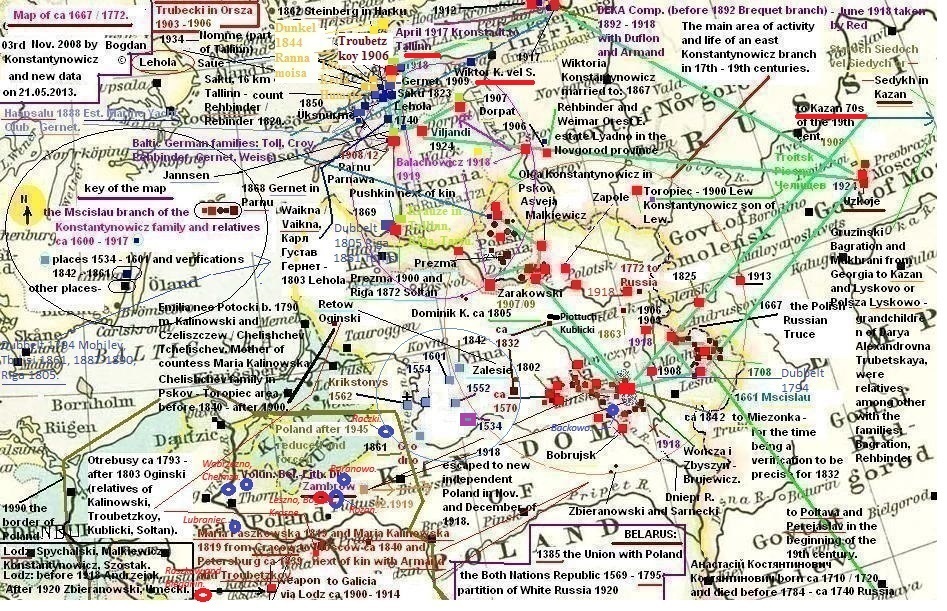
This the same genealogical Kielczewski line as Pola Negri married Dambski and her mother Eleonora Chalupec (Kielczewska) b. in 1861 in Brdo / Babiak close to Kolo [around me was a girl, spy of KOLO around 2018/2020], d. in 1954 in Beverly Hills. Eleonora's line came from Maciej Kielczewski, the son of Wojciech Kielczewski b. aft. 1700 / ca 1715, and the grandson of Jan Kielczewski b. ca 1670, d. in 1757, and 2nd wife Marianna. Jan older = Jan Kazimierz KIELCZEWSKI was born ca 1670. Eleonora Kielczewska married Chalupec in Lipno, but her husband came from Zilina in Slovakia, the Austria-Hungary Empire. The Shaposhnikov family come from Zilina and they were intermarried to the Armand family in Moscow. The Armands intermarried General Franciszek Maksymilian Paszkowski's daughter, Maria Wilhelmina Paszkowska b. 1819 in Greater Poland. The Shaposhnikovs acted for Russian intelligence net aft. 2000, linked Zilina with Thessaloniki and Bulgaria. Around Bogdan Konstantynowicz acted a man b. ca 1990 of Zilina ca 2014-2016. Gvantsa Tarashvi. of Tbilisi cooperated with Polish Foreign Ministry under Witold Waszczykowski of Piotrkow Trybunalski and of Lodz, together with Bielsko-Biala and named Zilina of Slovakia. So, Russian espionage net in Zilina was working around 1890s-2024 but aft. 2014 under support of Tczew-Sawin-Katowice underground close to me. And below big genealogical research of Bogdan Konstantynowicz.
Bogdan Konstantynowicz's grandparents:
1.
Zofia Plaszczewska b. 16 March 1904 in Wilno, the St Rafal parish, the blue-grey eyes, m. on 07 September 1924 in Wilno to Jerzy Konstantynowicz aka Marian Stankiewicz vel Marian Konstantynowicz/Yuri Konstantinovich b. 23 April 1898 in Tallinn or April 1897 in Tallinn, Ortodox, and named Zofia Konstantynowicz moved home in 1924 to Lida, the 77th Infantry Regiment's garrison till 15 September 1939; since 22 September 1939 in Wilno, on 22 February 1945 moved home to displaced persons camp close to Grodno, since May 1945 in Lodz, the Kosciuszki Str with help of the Andrzejak family, died in August 1987 in Lodz - her son Edward Gwidon Konstantynowicz was killed in the same home at the corner of Skladowa Str/Kilinskiego Str by Wojciech the counter-intelligence agent on the night 02/03 November 1987.
2.
Jerzy Konstantynowicz b. in 1897 in Tallinn, with false data: b. in Miezonka on 23 April 1898, or in Pogost/Pohost close to Berezyna, either in Warsaw in 1898, or in 1900 in Miezonka, with foster parents - Stanislaw Konstantynowicz the owner of Miezonka + Anna Malkiewicz; Jerzy was the son of Wiktor Konstantynowicz b. 1874 in Kazan + Staroch-Siedoch/Starykh-Siedykh of Kazan, the grandson of General Wasyl Konstantynowicz + Dss Maria Trubecka, the great-grandson of Maria Kalinowska Css, Dominik Konstantynowicz b. ca 1800 + Oktawia Piottuch-Kublicka 1-voto Szumska with her roots from Duke Stanislaw Radziwill b. 1722. Named Jerzy or Marian Konstantynowicz has scare under knee, the A blood group, only 160 cm, Colonel of intelligence with the Colonel uniform in the morning of 18 September 1939 as Colonel Piotr Siedlecki then in Grodno, Zawiasy, Palanga, the Kola Penninsula, Arkhangielsk, the General Anders Army, Cassino battle in 1944, after June 1944 till Spring 1947 in Italy; then in Buenos Aires in 1947-1953, Berisso/La Plata close to Buenos Aires in 1954, after 1955/1956 in Mexico. Jerzy Konstantynowicz aka Marian Konstantynowicz was Polish soldier on 04 December 1918 in Lapy, then Zambrow, Wilno in December 1918/January 1919, and he was soldier till 01 May 1947 in Genua in Italy. He was in Genua and Rome till November 1947. Above Dss Maria Trubecka Konstantynowicz of Kazan and then in Tallinn came from Grigory Troubeckoy / Grzegorz Trubecki, the son of Piotr Nikolaievich Troubetzkoy / Prince Petr Nikolaevich Troubetskoy born 18 November 1773 and died 16 November 1801 (or 1840) + Nadezhda Ivanovna Pestov / nee Pestova born 1793. Grigory Trubecki married Maria Kalinowska / countess Maria Kalinowska was born after 1805 or ca 1819. Grigorij Petrovich Trubecki settled before 1832 in the Kingdom of Poland. Maria Kalinowska was the daughter of Emilia Potocka b. 1790 married Kalinowski and second time married to Czeliszczew - Maria's father was Josif / Jozef Kalinowski / Osip Kalinowski b. after 1780 and died 1825; the grandfather was Seweryn Ksawery Kalinowski b. 1759 + Elzbieta Bielska from Olbrachcice b. ca 1760. Compare famous conspirator Jozef Kalinowski b. 01 Sept. 1835 in Vilnius / Wilno, his father Andrzej Kalinowski b. 10 Dec. 1805 or January 10, 1805 in Grodno and died in Hrozow 1878 (Trokiele), the Wilno Uniw.; his grandfather Jerzy Kalinowski b. ca 1780 or 1773 by wife Dorota Kulakowska - Kosciesza / Rosciesza; the great-grandfather Krzysztof Kalinowski - b. ca 1738/1750. Above Seweryn Ksawery Kalinowski b. 1759, was the son of Ignacy Kalinowski + Justyna Borzecka. Ignacy Kalinowski, 1720-1782, the son of Jozef Jan Walenty Kalinowski + Anna Firlej. Seweryn Ksawery Kalinowski was born 1759, married in 1780 to Elzbieta Bielski from Olbrachcice born ca 1760 with children: 1. Josef / Osip Kalinowski / JOZEF KALINOWSKI - general of Polish Army, b. ca after 1780, died 1825 - his wife Emilia Potocka born 1790, 2. Ignacy Franciszek Kalinowski b. 1784 d. 1831 and 3. Justyna Kalinowska married Russocka b. 1790 d. 1876. Jozef Kalinowski, ca 1780/1790-1825, the owner of Kamionka Wielka, Machnowka, Lubar, Udnow + Emilia Potocka b. ca 1791 in Guzow; the daughter of Prot Antoni Potocki, 1761-1801, the owner of Machnowka in the Berdyczow county. Prot Antoni Potocki b. 1761, the governor of Guzow, Kyiv till 1795, married Marianna Elzbieta Potocka, Zubow, Uwarow, nee Lubomirska b. in 1766, and Prot was a Warsaw banker and the owner of Cudnow/Chudniv and Makhnivka, the son of Jan Prosper Potocki + Paulina nee Szembek / Paula Oginska b. 1737 in Minoga, d. 1798, married 1st Celestyn Lubienski. Paula married three times: Lubienski, Oginski, Potocki. Paula had 4 children: Feliks Lubienski, Antoni Protazy Potocki, Michal Kleofas Oginski, and Jozefa Zofia.
3.
Piotr Golec, b. on 04 March 1904, in Lodz, the Wieckowskiego Str. The blood group 0 Rh+; bright black hair, blue eyes, in 1915-1918 in Wola Pszczolecka, in 1921 he was working for 'Brothers Klos'; in 1932 the private business, then private 'Gerlach' shop confiscated in June 1943 by Germans, in Summer 1944 Piotr Golec hid himself; he was taken by Red Army on 19 September 1939 east of Lwow close to Krasne, served the 'Dubno' unit and fought against Soviet Army 17-19 September 1939, died 20 October 1984 in his home in Lodz - this home was confiscated by soviet counter-intelligence in 1949 and here was sent Halina Jawors. b. in Leszno village as Halina Wodkiewicz, semite, and her great-grandson was living at Krokusow. 57 in Lodz, ca 2015 at Learoyd 1, then at Wi. 137 second floor with his friends of Pieniny 20 in Lodz/Burngat. 17/Tatna. 1B/Winterbourne 45, the friends of T. Cieslak of Krokusow. 72A in Lodz.
4.
Cecylia Grzanek vel Grzonek, the daughter of Agnieszka Skura vel Skora, b. 21 October 1909 in Lodz, the blood group A Rh+, the brown eyes, the very black hair, m. in Lodz on 27 May 1928, with two children, among others Lucjan Golec b. 30 March 1930, Colonel of Polish Army in Warsaw. Cecylia died on 17 May 1985 in Lodz, buried at 'Kurczaki' cementery.
Bogdan Konstantynowicz's great-grandparents:
1. Jan Golec b. 1866 in Wola Wiazowa, worked in Faustynow aft. 1882, carpenter, since 1892 in Lodz, in 1893 married Teofila Rogaczewska of Wola Pszczolecka, and Jan Golec died on 08 December 1907 in Lodz, buried the 'Zarzew' cementry in Lodz.
2. Teofila Rogaczewska, b. 02 April 1870 in Wola Pszczolecka, the Wygiezow parish, till 1892 she had the shop in Wola Pszczolecka, then in Lodz, died in December 1957, buried at the St Franciszek cementry in Lodz.
3. Wincenty Grzanek vel Grzonek, b. 06/07 October 1876 in Czarnocin the 1st No 22, married 21 May 1904, Catholic, soldier of Russian Army in 1900-1904 and again 1904-1906 in Chinese war at Manchuria, died on 30 March 1933. Wincenty Grzanek / Wincenty Grzonek was the son of Tomasz Grzonek / Grzanek, b. ca 1850, resident of Czarnocin 1st No 22 + Agnieszka Jakel / Jakiel.
4. Agnieszka Skora vel Agnieszka Skura, born on 08 January 1883, in Krery 8 km to Przedborz, the Chelmo parish, since 1900 worked at 'Gayer' factory in Lodz, lived at Wysockiego 4 in Lodz and Sasiedzka 6, married in Lodz on 21 May 1904, died on 20 March 1958, buried at the 'Kurczaki' cementery in Lodz. Agnieszka was the daughter of Kazimierz Skura / Skora, resident of Krery, m. Magdalena Nowak, died in 1947/1948 in Krery.
5. Wiktor Konstantynowicz aka Wiktor Staroch Siedoch born on 20 October 1874 in Kazan vel 'Konstantyn'; the son of General Wasyl Konstantynowicz of Kazan b. ca 1834/1840 (in Babianowszczyzna/Buhta close to Minsk in Belarus) and his wife Maria Trubecki / Duchess Mary Trubetskaya / Troubetzky born ca 1840 in Cracow/before 1853, the daughter of Css Maria Kalinowska Trubecka; the grandson of Dominik Konstantynowicz b. ca 1800, the landlord of Miezonka/Miazonka in 1842 married Oktawia Piottuch-Kublicka 1-voto Szumska, from the Dukes Soltan and she came from Duke Stanislaw Radziwill born 1722; the great-grandson of Wincenty Konstantynowicz of Buchta/Baguta/Babianowszczyzna b. ca 1775.
6.
Alexandra Nikolaevna nee Starych Siedych / Sedykh / Siedoh, born 03 February 1877 in St Petersburg, Ortodox, the daughter of Nikolai Ivanov Starych Siedych / Sedykh / Siedoh + Olga Ryabchinskaya / Olga Riabczynski b. ca 1845. Aleksandra Siedoh m. Wiktor Konstantynowicz vel Staroch Siedoch lived on 09 June 1934 in Estonia, Nomme, the Harku street No (tn) 28-2 and she was buried in the cemetery Hiiu-Rahu. Above named Starych Siedych Victor Konstantynowicz born 1874, in service since 1904, an officer since 1912, 'ensign' that is praporschik by Admiralty, in November 1917-May 1919 served the Balachowiczs, in the North - Western Army of White movement enlisted on May 20, 1919 served General Rodzianko, and in December 1919 at the headquarters of the 4th Infantry Division in Narwa, then in Viljandi in 1920s. In 1917 Wiktor Konstantynowicz was living in Peterburg / St. Petersburg but on June the 14th, 1924 they lived in the town of Viljandi, southern Estonia.
My great-great-grandmother was Olga Vasilievna Ivanova (Ryabchinskaya, b. ca 1845, m. 2nd Starych Siedych) has relatives who came from Gavrila Izylmetyev who had at least two sons:
Nikolai Gavrilovich IZYLMETYEV (1778-1850) with his wife Elena Vasilyevna (died 1865) and Dmitry Gavrilovich IZYLMETYEV (b. bef. 1785, died 1838) with his wife Ekaterina Savelyevna (born 1805) - both were sailors: the first a major general, the second a lieutenant general.
Fyodor Dmitrievich IZYLMETYEV b. 1832, joined the naval cadets in 1843; his relative Ivan Nikolaevich IZYLMETYEV (1813-1850), the son of named Nikolai IZYLMETYEV b. 1778, and named here Ivan b. 1813, fought in Petropavlovsk-Kamchatsky, is buried with the rank of rear admiral in Tallinn.
7.
Rachela Pilecka, b. ca 1869, the family of Witold Pilecki. Rachela was the mother of Zofia Konstantynowicz and the grandmother of Edward Gwidon Konstantynowicz. We back to Dominik Konstantynowicz b. ca 1800, the landlord of Miezonka in 1842, m. second to Oktawia Piottuch-Kublicka 1-voto Szumska, and Oktawia came from Duke Stanislaw Radziwill b. 1722. Dominik's youngest son was Ludwik Konstantynowicz born ca 1853, noble family, confirmed in 1853 in Minsk Litewski, the Fox coat of arms, the landlord of Borowina / Borowica manor in the Berezyna parish. Ludwik's older brothers: Antoni Konstantynowicz b. ca 1833 and General Wasyl Konstantynowicz b. ca 1835. Wasyl's sons: Wiktor Konstantynowicz b. in Kazan in 1874, and Apollon Konstantynowicz b. 1864 in Kazan. Antoni's sons: Jozef Konstantynowicz married in Swolna to Css Zarako-Zarakowska and next son Stanislaw Konstantynowicz, then landlord of Miezonka, m. Anna Malkiewicz. I back again to above named Colonel Gustaw Stankiewicz, the son of Marian Stankiewicz older from the Siedlce government b. ca 1830; and Gustaw Stankiewicz was born in 1860 - died in 1918 in Ukraine, who was maybe commandant of the 2nd Polish Corps in Ukraine in accordance with Nicman of 1995 and with a Moscow Archive of 2000, and Gustaw Stankiewicz died in 1918 over a fight against "reds" somewhere in Ukraine. My grandfather had nick-name Siedlecki in 1939 and he sent many letters to Siedlce in 1920-1930s. Maybe Gustaw Stankiewicz had a son b. ca 1890 and he is Stankiewicz married the woman-dentist of Warsaw b. ca 1900. They had the son Edward Stankiewicz b. ca 1925 - this line intermarried to the Plaszczewski-Konstantynowicz family. My uncle Jan Konstantynowicz took surname Jan Stankiewicz in 1944, but in 1950s communists figured it out. Jan Konstantynowicz said that he was a son of Marian Stankiewicz b. ca 1898/1900. We know on Edward Stankiewicz b. on 24 December 1925, died in May 1980 in Szczawno Zdroj. The commander of Witold Pilecki - my relatives, Adam Ostoja / Adam Ostoja Owsiany older, and of Bohdziewicz - my family (by the sister of Zofia Plaszczewska married Jerzy / Marian Konstantynowicz), was Colonel Zygmunt Bargiel. Witold Pilecki had many artistic talents. Witold b. 1901 in Oloniec / Olonets in Russian Karelia, the son of Ludwika Osiecimska and Julian Pilecki, the grandson of Lucjan Osiecimski b. ca 1837 + Wanda Majewska b. ca 1846; Jozef Pilecki, 1827-ca 1905 + Flawia Zurawska b. ca 1834 in Wawiorka close to Woroniewo in Russia; the great-grandson of Narcyz Zurawski b. ca 1800; January Majewski b. 1799 in ROWINY in the Woroncza parish + Katarzyna MOSZYNSKA b. ca 1820. Above Julian Pilecki b. 1860/1870, died in 1932 in Sukurcze, near Lida. Julian was the brother of Rachela Pilecka Plaszczewska b. ca 1869 and to Salomea Tumilewicz b. 1864. Rachela Plaszczewska was the daughter of Flawia Zorawska b. 1835 in Wawiorka, the Radziwoniszki parish in the Lida county. Flawia Zurawska married Jozef Pilecki. Flawia Pilecka Zurawska was the daughter of Narcyz Zurawski who married twice: the 2nd to Karolina HORWAT / Hojwalt / Houwalt b. 1827, the daughter of Benedykt Hojwalt vel Houwalt; the 1st in Rozana in 1825 to Salomea Kielczewska b. ca 1807, died in 1848 in Wawiorka, the Radziwoniszki parish. Salomea was living in Wezowszczyzna in the Zabloc parish, the Lida county; in Jarylowka manor in the Mscibow parish in the Lida county; in Wawiorka and in Wilno.
8.
Antoni Plaszczewski. My grandmother Zofia Plaszczewska married Jerzy Konstantynowicz, was tha daughter of Antoni Plaszczewski b. ca 1865, the Mejszagola district, and his wife Rachela Pilecka b. 1869. Antoni Plaszczewski born ca 1865 or in 1870, in 1907 in Wilno, Mala Obozowa Rd 207, bought from Marek Losiew in Wilenska Wies, and Antoni Plaszczewski was carpenter, served Polish underground network bef. 1918; Antoni Plaszczewski b. ca 1865 was the son of Jan Plaszczewski, b. ca 1840, inf, in 1907. Mentioned Rachela Pilecka b. ca 1869, the family of Witold Pilecki. Rachela Plaszczewska Pilecka was the mother of Zofia Konstantynowicz and the grandmother of Edward Gwidon Konstantynowicz. Antoni Plasczewski's family intermarried to Dominik Konstantynowicz's family, the landlords of Miezonka in 1842-November 1918. Dominik's youngest son was Ludwik Konstantynowicz born ca 1853, noble family, confirmed in 1853 in Minsk Litewski, the Fox coat of arms, the landlord of Borowina / Borowica manor in the Berezyna parish. Ludwik had two older brothers: Antoni Konstantynowicz b. ca 1833 and General Wasyl Konstantynowicz b. ca 1835. Antoni's sons: Jozef Konstantynowicz married in Swolna to Css Zarako-Zarakowska and next son Stanislaw Konstantynowicz, then landlord of Miezonka born ca 1855, m. Anna Malkiewicz of Oswiej and of Stara Swolna. I back again to above named Colonel Gustaw Stankiewicz, the son of Marian Stankiewicz older from the Siedlce government b. ca 1830; and Gustaw Stankiewicz was born in 1860 - died in 1918 in Ukraine, who was maybe commandant of the 2nd Polish Corps in Ukraine in accordance with Nicman of 1995 and with a Moscow Archive of 2000, and Gustaw Stankiewicz died in 1918 over a fight against "reds" somewhere in Ukraine. My grandfather had nick-name Siedlecki in 1939 and he sent many letters to Siedlce in 1920-1930s. Maybe Gustaw Stankiewicz had a son b. ca 1890 and he is Stankiewicz married the woman-dentist of Warsaw b. ca 1900. They had the son Edward Stankiewicz b. ca 1925 - this line intermarried to the Plaszczewski-Konstantynowicz family. My uncle Jan Konstantynowicz took surname Jan Stankiewicz in 1944, but in 1950s communists figured it out. Jan Konstantynowicz said that he was a son of Marian Stankiewicz b. ca 1898/1900. We know on Edward Stankiewicz b. on 24 December 1925, died in May 1980 in Szczawno Zdroj. The Plaszczewski family intermarried the Konstantynowiczs. But the Konstantynowicz family intermarried the Zarako-Zarakowskis of Swolna-Holubowo-Kniaziewo estate. Here in Swolna was born Stanislaw Zarakowski who was the man to order the presiding judge to sentence Capt. Witold Pilecki, the "hero of Auschwitz" to the death penalty, according to 'IPN' institute. In 1918 his family's estate of Holubowo-Swolna was nationalized during the Bolshevik revolution. They moved to Vilnius in 1918. Stanislaw Zarakowski was assigned a job with the Chief Military Prosecutor Office and quickly rose to become the Chief Military Prosecutor of the People's Republic of Poland till 1956. Remember: Zofia Plaszczewska married Jerzy Konstantynowicz aka Marian Stankiewicz/Marian Konstantynowicz, was the daughter of Rachela Pilecka married Plaszczewska, linked to the Bohdziewicz-Stankiewicz-Kaminski line of Baranowicze and Wilno. The Pileckis had a estate west to the Lida garrison of the 77th Infantry Regiment. This estate bordered the Thompson-Rydz Smigly land till September 1939. Count Jozef Zarakowski / Zarako - Zarakovski, born ca 1833 (like Antoni Konstantynowicz b. ca 1833), the owner of Holubowo palace, Kniaziewo estate, big Swolna lands (close to Stara Swolna, here the Malkiewicz family, they came from 'Polish Livland/Polskie Inflanty', Oswieja / Osvej, and then in Miezonka, Anna Malkiewicz m. Stanislaw Konstantynowicz - the foster parents of my grandfather Jerzy Konstantynowicz aka Marian Konstantynowicz born in Tallinn), Wasilewo village in the Dryssa ujezd, the Witebsk government, Russia.
Ryabchinsky, Andrey Fedotovich, the 1st Finnish Rifle Regiment until December 1918, in Russian volunteer units in Ukraine, then in the Northwestern Army - enlisted on July 10, 1919; August 6, 1919 in the 3rd Rifle Regiment of the 5th (Livny) Division; in December 1919 in the 19th Poltava Infantry Regiment.
Ryabchinsky Boris Petrovich, Second Lieutenant, the Russian Western Army in the 1st Plastun Regiment from August 10, 1919.
Ryabchinsky Vasily Grigorievich, b. 1885 in the town of Pulina, the Volyn Province, participant in the White movement.
Ryabchinsky, Konstantin Grigorievich, b. 1896 in the village of Toroshcha, the Volyn Province, participant in the White movement. Ryabchinsky, Mikhail Semenovich, b. 1880 in the village of Kozin, Kyiv Province. Ryabchich Mikhail Andreevich, b. 1883 in the Kyiv Province. RYABCHINSKY GRIGORY ANTONOVICH, born in the Rostov region, the Taganrog district, Gorskaya Parada village, died in 1943. Ryabchinsky, Konstantin Grigorievich b. 1897 in the Shepetivka district, the Chernya village, priest, arrested in 1930. RYABCHINSKY Grigory Pavlovich, born in 1881, lived in the village Loris-Melikovo, the Nazyvaevsky district, the Omsk region. He was sent to a special settlement with his family in 1930 in the Vasyugan region. Pavel Ryabchinsky b. ca 1850.
The Ryabchinsky family intermarried the Staroch Siedoch of Kazan in 1870s, Ortodox; they had a daughter b. 1877 who married Wiktor Konstantynowicz of Viljandi and Tallinn-Nomme born in 1874. Wiktor's brother was Apollon (Apollo, Apellon) Wasylewicz Konstantynowicz b. 1864, the sons of Wasilij Konstantynowicz / Wasyl Konstantynowicz who was born ca 1833;
the grandsons of Dominik Konstantynowicz of Miezonka / Miazonka aft. 1842, b. ca 1800/1805 (in 1802 in Babianowszczyzna/Baguta/Buchta).
Above the Balachowiczs and Bogdan Konstantynowicz's ancestors in Estonia:
on 11-21 October 1917, the German Army occupied the West Estonian archipelago, Moonsund archipelago. The German forces occupied Valga (Walk) on 22 February 1918, and Parnu (Pernau), Viljandi (Fellin) and Tartu (Dorpat) on 24 February 1918. Tallinn (Reval) was occupied on 25 February 1918. The Estonian Provisional Government had declared the country independent on 24 February 1918 in Tallinn.
Stanislaw Balachowicz served also under command of Bolsheviks since November 1917, e.g. struggles with Germans by the Lake Pejpus (= Peipus) near by Smolowa (= Smolva) on March 05th, 1918, where Stanislav Balachowicz was wounded and next transferred to Petersburg; next he was sent to Luga near by Petrograd (135 Km south of Petrograd); he was loyal towards Bolsheviks. In the middle of December 1917, Stanislaw Bulak - Balachowicz (i.e. Stanislaus Bulak-Balachovitch) had contacted his brother Jozef Balachowicz in Petrograd, and again in April 1918 (Petrograd, at military hospital, here also was Jerzy Dabrovski or Dambrowski). Stanislaw Balachowicz next, in April 1918, received assent at Bolshevik's hands in Moscow for forming of Polish cavalry regiment; he was General then, with support of count de Lubersac from the French Mission.
In May 1919 - Wiktor Konstantynowicz in Gdow with the Balachowiczs.
May 1919 - in Gdow, Wiktor Konstantynowicz changed troops, from the Balachowiczs to Yudenich (the 'Whites' under Rodzianko).
Stanislaw and also Jozef Balachowicz fought against baron Korf near by Luga (131 Km NE of Pskow) in May 1918; in this regiment served: Bohdan and Jerzy Dabrowski (Jerzy Dabrowski was friend of Stanislaw Balachowicz and his wife Zinajda - after 1935 she lived in Wilno), Chodorowicz, Wolkowiecki, Szumski (= Shumskij), Wawrzynski, Safaryn, Poljan, Michulski, Michalowski, Kozlowski, Karlowicz (related to Gen. Stanislaw Bulak Balachowicz).
Stanislaw and Jozef Balachowicz's regiment had thrown off superiority of Bolsheviks at the end of May 1918 and moved on Pskov (= Pskow). Balachowicz brothers had fought with Bolsheviks near by Pskov for June - till October 1918.
In November 1917 Wiktor Konstantynowicz in Petersburg, then under Jozef Balachowicz till May 1919.
In May 1918: both of brothers Jozef Balachowicz and Stanislaw Balachowicz served in Luga in own unit and revolted against Bolsheviks in the same month. Here my great-grandfather Wiktor Konstantynowicz.
In June - October 1918: Jozef and Stanislaw Balachowicz fought near by Pskov and next conquered the town at the end of October 1918 (alongside white Gen. Dragomirow), for two days only. The Balachowicz's regiment fell back over axle Izborsk - Pieczery (= Petschory, 41 Km west of Pskow i.e. Pskov); Courland was destination. The regiment got in touch with Gen. Wandam in the first half of November 1918 and was disarming Germans, that went back to home. The Balachowiczs conformed to the Estonian Army of Gen. Laidoner in the middle of November 1918 until March 01st, 1919, near by Dorpat (i.e. Tartu or Juriew); struggles broke out again with Bolsheviks close to Dorpat in January 1919, too. The Balachowicz's group conformed to white Gen. Rodzianko on March 02nd, 1919 (in the Army of Gen. Yudenich).
Jozef Balachowicz was appointed to Russian colonel in March 1919.
The struggles with Bolsheviks again since May 1919, and Stanislav Balachowicz conquered the Gdow (103 Km north of Pskow) station during offensive of Gen. Yudenich for Petrograd on May 13th, 1919; after conquered Pskov (= Pskow) on May 29th, 1919; the Balachowicz's group administered Pskov since June till August 1919 (until August 23rd); after had clashed with Gen. Yudenich and proceeded in guerrilla war against all: "reds" and "whites", near by Pskov - Werro (Voru probably, 36 Km west of Petschory) - by Velikaja river (here in September and October 1919 together with Estonian Army).
Wiktor Konstantynowicz in May 1919 in Gdow served Yudenich/Rodzianko.
On 25 May 1919 Estonians took Pskow. On 13 June 1919 battle at Krasnaya Gorka south-west to Kronstadt. 29 August 1919 White Russian and Estonian withdrew from Pskow;
in November - December 1919 the 4th Division together with White Russian fought around NARWA until armistice on 03 January 1920. Here my great-grandfather Wiktor Konstantynowicz.
My great-grandfather Wiktor Konstantynowicz served Jozef Balachowicz in November 1917 in St Petersburg. Jozef was the brother of Stanislaw Balachowicz. On March 2, 1919 in Estonia, Balachowicz's group subordinates itself to Russian General Rodzianko (White). On May 13, 1919, Balachowicz captured the Gdow station during Yudenich's Petrograd offensive (all communists in Gdow were hanged on telegraph poles). On May 29, 1919, Rodzianko captured Pskov by raiding from the north. On 21 May 1919 beginning of battle south-west to Petrograd. On 23/29 August 1919 White Russian and Estonian withdrew from Pskow; the Balachowicz's group administered Pskov since June 1919 till August 1919 (until August 23rd); after Balachowicz had clashed with Gen. Yudenich. In November-December 1919 the 4th Division together with White Russian fought around NARWA until armistice on 03 January 1920. Wiktor Konstantynowicz served of the North-Western Army of White movement enlisted on May 20, 1919 in GDOW and in December 1919 at the headquarters of the Estonian 4th Infantry Division in NARWA.
Stanislaw Balachowicz received permission to form a cavalry regiment in Luga from communist goverment in 1918. Balachowicz's troops, together with Estonian troops under General Johan Laidoner, liberated Gdow in May 1919 and captured Pskov. Stanislaw's father, Nikodem Balachowicz, leased the Skotopijewo farm near Maiszty/Mejszty. Nikodem and his wife Jozefa were associated with the Maiszty estate, where they both found employment as support staff. The Balachowicz family was Catholic and Stanislaw had six sisters and three brothers, of whom Jozef Balachowicz, eleven years his junior, later became his subordinate in 1918-1920. Stanislaw Balachowicz practiced on the Mejszty estate, and then for ten years, until the outbreak of World War I, worked as administrator of the Horodziec-Luzki estate owned by the Zyberk-Plater family. Horodziec-Luzki is situated in the Todayno district. Here was the Plater Manor and Park of Jan Plater- Zyberk with his wife Roza. Horodziec is a village in the Sharkivshchyna District of Belarus (Luzhki village). Horodziec now is in the Vitebsk Oblast, the Sharkivshchyna District, the Luzhki village.
Above Jan Tadeusz Plater-Zyberk b. 1908 in Horodziec, d. in 1980, Lausanne, married in 1935, in Warsaw. Jan Tadeusz Maria Plater-Zyberk was the son of Wiktor Kazimierz Konstanty Plater-Zyberk + Maria Plater-Zyberk. Jan Tadeusz married Roza Maria Gabriela Swiatopelk-Czetwertynska. Above Maria Plater-Zyberk (Michalowska), 1872-1964, born in Blonie, the daughter of Count Tadeusz Michal Plater-Zyberk + Zofia Aleksandrowicz / Witold-Aleksandrowicz. Maria married twice: Count Wiktor Kazimierz Konstanty Plater-Zyberk and Jozef Kokoszka-Michalowski.
Above Tadeusz Michal Plater-Zyberk, 1843-1918, born in Veisiejai in the Lozdzieje / Lazdijai District, of the Olita / Alytus County, died in Wojcieszkow in the Lublin province.
Tadeusz Michal was the son of Kazimierz Bartlomiej Plater-Zyberk + Ludwika Teodora Eleonora BORIEWICZ.
Mentioned Wiktor Kazimierz Konstanty Plater-Zyberk, 1855-1918, born in Liksna, d. in Vilno, the son of Henryk Waclaw Ksawery Plater-Zyberk + Adelajda KELLER.
Named above Henryk Waclaw Ksawery Plater-Zyberk, 1811-1903, born in Liksna, now Latvia, died in Kraslava.
The son of Michal Plater-Zyberg + Izabella Helena ZYBERG.
Mentioned above Michal Plater-Zyberg / Broel-Plater, 1777-1862, took the Zyberg coat of arms of his wife, died in Schlossberg in the Courland Duchy, was the son of Kazimierz Konstanty Broel-Plater.
The Bolshevik coup d'etat on 07/08 November 1917 found Stanislaw Balachowicz hospitalized in Petrograd, holding the rank of staff captain, he decided to remain in the army under communist control. In November 1917-till May 1918, he was in Petersburg / Petrograd, and he was sent from Petrograd at the head of a cavalry regiment to suppress peasant unrest in the Luga region. Then he was summoned to Petrograd, but he received a warning from friends that he would be murdered by the Bolsheviks upon his arrival. Stanislaw fought against Russians since May 1918 till the last days of 1920. In 1920 after some initial success, the force withdrew from Belarus. Jews suffered greatly at the hands of the General Bulak-Balachowicz during battle of Yurevichi in 1920. Stanislaw Bulak-Balachowicz fought against Red Army in September 1939 around Zelechow and Praga-Otwock area. He died in 1940. In 1919, he commanded a regiment in the North West Corps, part of the army of General Nikolai Yudenich. In August 1919, Bulak-Balachowicz was discharged from the White Army. Pilsudski said of him that in many cases he beat Bolsheviks better than staff generals.
After the German Revolution, between 11 and 14 November 1918, the representatives of Germany handed over political power in Estonia to the national government. As the departure of German troops in November 1918 left a void, the Russian Bolshevik troops invaded Estonia. The Baltic-German units established before the agreement was concluded. In the city of Rakvere, the 5th Estonian Regiment had established the Baltic-German Mounted Machine-Gun Commando under Colonel Konstantin Weiss, the later commander of the Baltic Battalion. In the city of Viljandi, a Baltic-German militia (Heimatschutz) squad had been established, led by Captain Viktor von zur Muhlen.
On 18 December 1918, the Viljandi and Tartu militia squads were combined to form the Tartu Baltic Battalion, under the command of Captain Viktor von zur Muhlen. Talks with Russia continued through December 1919, while heavy struggle continued at Narva. The peace treaty was finally concluded on 31 December 1919, and the ceasefire came into effect on 3 January 1920.
On 2 February 1920, the Peace Treaty of Tartu was signed by the Republic of Estonia and Russia. In 1921 the 4th Estonian Division was based on the post-War of Independence structure since February 1920.
The 4th Division of the Estonian Defence Forces was established to cover Parnu and Viljandi Military District and Valga Military District in 1920. Following the signing of the Treaty of Tartu on February 2, 1920, the military underwent restructuring into division-based districts.
In 1920-1921 the 4th Division stayed in Parnu and Viljandi - here my great-grandfather Wiktor Konstantynowicz in staff of Division. In 1921 the 4th Division was disbanded, and my great-grandfather Viktor Konstantynowicz remained in the skeleton divisional headquarters in Viljandi, and here Viktor Konstantynowicz remained in 1922-1924.
In 1930th Wiktor Konstantynowicz moved home to Nomme to his daughter Galina Dunkel nee Konstantynowicz and her two children.
But in December 1934 Galina's husband Balduin Heinrich Dunkel was murder.
In 1922, two years after the war, the army consisted of 3 field divisions, but the divisional district system (including the 4th Division) was integral to the post-war territorial defense planning. A reorganisation took place on 1 February 1940 and a fourth division was created again in Viljandi. The division was made up by the Parnu-Viljandi Military District under Colonel Jaan Maide.
Jozef Balachowicz had withdrawn from Russian Army near by Riga on October 12th, 1917 and next served in Polish troops of the 1st Polish Corps in Pskov (under command of Gen. Jozef Dowbor Musnicki and collaborated with Gen. Jacyna from Petrograd, October / November 1917). Jozef Balachowicz was transfered to Petrograd in the middle of November 1917, keep on within the 1st Polish Corps.
Jozef maybe had gotten married in Petrograd 1918, and also met brother in Petrograd in December 1917.
Jozef Balachowicz served in Petrograd in a Polish cavalry troop under command of Przysiecki and was disarmed by Bolsheviks in December 1917. All details are lacking about Jozef Balachowicz since January 1918 until the beginning of May 1918, probably in Petrograd or together with his brother Stanislaw after March 1918; Jozef was then in Luga, in May 1918.
In November 1917 Wiktor Konstantynowicz in St Petersburg served to Jozef Balachowicz. Wiktor together with Jozef Balachowicz since January 1918 until the beginning of May 1918, probably in Petrograd or with Jozef Balachowicz and Stanislaw Balachowicz in March 1918; then Jozef Balachowicz was in Luga, in May 1918.
In May 1919 - Wiktor Konstantynowicz in Gdow with the Balachowiczs.
May 1919 - in Gdow, Wiktor Konstantynowicz changed troops, from the Balachowiczs to Yudenich.
Stanislaw and also Jozef Balachowicz fought against baron Korf near by Luga (131 Km NE of Pskow) in May 1918; in this regiment served: Bohdan and Jerzy Dabrowski (Jerzy Dabrowski was friend of Stanislaw Balachowicz and his wife Zinajda - after 1935 she lived in Wilno), Chodorowicz, Wolkowiecki, Szumski (= Shumskij), Wawrzynski, Safaryn, Poljan, Michulski, Michalowski, Kozlowski, Karlowicz (related to Gen. Stanislaw Bulak Balachowicz).
Stanislaw and Jozef Balachowicz's regiment had thrown off superiority of Bolsheviks at the end of May 1918 and moved on Pskov (= Pskow). Balachowicz brothers had fought with Bolsheviks near by Pskov for June - till October 1918.
In November 1917 Wiktor Konstantynowicz in Petersburg, then under Jozef Balachowicz till May 1919.
In May 1918: both of brothers Jozef Balachowicz and Stanislaw Balachowicz served in Luga in own unit and revolted against Bolsheviks in the same month. Here my great-grandfather Wiktor Konstantynowicz.
In June - October 1918: Jozef and Stanislaw Balachowicz fought near by Pskov and next conquered the town at the end of October 1918 (alongside white Gen. Dragomirow), for two days only. The Balachowicz's regiment fell back over axle Izborsk - Pieczery (= Petschory, 41 Km west of Pskow i.e. Pskov); Courland was destination. The regiment got in touch with Gen. Wandam in the first half of November 1918 and was disarming Germans, that went back to home. The Balachowiczs conformed to the Estonian Army of Gen. Laidoner in the middle of November 1918 until March 01st, 1919, near by Dorpat (i.e. Tartu or Juriew); struggles broke out again with Bolsheviks close to Dorpat in January 1919, too. The Balachowicz's group conformed to white Gen. Rodzianko on March 02nd, 1919 (in the Army of Gen. Yudenich).
Jozef Balachowicz was appointed to Russian colonel in March 1919.
A short explanation to General Rodzianko, Wiktor Konstantynowicz and of Stanislaw Balachowicz:
from November 1915, Staff Captain Stanislaw Bulak-Balachowicz commanded a cavalry squadron of a partisan unit attached to the Northern Front headquarters near Riga.
Stanislaw's brother Jozef Balachowicz and Wiktor Konstantynowicz (also Stanislaw Szostak of Miezonka) were in St Petersburg in November 1917. Following the Brest-Litovsk Peace Treaty on March 3, 1918, Staff Captain Stanislaw Bulak-Balachowicz detached his troops under pressure from German forces, marched into the Bolshevik area of operations. By order of Leon D. Trotsky, in early summer 1918, Stanislaw Balachowicz formed the Luzhsk Cavalry Guerrilla Regiment based on his subordinates. In July 1918, Stanislaw's unit was assigned to suppress anti-Bolshevik peasant revolts close to Luga and Struga Belye. By the end of October 1918, Stanislaw's regiment had reached over 1,100 men. Meanwhile, in October 1918, information reached Staff Captain S. Bulak-Balachowicz about the formation of the Pskov Volunteer Corps by the Whites in Pskov. He decided to desert from Bolshevik service and join the Whites. Stanislaw Balachowicz sent Lieutenant Vidiakin and Lieutenant Permikin, to the White Corps headquarters, who informed them of the partisans' march toward Pskov. On the night of November 5/6, 1918, two cavalry units of the Regiment, 446 men, entered Pskov. The White Corps granted amnesty to S. Bulak-Balachowicz's soldiers.
In November 1918, it led to the resignation of the commander of the Northern Corps, General Alexei J. Wandam / Vandam. Alexei Vandam, 1867-1933 born Aleksei Yefimovich Yedrikhin, was a major general. The supporters of Stanislaw Balachowicz wanted to push through his candidacy for the new commander of the Corps, but this position was assumed by Colonel G. G. von Nef.
Stanislaw's brother Jozef Balachowicz was transfered to Petrograd in the middle of November 1917, keep on within the 1st Polish Corps.
Jozef maybe had gotten married in Petrograd 1918, and also met brother in Petrograd in December 1917.
Jozef Balachowicz served in Petrograd in a Polish cavalry troop under command of Przysiecki and was disarmed by Bolsheviks in December 1917. All details are lacking about Jozef Balachowicz since January 1918 until the beginning of May 1918, probably in Petrograd or with his brother Stanislaw after March 1918; Jozef was then in Luga, in May 1918.
In November 1917 Wiktor Konstantynowicz in St Petersburg served to Jozef Balachowicz. Wiktor together with Jozef Balachowicz since January 1918 until the beginning of May 1918, probably in Petrograd or with Jozef Balachowicz and Stanislaw Balachowicz in March 1918; then Wiktor Konstantynowicz and Jozef Balachowicz was in Luga, in May 1918.
One year later in May 1919 - Wiktor Konstantynowicz was in Gdow with the Balachowiczs. In May 1919 - in Gdow, Wiktor Konstantynowicz changed troops, from the Balachowiczs to Yudenich.
We back to May 1918 when Stanislaw Balachowicz and also Jozef Balachowicz fought against baron Korf near by Luga (131 Km NE of Pskow) in May 1918; in this regiment served: Bohdan and Jerzy Dabrowski (Jerzy Dabrowski was friend of Stanislaw Balachowicz and his wife Zinajda - after 1935 she lived in Wilno), Chodorowicz, Wolkowiecki, Szumski (= Shumskij), Wawrzynski, Safaryn, Poljan, Michulski, Michalowski, Kozlowski, Karlowicz (related to Gen. Stanislaw Bulak Balachowicz).
Stanislaw and Jozef Balachowicz's regiment had thrown off superiority of Bolsheviks at the end of May 1918 and moved on Pskov (= Pskow). Balachowicz brothers had fought with Bolsheviks near by Pskov in June 1918 till October 1918.
One year earlier in November 1917 Wiktor Konstantynowicz in Petersburg, then under Jozef Balachowicz till May 1919.
In May 1918: both of brothers Jozef Balachowicz and Stanislaw Balachowicz served in Luga in own unit and revolted against Bolsheviks in the same month. Here my great-grandfather Wiktor Konstantynowicz.
In October 1918 Estonians also established contact with the Bolshevik govermment. Julius Seljamaa was the Estonian representative in Petrograd. In London, Piip made contact with Maxim Litvinov. These relations ended with the Soviet attack on Estonia on November 22, 1918. On December 6, 1918, the Estonian General Staff and the White Russian representatives signed an agreement which put the Northern Corps, a white Russian force of 3,000 men organized in Pskov, under the command of the Estonian Staff. After Bolsheviks were driven from Estonian soil, this formation was removed from Estonian command and became the North-West Russian Army under the command of General Nikolai Yudenich.
The Balachowicz's group conformed to white Gen. Rodzianko on March 02nd, 1919 (in the Army of Gen. Yudenich). Jozef Balachowicz was appointed to Russian colonel in March 1919. Wiktor Konstantynowicz fought under Stanislaw Balachowicz. The struggles with Bolsheviks again since May 1919, and Stanislav Balachowicz conquered the Gdow (103 Km north of Pskow) station during offensive of Gen. Yudenich for Petrograd on May 13th, 1919.
Earlier in January 1919, Stanislaw Balachowicz's Guerrilla Unit covered the White Corps' retreat from Pskov, for which Stanislaw Balachowicz was promoted to Russian lieutenant colonel.
In February 1919, the Unit operated on Lake Peipus between the village of Mechikorm and Perrisar / Porka Island. At the end of February 1919, Stanislaw Balachowicz submitted a plan for an attack on Bolshevik forces to General Aleksander P. Rodzianko, commander of the White Corps' Southern Group. In April 1919 some White leaders in Estonia and Finland considered it necessary to force an immediate march on Petrograd, together with N. Ivanov, a minister in the North-Western government formed in August 1919.
On May 13, 1919, the Northern Corps, 3,000 soldiers, under the command of Colonel Anton Dzerzhinsky / Antoni Dzierzenski, launched an offensive from Estonian territory. On 13 May 1919/May 15, 1919, the Whites captured Gdow, and on May 17, 1919, Yamburg, and on May 25, 1919, the 2nd Estonian Division under Colonel Puskar entered Pskov.
Wiktor Konstantynowicz vel Staroch Siedoch on 09 June 1934 lived in Estonia, Nomme, the Harku street No (tn) 28-2 and buried in the cemetery Hiiu-Rahu. Above named Starych Siedych Victor Konstantynowicz born 1874, in service since 1904, an officer since 1912, 'ensign' that is praporschik by Admiralty (ca 1914 Lieutenant), in the North - Western Army of White movement enlisted on May 20, 1919 in GDOW and in December 1919 at the headquarters of the 4th Infantry Division in NARWA.
The Estonian offensive in May 1919 had reached its objectives. The Northern Russian Corps now under general Nikolai Yudenich. At the request of the Allies, the Estonians continued cooperation with the Northern Russian Corps which was renamed the North- West Army until January 1920. Russian General Lohvitski met Pusta after the War of Independence had broken out, but the war with Bolshevist Russia lasted from 5 January 1919 to 5 January 1920, the encounters with the West Russian Volunteer Army from 26 July 1919.
Wiktor Konstantynowicz served in December 1919 till 1921/1922 the 4th Estonian division, in Narwa and Viljandi. Ants Kurvits was recalled to service on November 1, 1922, to form the Estonian Border Guard by May 1923. The staff in Viljandi and Parnu. In 1922 the 4th Division was demobilized, the 1st Division based in Rakvere for the northern front, the 2nd Division in Tartu for the southeast, and the 3rd Division initially in Parnu before relocating to Tallinn including Harju, Laane, Viljandi counties.
We back to General Alexander Rodzianko, who became Commander-in-Chief of the Northern Corps on June 1, 1919; 11 days earlier my great-grandfather Wiktor Konstantynowicz was enlisted to Rodzianko's units on 20 May 1919 in Gdow.
After conquered Pskov (= Pskow) on May 29th, 1919; the Balachowicz's group administered Pskov since June till August 1919 (until August 23rd); after Stanislaw Balachowicz had clashed with Gen. Yudenich and proceeded in guerrilla war against all: "reds" and "whites", near by Pskov - Werro (Voru probably, 36 Km west of Petschory) - by Velikaja river (here in September and October 1919 together with Estonian Army); the Balachowicz's served again Estonia in October 1919 (the 32nd Division) until February 02nd, 1920.
In May-June 1919 it was the plan of General Alexander Rodzianko, who became Commander-in-Chief of the Northern Corps on June 1, 1919, planning the operation to launch an offensive not by the shortest route to Petrograd, but first towards Pskov.
However, the Estonian government itself was interested in an offensive towards Pskov, and all the main forces of the Russian Northern Corps were transferred to Narva. In this situation, in May 1919, the Whites had to plan an offensive from Pskow to the north towards Gdov and on north-east to Luga. Support was expected from the Estonian army to be landed in Kopor Bay, at the Pejpija harbor, in cooperation with Admiral Walter Cowan's British squadron.
Pskov-Gdow was chosen as the second line of attack led by the 2nd Estonian Division, supported by Stanislaw Balachowicz. During the Red Army's counteroffensive on June 19, 1919, the Northern Corps was officially detached from the Estonian army and incorporated into the newly formed White Northwestern Army. Here my great-grandfather Wiktor Konstantynowicz (the Corps' 2nd Brigade). General Nikolai Yudenich became commander of the entire Northwestern Army.
One year earlier in November 1918, Rodzianko commanded units that formed the Pskov Volunteer Corps, whose command promoted A. P. Rodzianko to major general. On January 20, 1919, he arrived in Revel / Tallinn and was given command of the Southern Group of Forces of the Northern Corps, which operated in the Yuriev area. In February 1919, he formed and then became commander of the Corps' 2nd Brigade. In May 1919, Rodzianko organized the unsuccessful spring offensive from Estonian territory towards Petrograd.
Stanislaw's brother, Jozef Balachowicz, was promoted to lieutenant colonel and then colonel in Yudenich's Army struggle with the Soviets until early May 1919, but was largely positional. Prince von Lieven's group also joined Yudenich's forces. Rodzianko Alexander, born 1879, in November 1918, formed anti-Bolshevik battalions in Riga alongside the German 8th Army; in March 1919, he commanded the southern group of the Russian Northern Volunteer Corps in Estonia; in May 1919, he commanded the Corps occupying Pskov, and in November 1919, he suffered defeat during Yudenich's army's retreat from Petrograd to Narwa in Estonia.
On May 13, 1919, Balachowicz captures the Gdow station during Yudenich's Petrograd offensive (all communists in Gdow were hanged on telegraph poles). On May 29, Balachowicz captures Pskov by raiding from the north.
On 10 May 1919, Balachowicz was given the command over an assault group and was ordered to drive it to the rear of the Bolshevik lines and three days later his forces took the town of Gdov.
Wiktor Konstantynowicz vel Staroch Siedoch on 09 June 1934 lived in Estonia, Nomme, the Harku street No (tn) 28-2 and buried in the cemetery Hiiu-Rahu. Above named Starych Siedych Victor Konstantynowicz born 1874, in service since 1904, an officer since 1912, 'ensign' that is praporschik by Admiralty, in the North - Western Army of White movement enlisted on May 20, 1919 (Captain ?) and in December 1919 (Major ?) at the headquarters of the Estonian 4th Infantry Division.
On 29 May 1919, Balachowicz entered Pskov (the Whites forces captured Pskov on May 25, 1919) and he was promoted to colonel by General Yudenich and Stanislaw took nickname 'ataman' / Bat'ko / 'father'. Balachowicz became the military administrator of Pskov. He personally ceded most of his responsibilities to a municipal Council and focused on both the cultural and economic recovery of the war-impoverished city. The highest command of Estonian Army visited Stanislaw Balachowicz's forces in Pskov on 31 May 1919. Stanislaw Balachowicz met Estonian general Johan Laidoner. Estonian forces (Petseri Battle Group) and the White Russian Northern Corps (later the Northwestern Army) launched an offensive against the Bolshevik Red Army. A 'red' expedition was launched against Bulak Balchowicz's troops.
Balachowicz's intelligence was commanded by Colonel Engelhardt.
From June 1919 to August 1919, Balachowicz's unit "managed" Pskov.
Above intelligence officer in November 1917 (Petersburg) till October 1918 (nearby PSKOV) likely Boris Aleksandrovich Engelhardt b. 1877, d. 1962, the first revolutionary commandant of Petrograd during the February Revolution of 1917. In October 1918 Estonians also established contact with the Bolshevik govermment. Julius Seljamaa was the Estonian representative in Petrograd. In London, Piip made contact with Maxim Litvinov. These relations ended with the Soviet attack on Estonia on November 22, 1918. Balachowicz brothers had fought with Bolsheviks near by Pskov in June 1918 till October 1918.
One year earlier in November 1917 Wiktor Konstantynowicz in Petersburg, then under Jozef Balachowicz till May 1919.
In May 1918: both of brothers Jozef Balachowicz and Stanislaw Balachowicz served in Luga in own unit and revolted against Bolsheviks in the same month. Here my great-grandfather Wiktor Konstantynowicz and Colonel Boris Engelhardt (Colonel Engelhardt escaped from Petrograd in June/July 1918, but was working for the Balachowiczs since November 1917 in Petrograd).
By order of Leon D. Trotsky, in early summer 1918, Stanislaw Balachowicz formed the Luzhsk Cavalry Guerrilla Regiment based on his subordinates.
In July 1918, Stanislaw's unit was assigned to suppress anti-Bolshevik peasant revolts close to Luga and Struga Belye.
By the end of October 1918, Stanislaw's regiment had reached over 1,100 men. Meanwhile, in October 1918, information reached Staff Captain S. Bulak-Balachowicz about the formation of the Pskov Volunteer Corps by the Whites in Pskov. He decided to desert from Bolshevik service and join the Whites. Stanislaw Balachowicz sent Lieutenant Vidiakin and Lieutenant Permikin, to the White Corps headquarters, who informed them of the partisans' march toward Pskov. On the night of November 5/6, 1918, two cavalry units of the Regiment, 446 men, entered Pskov. The White Corps granted amnesty to S. Bulak-Balachowicz's soldiers.
In November 1918, it led to the resignation of the commander of the Northern Corps, General Alexei J. Wandam / Vandam. Alexei Vandam, 1867-1933 born Aleksei Yefimovich Yedrikhin, was a major general. The supporters of Stanislaw Balachowicz wanted to push through his candidacy for the new commander of the Corps, but this position was assumed by Colonel G. G. von Nef.
Stanislaw's brother Jozef Balachowicz was transfered to Petrograd in the middle of November 1917, keep on within the 1st Polish Corps.
Jozef Balachowicz maybe had gotten married in Petrograd 1918, and also met brother in Petrograd in December 1917.
Jozef Balachowicz served in Petrograd in a Polish cavalry troop under command of Przysiecki and was disarmed by Bolsheviks in December 1917. All details are lacking about Jozef Balachowicz since January 1918 until the beginning of May 1918, probably in Petrograd or with his brother Stanislaw after March 1918; Jozef was then in Luga, in May 1918.
In November 1917 Wiktor Konstantynowicz in St Petersburg served to Jozef Balachowicz. Wiktor together with Jozef Balachowicz since January 1918 until the beginning of May 1918, probably in Petrograd or with Jozef Balachowicz and Stanislaw Balachowicz in March 1918; then Wiktor Konstantynowicz and Jozef Balachowicz was in Luga, in May 1918.
We back to Colonel Boris Engelhardt b. 1877 in the family estate of Zarevo in the Smolensk Governorate, as the son of Alexander Petrovich Engelhardt, a general and the inspector of artillery + Klavdija Karlovna Scheidemann. Boris was Orthodox, and he had brothers Aleksandr and Yuri, and a sister Elizaveta. They were living in rural Smolensk province. Engelhardt retired on January 31, 1917, with the right to wear the uniform, and he was a State Duma deputy. The mother of Colonel Boris was Klavdija Karlovna Scheidemann, 1852-aft. 1918, the daughter of Karl Friedrich Scheidemann + Ekaterina Pavlovna Kurdjumov, 1827-1904 in village Kozackoe in the Putivl county of the Kursk province. Above Klavdija Karlovna Engelhardt had 2 sisters: Varvara Lubich Yarmolovich Lozinska / Lozina-Lozinska and Ekaterina Potocki married Nikolay Potocki, 1844-aft. 1891, the son of PLATON Potocki, b. 1806 + Anna Storozenko;
Platon was the son of Aleksandr Potocki b. ca 1775, the grandson of Wasyl Potocki b. ca 1745;
Wasyl Potocki was the son of Grzegorz Potocki b. ca 1720 / Grigory Potocki.
Grzegorz Potocki was the son of Franciszek Potocki.
We back to Boris Alexandrovich Engelhardt, a colonel, the first revolutionary commandant of Petrograd on 27 February 1917. The Temporary Committee of the State Duma, formed earlier that day under Chairman Mikhail Rodzianko, selected Engelhardt for his military experience and perceived loyalty to parliamentary authority. Boris Alexandrovich Engelhardt, rejected the Bolshevik seizure of power during the events of 25-26 October 1917, as an illegitimate coup.
Remaining in Petrograd immediately after the Bolsheviks' occupation of key sites like the Winter Palace and Smolny Institute, Engelhardt refused to submit to the new regime which arrested of Provisional Government ministers on 26 October / 8 November 1917. In middle November 1917 Boris Engelhardt was intelligence officer of the Balachowiczs in Petrograd. My grandfather Jerzy / Marian Konstantynowicz was in Petrograd in June 1917 - middle November 1917, then in Minsk Litewski. My great-grandfather Wiktor Konstantynowicz nickname Staroch-Siedoch was in Petrograd with the Balachowiczs in November 1917 till early 1918.
Engelhardt contributed to early anti-Bolshevik networks of Jacyna-Balachowicz team. "Engelhardt's memoirs later portray this period as a pivotal betrayal, underscoring causal factors like Provisional Government weaknesses and Bolshevik exploitation of war weariness over ideological fervor alone".
Engelhardt left Petrograd in June 1918 with the Balachowiczs, and in October / November 1918 moved to the south to Kiev. He became head of the political section of the Volunteer Army's representation in Kyiv in November 1918. By December 1918, he continued in a similar capacity in Odessa. On March 18, 1919, Engelhardt joined the Armed Forces of South Russia as assistant to the head of the propaganda department under the Special Council at the Commander-in-Chief.
Earlier Boris settled in his estate Pecherskaya Buda in the Mstislavsky County of the Mogilev Governorate, where he became seriously interested in agriculture and visited Denmark.
The estate Pecherskaya Buda / Pieczerska Buda in the Mscislau / Mstislavl / Mstislavsky County of the Mogilev Governorate, 38 km north-east to Soino, ex-Konstantynowiczs estate, then to the Holynskis; 29 km north-east to Pietrowiczi; 45 km south-east to Monastyrszczina-Dudino of the Holynskis, see the assassination of J. F. Kennedy. Pecherskaya Buda, now in the Khislavichskiy rayon, Smolenskaya oblast; belonged to the Engelhardt family in the Mstislavl County (uezd) of the Mogilev Governorate, 12 km southeast of Khislavichi / Kislawicze / Chislawiczi / Choslawicze.
From 4 April 1917, Boris Engelhardt worked in the Military Commission under the chairmanship of General Alexei Polivanov. In the summer of 1918, he fled from Petrograd. In November 1918 in Ukraine. Engelhardt lived in exile in France where he worked as a taxi driver, then in Latvia as a trainer at the Riga Hippodrome. Engelhardt was arrested and served administrative exile in the Khorazm Region from 1940 to 1946.
Pskov was yet again lost to the Bolsheviks in mid-July 1919, and general Yudenich ordered Stanislaw Balachowicz to be arrested even though only a few days earlier he promoted him to major general. At the beginning of August 1919 once again Balachowicz evaded being captured. He handed over his soldiers to his brother Jozef Balachowicz, and they moved to the Estonian-controlled Ostrov. There he once again created a partisan unit of 600 men strong. On August 23, 1919 Stanislaw Bulak-Balachowicz is relieved of command of the Corps in Pskov by Yudenich. Balachowicz joins the partisans. General Rodzianko on June 1, 1919, formally assumed command of the Corps (renamed the Northwestern Corps, and subsequently the Northwestern Army); in August 1919, Rodzianko was in conflict with Lieutenant General Nikolai N. Yudenich. General A. P. Rodzianko was preparing a plan for the autumn 1919 offensive on Petrograd. On October 2, 1919, Rodzianko became lieutenant general, deputy commander of General N. N. Yudenich's Army; Rodzianko took command of the 3rd Division, which captured Gatchina and Tsarskoye Selo - here my great-grandfather Wiktor Konstantynowicz.
In September 1919, Rodzianko's unit captured the railway node in Porkhov and broke the Pskov-Polotsk rail road, which added greatly to the White Russian's initial success. On November 5, 1919 his unit yet again entered the area between Pskov and Ostrov and destroyed the three remaining railway lines linking Pskov with the rest of Russia. Stanislaw Balachowicz handed over his soldiers to his brother Jozef Balachowicz, and they moved to the Estonian-controlled Ostrov. There he once again created a partisan unit of 600 men strong in September 1919.
On January 22, 1920, general Yudenich signed an order of dissolution of his army. On January 28, 1920, general Stanislaw Balachowicz together with several Russian officers and the Estonian police arrested him.
Stanislaw Balachowicz fought against Bolsheviks again since May 1919, and Stanislav Balachowicz conquered the Gdow (103 Km north of Pskow) station during offensive of Gen. Yudenich for Petrograd on May 13th, 1919; after conquered Pskov (= Pskow) on May 29th, 1919; the Balachowicz's group administered Pskov since June till August 1919 (until August 23rd); after had clashed with Gen. Yudenich and proceeded in guerrilla war against all: "reds" and "whites", near by Pskov - Werro (Voru probably, 36 Km west of Petschory) - by Velikaja river (here in September and October 1919 together with Estonian Army).
Wiktor Konstantynowicz in May 1919 in Gdow under Yudenich.
On 25 May 1919 Estonians took Pskow. On 13 June 1919 battle at Krasnaya Gorka south-west to Kronstadt. 29 August 1919 White Russian and Estonian withdrew from Pskow; in November - December 1919 the 4th Division together with White Russian fought around NARWA until armistice on 03 January 1920. Here my great-grandfather Wiktor Konstantynowicz.
On 28 November 1918 - 4 Estonian Division in Narwa; 05 December - Johvi; on 13 December 1918 - Hunda river, north to Rakvere; 24 December - north-west to Tapa; 02 January 1919 - 40 km east to Tallinn; the 4th Division on seafront, east to Tallinn; January 1919 - Finnish troops with 4th Division close to Kehra; 08 January 1919 - counter-attack of the 4th Division alongside sea; 14 January 1919 - in Rakvere take rest out of front line; 12 May 1919 - 4th Div. in Narwa; 13 May - White Russian attacked on east, south of Narwa:
my great-grandfather Wiktor Konstantynowicz served the Balachowiczs in November 1917 till May 1919. Then Wiktor Konstantynowicz in May 1919 served the North-Western Army of White movement enlisted on May 20, 1919 in GDOW. In December 1919 till 1922 Wiktor Konstantynowicz served 4th Estonian Division in Staff of Division, after 1920 in Viljandi.
On 19 May 1919 White Russian in Jomburg. On 21 May beginning of battle south-west to Petrograd. On 25 May 1919 Estonians took Pskow. On 13 June 1919 battle at Krasnaya Gorka south-west to Kronstadt. 29 August 1919 White Russian and Estonian withdrew from Pskow; in November - December 1919 the 4th Division together with White Russian fought around NARWA until armistice on 03 January 1920. On 12 December 1918 British Navy came to Tallinn. Wiktor Konstantynowicz was officer of the HQ of the 4th Infantry Division in December 1919 till 1921/1922 (in Viljandi) - Wiktor Konstantynowicz served of the North-Western Army of White movement enlisted on May 20, 1919 and in December 1919 at the headquarters of the 4th Infantry Division in NARWA.
In November 1917 Wiktor Konstantynowicz in Petersburg under Jozef Balachowicz till May 1919 (on 12 December 1918 British Navy came to Tallinn) -
his son Jerzy Konstantynowicz aka Marian Konstantynowicz in November 1917 in Petersburg; in December 1917 in Minsk Litewski; in January 1918 in Stary Bychow. And Jerzy escaped in November 1918 from Miezonka to Minsk, under General Wejtko, and at the beginning of December 1918 in Lapy, Zambrow and then in Wilno in Dec. 1918/January 1919.
November 1918, in mid-November 1918, the newly formed Estonian Army replaced the Germans on the front line against the Bolsheviks. S. Balachowicz surrendered to the Estonian Army. Around mid-November 1918, Balachowicz fought the Soviets near Dorpat under the command of General Laidoner
(Estonian, Johann Laidoner, born 1884, died 1953 at Lubianka - murdered along with Jankowski from Poland; general from 1901 in the Russian Army; graduated from the General Staff Academy in Russia; from December 1917 to February 1918 he commanded an Estonian division within the Russian Army, and from March to October 1918 there is no data; in November 1918 he returned to Estonia; from 1940 to 1953 in Soviet camps, including Lubianka).
December 1918:
the Soviets advance behind the Germans towards Riga, which they captured on January 3, 1919, which stabilizes the Estonian front in the Dorpat area (here, Balachowicz's unit).
January 1919, Balachowicz has been fighting the Soviets near Dorpat since mid-November 1918; he is subordinated to the Estonian Army. From November 17, 1918, the Soviets advance westward, following the retreating German army; on January 3, 1919, the Soviets occupy Riga. This cut off Balachowicz's path to Poland, which had been independent for three months.
Balachowicz remains in the Estonian Army (from mid-November 1918 to March 1, 1919).
On March 2, 1919 in Estonia, Balachowicz's group subordinates itself to Russian General Rodzianko (White), whose forces are part of General Yudenich's Army. Stanislaw's brother, Jozef Balachowicz, is promoted to lieutenant colonel and then colonel in Yudenich's Army.
The struggle with the Soviets at the front, mostly positional, continues until early May 1919.
Prince von Lieven's group also joins Yudenich's forces. Rodzianko Alexander, born 1879; died ?; in November 1918 in Riga, he forms anti-Bolshevik battalions alongside the German 8th Army; in March 1919, he commands the southern group of the "Russian Northern Volunteer Corps" in Estonia;
in May 1919, he commanded the Corps occupying Pskov, and in November 1919, he suffered defeat during the retreat of Yudenich's army from Petrograd to Estonia.
On May 13, 1919, Balachowicz captured the Gdow station during Yudenich's Petrograd offensive (all communists in Gdow were hanged on telegraph poles). On May 29, he captured Pskov by raiding from the north.
An 'red' expedition was launched against Bulak-Balachicz's troops. Balachowicz's intelligence was commanded by Colonel Engelhardt; from June to August, Balachowicz's unit "managed" Pskov. After conquered Pskov (= Pskow) on May 29th, 1919; the Balachowicz's group administered Pskov since June till August 1919 (until August 23rd); after had clashed with Gen. Yudenich and proceeded in guerrilla war against all: "reds" and "whites", near by Pskov - Werro (Voru probably, 36 Km west of Petschory) - by Velikaja river (here in September and October 1919 together with Estonian Army); they served again Estonia in October 1919 (the 32nd Division) until February 02nd, 1920.
Stanislaw Balachowicz at the same time conducted talks with a Byelorussian administration in Riga, and also with Polish agency (captain Myszkowski). The Balachowicz's group in the middle of February 1920 threaded its way through Estonia (from Reval i.e. Tallinn, Rewel) and Latvia, to Dyneburg (= Dzvinsk or Daugavpils) on circa February 20th, 1920 and they made oath of fidelity to Polish Army, however just on March 02nd, 1920 the Balachowicz's group had gone on to Polish units in Daugavpils; they came to a halt in Brest in March 1920. The Balachowicz's Corps (group) fought against Bolsheviks at east Polish front since June 1920; went back through Luninec, Brest and Leczna (together with the Orenburg Cossacks under command of Jakovlev - here since August 09th, 1920 till August 16th, 1920); after they liberated Wlodawa on August 17th, 1920 and Kamin - Kasyrs'kyj on September 15th, 1920; Pinsk on September 16th, 1920; Derevok and Ljubesh (= Lubieszow) on September 22nd, 1920 and again near by Pinsk on September 26th.
The rest in Luninec since September 30th and change of name on "People's Voluntary Allied Army" of Major-General Stanislaw Bulak - Balachowicz: colonel Mikosz commanded the "Minsk regiment", aide of Corps: Grotkowski, cavalry of captain Saradin, lieutenant Lis - Blonski as messenger, colonels: Pawlowski, Matwiejew, Zgun (i.e. Shgun), Peremykin, "the Spark" and captain Wojciechowski.
I remind you that my grandfather, Jerzy Konstantynowicz, aka Marian Stankiewicz, or Marian Konstantynowicz with the nickname Colonel Piotr Siedlecki/Colonel Stankiewicz, b. 1897/1898 in Tallinn,
was the son of Wiktor Konstantynowicz, aka Staroch Siedoch with the nickname 'Konstantyn' (Wiktor Konstantynowicz served of the North - Western Army of White movement enlisted on May 20, 1919 in GDOW and in December 1919 at the headquarters of the 4th Infantry Division in NARWA).
Wiktor's brother, Apollon Konstantynowicz, died in 1902, and had a son, Eugeniusz Konstantynowicz, aka Constantinowitz, who settled in Paris. Jerzy and Eugene/Eugeniusz were cousins.
My genealogical branch also includes Wiktoria Konstantynowicz older, b. 1846, the daughter of Ivan / Jan Konstantynowicz b. ca 1800, the brother of Dominik Konstantynowicz b. 1800/1805, both the grandsons of Antoni Konstantynowicz of the Mscislau branch.
Wiktoria Konstantynowicz was b. 1846 and died in 1899 / 1900. Wiktoria Konstantinovich was living in Lyadno / Liadno - a village in central part of the Porkhov / Porchovsk district in the Pskov oblast; close to the Tugotinskaya volost - around 50 / 55 km east - south - east of Pskov / Pskow. Pskov fell into Red Army hands on August 28, 1919 but after the Brest-Litovsk Peace Conference ended on 3 March 1918, the German Army took Pskov. Pskov was occupied by the Estonian army between 25 May 1919 and 28 August 1919 by General Stanislaw Bulak-Balachowicz and democratically elected municipal council, and they put an end to censorship of press and allowed for creation of associations and newspapers.
My great-grandmother, nee Staroch Siedoch/Sedykh, came from Kazan, later settled in St. Petersburg and Tallinn.
Anna Armand - the cover for Lenin and Inessa Armand's guardian - had a second husband, a Jewish revolutionary from Riga, also an acquaintance of Lenin.
Mentioned Wiktor Konstantynowicz b. 1874, was married to Alexandra Nikolaevna nee Starych Siedych / Sedykh / Siedoh, born 03 February 1877 in St Petersburg, the daughter of Nikolai Ivanov Starych Siedych / Sedykh / Siedoh + Olga Ryabchinskaya / Olga Riabczynski (at present this family Riabczynski in Minsk, Belarus; different Olga Riabczynskaja in Shahty / Szachty during Second World War).
Wiktor Konstantynowicz vel Staroch Siedoch on 09 June 1934 lived in Estonia, Nomme, the Harku street No (tn) 28-2 and buried in the cemetery Hiiu-Rahu. Above named Starych Siedych Victor Konstantynowicz born 1874, in service since 1904, an officer since 1912, 'ensign' that is praporschik by Admiralty, in the North - Western Army of White movement enlisted on May 20, 1919 and in December 1919 at the headquarters of the 4th Infantry Division.
In 1917 Wiktor Konstantynowicz was living in Peterburg / St. Petersburg but on June the 14th, 1924 they lived in the town of Viljandi.
Staroch Siedoch Olga's (b. ca 1845) father was Vasilij Ryabchinsky / Basil Riabczynski, b. ca 1800/1820. Maybe they came from Ryabchinsky in the town of Pulina / Pulin / Puliny / Chervonoarmiysk, the Volhynia / Volyn Province (compare, 3% Askenazi Jewish and 3% ex-Bosnia roots). Olga Riabczynski m. Staroch Sedykh, b. ca 1845, married twice. Olga's daughter, nee Staroch Sedykh, b. 1877, married Wiktor Konstantynowicz b. 1874 in Kazan and they were living in St Petersburg, then in Tallinn-Nomme and Viljandi in Estonia.
Wiktor Konstantynowicz vel Staroch Siedoch on 09 June 1934 lived in Estonia, Nomme [close to TALLINN where my grandfather was living in 1917: Jerzy Konstantynowicz / Marian Konstantynowicz vel Stankiewicz vel Siedlecki, Colonel of the Polish Intelligence Military service aft. 1918 until 1939], the Harku street No (tn) 28-2 and buried in the cemetery Hiiu-Rahu. Wiktor Konstantynowicz or Wiktor Konstantynowicz Staroch Siedoch was born on 20 October 1874 in Kazan = Sedykh.
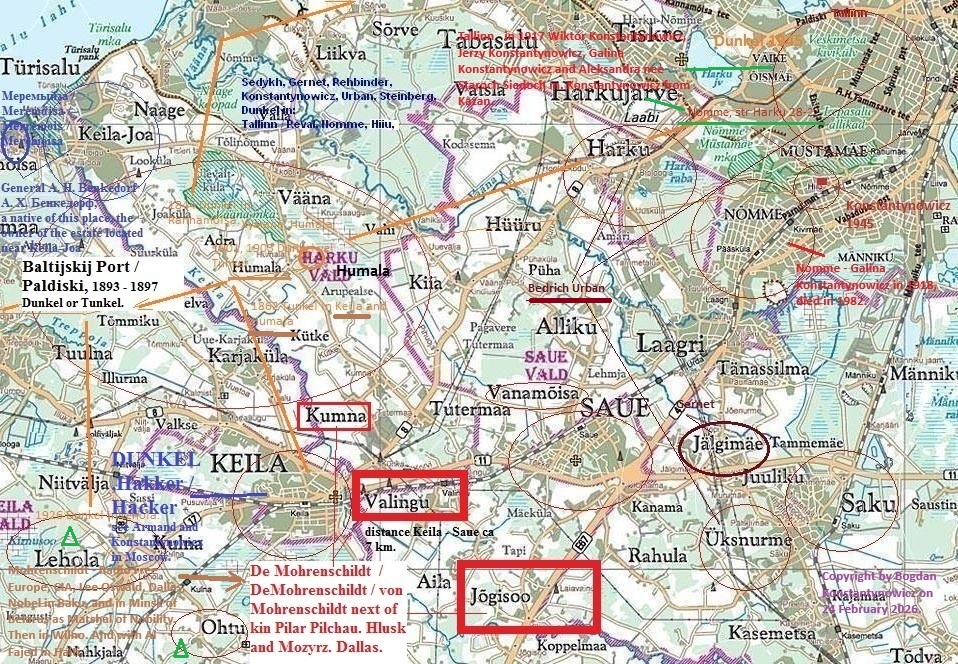
I remind you that my grandfather, Jerzy Konstantynowicz, aka Marian Stankiewicz, or Marian Konstantynowicz with the nickname Colonel Piotr Siedlecki/Colonel Stankiewicz, was born in Tallinn in 1897/1898, and he was the son of Wiktor Konstantynowicz, aka Staroch Siedoch with the nickname 'Konstantyn' b. 1874 in Kazan. Wiktor's brother, Apollon Konstantynowicz, born in Kazan in 1864, died in 1902, and had a son, Eugeniusz Konstantynowicz, aka Constantinowitz, who settled in Paris. Jerzy / Yuri Konstantynowicz and Eugene/Eugeniusz were cousins. My great-grandmother, Aleksandra Staroh-Sedoh (Starych Siedych), 1877-1948 or Staroch Siedoch/Sedykh, came from Kazan, later settled in St. Petersburg and Tallinn. Anna Armand married Apollon Konstantynowicz - the cover for Lenin and Inessa Armand's guardian - had a second husband, a Jewish revolutionary from Riga, also an acquaintance of Lenin.
The Karczewski / Watta-Karczewski moved home after 1903/1905 to MIEZONKA, and this family connected Tczew, Chelmza, Miezonka in Belarus, Zychlin, the Chocen district south to Wloclawek, Wroniawy and Pobiedziska together with the Nostitz-Jackowski family, Karwat of the Srem county, and the Kozuchowskis. Reval / Tallinn and Estonia as the center of my Konstantynowicz family's life in the 19th and 20th century. The murder of my father Edward Konstantynowicz on 02/03 November 1987 by the Lodz counter-intelligence, the son of Jerzy Konstantynowicz b. in Tallinn in 1897/1898, not in Miezonka in 1898/1900 aka Marian Stankiewicz vel Marian Konstantynowicz, the grandson of Wiktor Konstantynowicz born in Kazan in 1874, the great-grandson of Dss Maria Trubecka and General Wasyl Konstantynowicz b. ca 1834/1840 of Miezonka. Bogdan Konstantynowicz, the author and the owner of this domain in California, and his fight against the Lodz counter-intelligence in 1980s. The Karczewski / Watta-Karczewski moved home after 1903/1905 to MIEZONKA, and this family connected Tczew, Chelmza, Miezonka in Belarus, Zychlin, the Chocen district south to Wloclawek, Wroniawy and Pobiedziska together with the Nostitz-Jackowski family, Karwat of the Srem county, and the Kozuchowskis. Reval / Tallinn and Estonia as the center of my Konstantynowicz family's life in the 19th and 20th century. The murder of my father Edward Konstantynowicz on 02/03 November 1987 by the Lodz counter-intelligence, the son of Jerzy Konstantynowicz b. in Tallinn in 1897/1898, not in Miezonka in 1898/1900 aka Marian Stankiewicz vel Marian Konstantynowicz, the grandson of Wiktor Konstantynowicz born in Kazan in 1874, the great-grandson of Dss Maria Trubecka and General Wasyl Konstantynowicz b. ca 1834/1840 of Miezonka. Bogdan Konstantynowicz, the author and the owner of this domain in California, and his fight against the Lodz counter-intelligence in 1980s.
My grandfather, Jerzy Konstantynowicz (born not in 1898/1900 in Miezonka, Pogost, Warsaw; he was born in Reval / Tallinn in 1897 or on 23 April 1898; ca 1897-1906 Jerzy was living in Parnu or Tallinn; in 1907 in Mohylev by Dnieper river in east Belarus; in 1908-1912 studied in Parnu / Parnawa [Parnu Kuninga Tanava Pohikool]; in March/November 1917 in Tallinn or Nomme close to Tallinn; in November 1917 in St Petersburg), was the son of Wiktor Konstantynowicz, aka Staroch Siedoch, aka 'Konstantyn', Catholic, who lived in Viljandi in Estonia in 1920s, and in Nomme, a suburb of Tallinn. Jerzy was the NEPHEW of Apollon Konstantynowicz.
Jerzy had false certificates with date on 23 April 1898 or 23 April 1900 in Warsaw either Pogost or in Miezonka in Belarus now, the Bjalynicy (= Belynichi) region in the Mahileu (= the Mogilev province) "oblast"; the village is situated among grand forest and southwards was big marsh - Miezonka was at a territory of enormous estates the Radziwilles before A.D. 1840;
the Combat Organization of the Polish Socialist Party conducted a contraband of weapon from Russia to Austria - Hungary at the beginning of the 20th century keeping in touch with Josef Pilsudski (b. 1867) and that track led out of Petersburg among other things across Miezonka and Lodz (the Tuvim street) in the direction to Galicia; a family of ANDRZEJAK from Lodz involved in this activity occupied quarters in Miezonka (among other things) all over the first World War and thus they became technolators of aviation and the basis of the amateurish movement of aviation sports in Lodz after 1920. The Andrzejaks and Zbieranowski lived in 1917 in Moscow and escaped to Miezonka again in November 1917.
Jerzy's sister was Galina Dunkel born in 1900 in REVAL / Tallinn, Orthodox. So, since my grandfather's mother of Staroch Siedoch from Kazan was Orthodox, according to Russian law, Jerzy Konstantynowicz was born Orthodox and had to be baptized in the Orthodox church in Tallinn in 1897 or on 23 April 1898. However, Jerzy / Yuri / George's father, Wiktor Konstantynowicz, was Catholic, which made it easier for my grandfather to obtain a false birth certificate from the Berezyna parish. The Konstantynowicz family in Miezonka was Catholic: Jerzy's foster parents. My grandfather's sister, Galina Dunkel, was also Orthodox and was born in Tallinn in 1900 (with false date in 1902). My grandfather, therefore, only became Catholic in Lapy, Poland, in December 1918. And so it remained, even though he lived in Argentina, in La Plata-Berisso, among Orthodox Belarusians but also among Catholic Poles.
Irina K. in Moscow is the great-granddaughter of Staroch Siedoch family. Victor Konstantinovich born in 1874; Irina K. was looking in 2006 for Galina Konstantinovich Dunkel in Estonia. Galina Konstantinovich lived in Nomme (near Tallinn, Estonia) starting in 1918. Earlier in 1917 she was married in Tallinn.
"The names of the people in 1945 who saw to the burial were Rita Tungel (Tunkel / Dunkel) and Galina Tungel / Tunkel. ... Alexandra Nikolaevna Staroh-Sedoh, b. 1877, d. 1948, lived in Nomme, with her husband Viktor Konstantinovich, b. 1874, d. 1945"; their daughter Galina b. ca 1900/1902 or in 1900, lived in Nomme since 1918 up to 1968 at least. She was married to Dunkel. Alexandra and Viktor were buried at Hiiu-Rahu cemetery in Tallinn. Galina was married to Tungel / Dunkel. Galina Starohh-Sedohh / Galina Konstantinovich was born in 1900, in Tallinn, the Harjumaa county, Estonia. She married Balduin Heinrich Dunkel in 1917, in Tallinn. Galina d. in 1982. Balduin Heinrich Dunkel, 1890-1934, was killed in Tallinn in December 1934. Galina lived in 1918 in Nomme, had a son Georgi Dunkel b. 1918, and a daughter Tamara Tunkel b. 1925. We have younger second Galina Tunkel of Moscow, now in Hamburg, studied at the Moscow Region State University; born ca 1987 in Moscow.
So, my grandfather was born in Tallinn / Reval (Jerzy Konstantynowicz / George Konstantinovich was born in 1897 in REVAL / Tallinn or on 23 April 1898 in Reval; Jerzy was living ca 1897/1900 in Reval and then ca 1901 till 1906 in Tallinn / Reval or Parnu / Parnawa in Estonia; 1907 in Miezonka and in Mohylew by Dniestr river), and studied in Parnu in 1908-1912 (Parnu Kuninga Tanava Pohikool); and escaped from St Petersburg on 30 March 1917 - Kronstadt Stronghold [1912-1916 studied at the Naval Academy in St Petersburg, 1916-March 1917 in Kronstadt, the marine office] - to Tallinn by motorboat with Estonian man. In Tallinn, Jerzy Konstantynowicz / George or Yuri Konstantinovich was in April 1917 until June 1917.
On October 26, 2025, 2 percent of my websites, related to the Soviet aggression against Poland in 1939, were deleted. On February 16, 2026, the day after the announcement of the liquidation of Zbigniew Brzezinski's globalist doctrine, they were re-published. This was the exact anniversary, according to the pre-revolutionary Orthodox calendar, of the Bolshevik victory in St. Petersburg. By 2:00 a.m. on October 26, 1917 / November 8, 1917, the Winter Palace had been taken over by Bolshevik troops, and members of the Provisional Government had been arrested. This is the same hand as shoot in my bus on 11 November 2019 at North Rd, 12.03pm, with a woman of 'Dabrowa' district in Lodz = Elizabeth 28 [and 'Giorgi' Tarashvil. b. ca 1994/1998, the son of Shalva Tarashvil., b. in 1960s, long semitic head after his mother, 175 cm, at Elizabeth 2], and a boy, b. ca 1990 from Serbia, Roma origins. At the same time, October 26th is the anniversary of when I caught three people, spies around me: Zbi. Natkanski of Honoratow, Ewa Chudzik married Ku., I. G. married Ko., and then my father, Edward Konstantynowicz, was murdered in the night of 2/3 November. This was 1987, and that began my investigation-how, who, and why my family was murdered on the Konstantynowicz side. On this anniversary, October 26, 2025, my US-based domain was hacked.
The Russians have built a wonderful network of deep political intelligence and placed it in the US at the beginning of the 20th century
- they have grabbed the head of the northern hemisphere aft. 1963. With Marshal Konstanty Rokossowski and General Wojciech Jaruzelski. They lived together with Gniewosz, Higersberger, Szaniawski, Kobylanski, Rakowiecki and Krzysztofowicz, Lasocki of Krzynowloga Mala and Popiel.
The Hutten-Czapski of Bukowiec in the Swiecie county and in Kojdanow and close to Swiedziebnia.
Dzialynski and Oskierka in the Pleszew county and Miezonka in the Berezyna parish.
On the Miezonka river was a mill owned by the Szostak family from the 60's of the nineteenth century. The Miezonka aristocratic locality partly abolished after 1937, and finally after the Second World War in 1944 - before eighties of the twentieth century. Only the Miezonka village area remaining south of the nobility houses, which were plowed. In 2012, there were remnants of the Catholic cemetery - photos on my domain 'konstantynowicz.info'.
The cemetery has a long history. The origins of the first half of the nineteenth century, when it was leased by the Czapski noble family from the Radziwill family. After 1842 the property was in the Konstantynowicz hands. Since the sixties of the 19th century settled here Szostak and other Catholic gentry. They were also the Zbieranowskis who received a land from the Radziwill family for their service to this aristocratic family. We had affinities with the Radziwills.
After 1937 the Bolsheviks killed the Poles suspected of collaborating with the Polish military intelligence.
After 1944 the Soviets demolished all the houses of the nobility, but some fundamentals remained visible in the photographs. Land was plowed, planted with grass and turned into pasture land and a hill align up even, on which were the first noble houses in 1850, belonging to the Konstantynowiczs.
The chapel was destroyed, but the remaining stones. From the small Catholic cemetery in the area of the former noble Miezonka locality, remained only some graves, among others the Witkowskis. Currently, the south-east of the cemetery is a Belarusian village Miezonka where ca 2000 older people known on Polish Catholic nobility of the noble Miezonka village. The fate and history of my Konstantynowicz and Kiedrzynski families were connected by the Aksak-Ilinski-Lasek/Laski line and by the Illuminati secret underground from Miezonka, Backow, Puckow, Luboszany in the Berezyna parish, Romanow in the Zytomierz county, Leszno village close to Bogate and to Krasne, by Janczewo in the Wizna parish, in St Petersburg and Moscow, and with Kamyk close to Czestochowa. At the beginning we look on my father's line came from Minsk-Baguta/Babianowszczyzna close to Smilowicze-Miezonka/Miazonka close to Berezyna-Mscislau-Tallin/Nomme/Viljandi and from Kazan-Ukraine branch of Staroch Siedoch-Ryabchinsky. We have Olga Vasilievna Ivanova (nee Ryabchinskaya) b. ca 1845. Olga Vasilyevna Ryabchinskaya, the wife (1st) of Nikolai Alexandrovich Ivanov (but the 2nd to Staroch-Siedoch), a mechanical engineer in the Baltic Fleet.
The same person Olga Ryabchinskaya (b. ca 1845) married (2nd) Staroch Siedoch / Sedykh of Kazan (her daughter b. 1877 nee Staroch Siedoch, moved home to Estonia, married Wiktor Konstantynowicz b. 1874 in Kazan, who moved home to Viljandi). The surname Staroch-Siedoch = Sedih, Sedykh, Sedoh, Siedoch, Siedoh of the Tatarstan, and in Kazan.
Above person, Olga, is linked to Fyodor Dmitrievich Izylmetyev b. 1832, the head of the Naval Academy in St. Petersburg.
As a young boy, my great-grandfather, Viktor Konstantynowicz, was a sailor (and his son Jerzy Konstantynowicz was young sailor in Parnu, Tallinn, St Petersburg and Kronstadt). Wiktor Konstantynowicz served on a yacht 'Tamara' and learned the maritime craft from Sandro, who was born in Tbilisi, the Romanow family. The Armand-Konstantynowicz branch in Moscow was intermarried to Saparow-Japaridze-Oldenburg line. Japaridze came from Racha in Georgia. Oldenburg intermarried Romanow empire family. Viktor Konstantinovich later settled in St. Petersburg (1912-1917) and, around 1896, Wiktor Konstantynowicz married a girl from the Staroch Siedoch family, who lived in Kazan, where Viktor's father, General Wasyl Konstantynowicz (Wasyl married Dss Maria Trubecka born in Cracow), also lived. My father Edward Konstantynowicz had a model of this yacht as a very important souvenir. It was made of yellow amber. Marian, or Jerzy Konstantynowicz, my grandfather, used this yacht's picture to sign letters from his internment in Palanga, Lithuania, in 1939/1940. This yacht is the 'Tamara', owned by Alexander Mikhailovich (Sandro) Romanow.
Alexander Mikhailovich (Sandro), b. 01 April 1866 in Tbilisi died 1933, Nice, France. Sandro's famously traveled to the East and INDIA with his brother, Sergei Mikhailovich, on the 'Tamara'. Sandro was a brother-in-law to Tsar Nicholas II (having married Nicholas's sister, Grand Duchess Xenia Alexandrovna, in 1894). Sandro's yacht was called 'Tamara' and he sailed it to the Far East with his brother Sergei meeting up with the Tsesarevich Nicholas in Colombo, Sri Lanka, in February 1891. His command of the 'Tamara' was a practical training ground and a stage for diplomacy. In Colombo, Azbelev, the director of a maritime company trading tea between Japan and Ceylon, owned a trading post. This Abelev had a brother who was the executive director of the 'Duflon and Konstantinovich' company in St. Petersburg-Zaporozhye-Moscow. "23,000 Miles on the Yacht Tamara. The Voyage of Grand Dukes Alexander and Sergei Mikhailovich in 1890-1891" wrote by Gustav Radde is a two-volume travelogue, of the journey, aboard the private yacht 'Tamara'.
Sandro was the Chief of the Commercial navigation and ports (1902-1905), during the First World war was in charge of the aviation in the army: paid much attention to the development of aviation industry in Russia, on his initiative, established flight schools, began preparing the first national flight training and 1914 appointed head of the organization of aviation business in the armies. Mason, and called himself Philalethes. Receiving education at home in Georgia, often went for long voyages: in 1886 - 1889 made a voyage round the world on the corvette 'Rynda' (in 1890 Sandro known brothers: Wiktor Konstantynowicz and Apollon Konstantynowicz - with Breguet in 1890 and Duflon in 1892) and in 1890 - 1891, at his own yacht 'Tamara' Sandro traveled to India, described in his journals. In 1892 he commanded the destroyer 'Revel', in 1895, was a senior officer of a battleship and in 1899, on the battleship 'Admiral Apraksin', then transferred to the Black Sea Fleet, where he commanded the battleship 'Rostislav'.
My grandfather Jerzy / Marian Konstantynowicz studied in Parnu before Great War, then served in Kronstadt. Parnu / Parnawa was under the Pilar-Pilchaus influence. The Duflon and Konstantynowicz Company re-searched radio-telegraph military topics.
The Russians have built a wonderful network of deep political intelligence and placed it in the US at the beginning of the 20th century